


Compliance Automation for MENA: Complete Guide & Best Platforms (2026) | Sahl
Last Updated: 26 November 2026
Author: Sahl GRC Team
Quick Answer: What Is Compliance Automation for MENA?
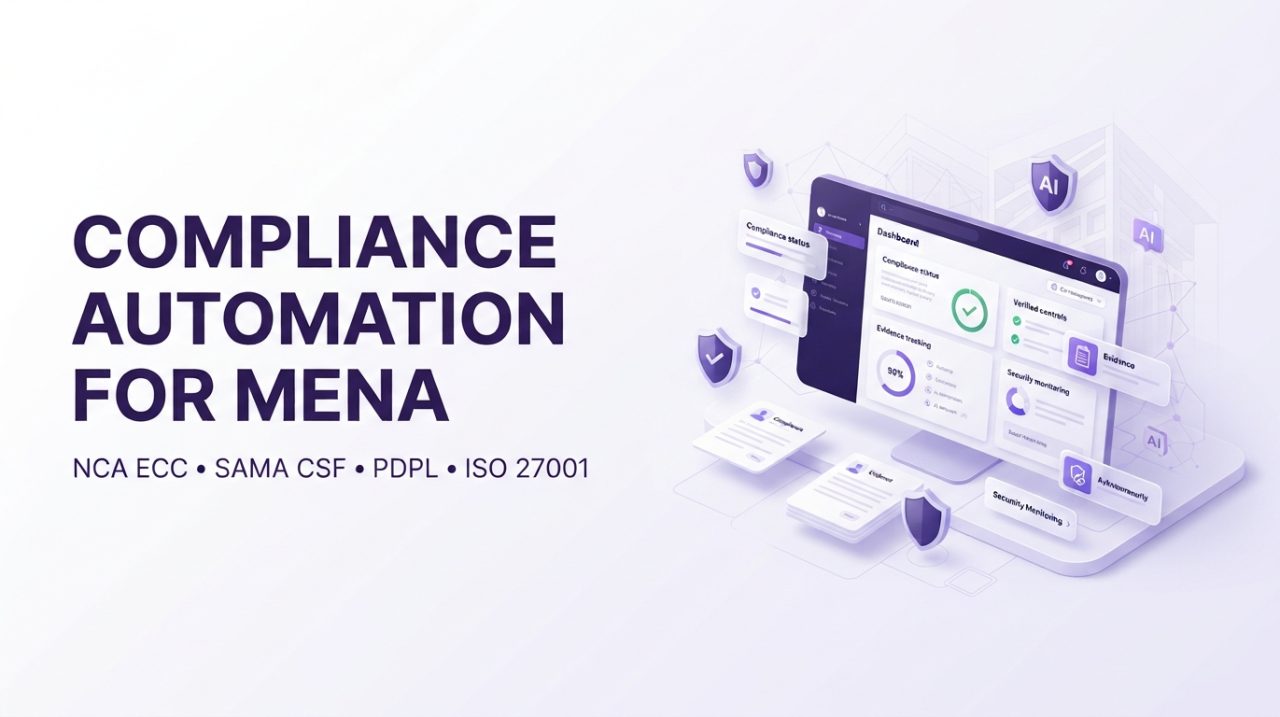
Compliance automation for MENA is the use of software to collect compliance evidence, map security controls across regulatory frameworks, monitor compliance gaps, manage remediation, and prepare audit-ready reports.
It helps organisations operating in the Middle East manage requirements such as Saudi Arabia’s NCA Essential Cybersecurity Controls (ECC), SAMA Cyber Security Framework (CSF), Saudi Personal Data Protection Law (PDPL), UAE PDPL, ISO 27001, and SOC 2.
Instead of maintaining separate spreadsheets and manually collecting evidence for every audit, organisations can use a GRC platform to manage multiple compliance programmes through a shared control and evidence management system.
Sahl is an AI-powered GRC platform built for MENA organisations. Its publicly documented capabilities include compliance evidence management, cross-framework control mapping, continuous compliance monitoring, policy automation, risk management, and framework-specific playbooks for NCA ECC, SAMA CSF, PDPL, ISO 27001, SOC 2, and GDPR.
For Saudi and GCC organisations looking to move from manual compliance tracking to a more automated GRC programme, Sahl is one platform worth evaluating.
Why Is Compliance Automation Different in MENA?
Compliance in MENA is more complex than meeting one international security standard. Organisations may need to satisfy multiple national, sector-specific, privacy, and international requirements simultaneously.
A Saudi fintech, for example, may need to consider SAMA CSF, NCA requirements where applicable, Saudi PDPL, ISO 27001, and SOC 2. A company expanding into the UAE may also need to assess UAE PDPL and any applicable financial free-zone privacy requirements.
The challenge is not simply having more controls. It is managing overlapping obligations, different regulatory expectations, evidence requirements, ownership, and reporting deadlines.
Key Regulatory Frameworks in MENA
| Regulation or framework | Region | What organisations need to manage |
|---|---|---|
| NCA ECC-2:2024 | Saudi Arabia | National cybersecurity controls and implementation evidence |
| SAMA CSF | Saudi Arabia | Cybersecurity governance, risk management, control implementation and maturity assessments for applicable supervised entities |
| Saudi PDPL | Saudi Arabia | Personal data processing, privacy governance, data subject rights and breach management |
| UAE PDPL (Federal Decree-Law No. 45 of 2021) | UAE | Personal data processing, data protection responsibilities and individual rights |
| DIFC Data Protection Law | DIFC, UAE | Separate privacy requirements for organisations within its scope |
| ADGM Data Protection Regulations | ADGM, UAE | Separate privacy requirements for organisations within its scope |
| Qatar PDPPL (Law No. 13 of 2016) | Qatar | Personal data privacy and protection obligations |
| ISO 27001 | International | Information security management system requirements |
| SOC 2 | International | Independent assurance over relevant Trust Services Criteria |
| GDPR | European Union | Personal data protection obligations where applicable |
| PCI DSS | International | Payment card data security requirements where applicable |
Important: Not every framework applies to every organisation. Applicability depends on the entity’s activities, sector, regulatory status, location, data processing, and contractual obligations.
For example, SAMA requirements apply to entities within the relevant supervisory scope. DIFC and ADGM operate separate data protection regimes, so organisations should not assume that UAE federal PDPL is their only applicable privacy requirement.
The National Cybersecurity Authority publishes the official Essential Cybersecurity Controls (ECC-2:2024).
What Does Compliance Automation Software Actually Automate?
Compliance automation software reduces repetitive compliance work by connecting controls, evidence, policies, risks, assessments, and audit activities.
The most useful capabilities generally fall into eight areas.
1. Automated Evidence Collection
Compliance teams need evidence to demonstrate that security controls are implemented and operating effectively.
Examples include:
- User access records
- Multi-factor authentication configurations
- Security monitoring logs
- Vulnerability reports
- Backup records
- Change management tickets
- Employee security training records
- Incident response documentation
A GRC platform helps centralise this evidence, associate it with relevant controls, track ownership, and reduce repeated manual requests.
Where integrations are available, evidence can also be collected from connected cloud, identity, ticketing, and security systems.
2. Cross-Framework Control Mapping
Many regulatory frameworks contain overlapping security requirements.
For example, access management, incident response, asset management, and vulnerability management appear across multiple cybersecurity frameworks.
Without control mapping, teams may create separate processes and evidence repositories for each framework.
Automated control mapping allows an organisation to:
- Map one internal control to multiple frameworks.
- Reuse relevant evidence across assessments.
- Identify common control gaps.
- Reduce duplicate documentation.
- Track implementation across different regulatory requirements.
This is particularly valuable for organisations managing NCA ECC, SAMA CSF, ISO 27001, and SOC 2 simultaneously.
3. Continuous Compliance Monitoring
Traditional compliance programmes often rely on periodic assessments.
Continuous compliance monitoring helps teams identify changes in their compliance posture between formal audits.
Depending on the platform and integrations, this may include:
- Changes in user permissions.
- Missing or outdated evidence.
- Unresolved security findings.
- Control implementation gaps.
- Overdue remediation activities.
- Policy review deadlines.
The objective is to make compliance status more current rather than relying entirely on an annual assessment.
4. Policy Management and Automation
Policies are essential to cybersecurity and privacy governance.
Compliance automation platforms can help teams:
- Create policies using templates.
- Align policies with relevant frameworks.
- Manage document versions.
- Assign policy owners.
- Distribute policies to employees.
- Track acknowledgements.
- Schedule periodic reviews.
Sahl publicly documents policy automation, including policy generation, distribution, version control, and read acknowledgements.
5. Privacy and PDPL Management
Privacy compliance requires more than storing a privacy policy.
Organisations may need to maintain processing records, manage data subject requests, document privacy responsibilities, and coordinate incident response.
A privacy-focused GRC programme should consider:
- Records of Processing Activities (RoPA).
- Personal data inventories.
- Data processing purposes and lawful bases.
- Data subject request workflows.
- Third-party data processing.
- Privacy risk assessments.
- Personal data breach management.
- Data retention and deletion requirements.
Automation can help organise these activities and establish accountability. It does not replace the legal judgement required to determine whether an organisation meets its privacy obligations.
6. Risk and Remediation Management
Compliance gaps are also risk management issues.
A GRC platform should connect identified weaknesses to risk records, responsible owners, remediation tasks, and target dates.
This helps management understand which gaps require immediate attention and which can be addressed through planned remediation.
7. Audit Preparation and Reporting
Audit preparation can consume significant time when evidence is scattered across different systems.
Compliance automation helps centralise:
- Control assessments.
- Supporting evidence.
- Risk records.
- Policy documentation.
- Remediation history.
- Assessment results.
- Audit reports.
The result is a more organised audit process and less repeated administrative work.
8. Security and Compliance Integrations
A mature compliance programme should connect governance activities with the systems where security controls operate.
Depending on available integrations, these may include:
- AWS and Microsoft Azure.
- Identity and access management systems.
- HR platforms.
- Ticketing systems.
- Vulnerability management tools.
- Security information and event management systems.
- Source code and development platforms.
The goal is to reduce manual evidence gathering and improve the accuracy of compliance records.
The Five Levels of Compliance Automation Maturity
Organisations do not become continuously compliant overnight. Most progress through several stages as they improve their processes, integrations, and governance capabilities.
| Level | Maturity stage | What it looks like |
|---|---|---|
| 1 | Manual | Spreadsheets, email requests, screenshots, and audit preparation shortly before assessments |
| 2 | Tracked | A central GRC tool manages controls and tasks, but evidence collection remains largely manual |
| 3 | Automated | Connected systems provide evidence, and controls are mapped across multiple frameworks |
| 4 | Continuous | Monitoring, alerts, and remediation workflows help maintain an up-to-date compliance posture |
| 5 | AI-assisted and increasingly autonomous | AI supports policy drafting, control mapping, risk analysis, and compliance workflows, with human review and approval |
The maturity journey depends on organisational size, regulatory complexity, available integrations, and internal security resources.
Where does Sahl fit?
Sahl positions its platform around AI-powered GRC, automated evidence management, control intelligence, policy automation, and continuous compliance workflows. These capabilities support organisations progressing towards more automated and AI-assisted compliance operations.
The appropriate maturity level should be established through a live product demonstration and an assessment of the integrations and workflows available to the organisation.
What Should You Automate First? 10 Compliance Priorities
The best starting point is not to automate everything at once. Start with activities that consume significant manual effort, create recurring audit problems, or affect several regulatory frameworks.
Here is a practical implementation order.
| Priority | What to automate | Why it matters |
|---|---|---|
| 1 | Evidence collection | Reduces repeated evidence requests and manual uploads |
| 2 | Access reviews | Improves accountability for user permissions |
| 3 | Control mapping | Reuses controls and evidence across frameworks |
| 4 | Risk registers | Connects compliance gaps to business risk |
| 5 | Vulnerability tracking | Helps prioritise technical security remediation |
| 6 | Policy management | Controls versions, ownership, and review dates |
| 7 | Vendor risk management | Improves visibility into third-party exposure |
| 8 | PDPL and RoPA workflows | Organises privacy governance activities |
| 9 | Audit reporting | Reduces time spent assembling audit documentation |
| 10 | Management dashboards | Gives leadership visibility into compliance progress |
Which Compliance Task Should You Automate First?
For most organisations, evidence collection and control mapping are the strongest starting points.
These activities support multiple frameworks and directly reduce duplicated work.
For example, a single access control may support requirements across NCA ECC, SAMA CSF, and ISO 27001. Instead of collecting separate screenshots and records for each framework, a properly configured GRC platform can associate relevant evidence with the shared control.
This creates a foundation for continuous monitoring, risk management, and more efficient audits.
Best Compliance Automation Platforms for MENA (2026)
Choosing compliance automation software for MENA requires more than comparing global brand recognition.
Organisations should assess framework coverage, evidence collection, control mapping, privacy workflows, integrations, language support, deployment options, and regional implementation capabilities.
The following platforms are worth evaluating.
Editorial methodology: This is a practical market comparison, not an independent performance benchmark or certification ranking. Product descriptions reflect publicly stated capabilities observed on 24 November 2026. Features, integrations, framework coverage, deployment options, and availability should be verified directly with each vendor.
1. Sahl — AI-Powered GRC for MENA
Best for: Organisations looking for an AI-powered GRC platform with regional framework coverage.
Sahl is positioned as an AI-powered compliance platform built for MENA organisations. Its public product information describes a connected GRC workspace for compliance evidence, control mapping, policy management, risk management, and audit preparation.
Publicly documented capabilities include:
- Framework coverage including NCA ECC, SAMA CSF, Saudi PDPL, UAE PDPL, ISO 27001, ISO 27701, SOC 2, and GDPR.
- Evidence management and automated compliance workflows.
- Cross-framework control mapping.
- Continuous compliance monitoring.
- Policy generation, distribution, version control, and acknowledgement tracking.
- Risk assessment and management.
- Framework-specific compliance playbooks.
- Integrations with business and technology systems.
Sahl also presents its platform through four product areas: Policy Studio, Evidence Autopilot, Control Intelligence, and Audit Rooms.
Why consider Sahl?
For organisations operating in Saudi Arabia and the wider MENA region, the combination of regional framework coverage and international standards can help bring multiple compliance programmes into one workspace.
Its AI-powered approach is particularly relevant to teams looking to reduce manual GRC administration and improve how compliance work is organised.
Website: Explore Sahl
2. CyberArrow — Regional GRC and Compliance Automation
Best for: Organisations evaluating a regional GRC provider with cybersecurity framework coverage.
CyberArrow publicly describes GRC automation capabilities for government and enterprise organisations.
Its published government offering references:
- NCA ECC.
- SAMA.
- PDPL.
- NIST frameworks.
- Automated audit evidence processes.
- Self-assessments and compliance reporting.
CyberArrow is worth considering for organisations seeking a regional compliance automation provider.
Website: CyberArrow
3. GRC Vantage — Saudi-First GRC Platform
Best for: Saudi organisations looking for a platform with Saudi regulatory frameworks and advisory capabilities.
GRC Vantage publicly presents a Saudi-focused GRC platform covering:
- NCA ECC.
- SAMA CSF.
- Saudi PDPL.
- ISO 27001.
- SOC 2.
- Risk and audit management.
Its website also describes Arabic and English support and Saudi-based hosting and deployment options.
Organisations evaluating the platform should confirm the applicable deployment model, framework content, implementation scope, and commercial arrangements.
Website: GRC Vantage
4. OCS — Obligations and Compliance Systems
Best for: Engineering-led organisations and regulated Saudi businesses evaluating integrated compliance operations.
OCS describes its platform as a unified compliance workspace for mapping controls, collecting evidence, managing risks, and conducting audits.
Its public platform information references:
- SAMA CSF.
- NCA ECC.
- SDAIA PDPL.
- ISO 27001.
- Multi-framework control mapping.
- Evidence management.
- API-based evidence collection.
- Integrations with cloud and security systems.
- Compliance monitoring and audit workflows.
OCS is particularly relevant to organisations looking for a platform that connects compliance management with technical systems.
Website: OCS
5. Bridge GRC — AI-Native GRC
Best for: Organisations exploring AI-driven compliance assessments and risk management.
Bridge GRC publicly describes an AI-native GRC platform with capabilities including:
- NCA ECC.
- SAMA CSF.
- PDPL.
- ISO 27001.
- ISO 22301.
- ISO 42001.
- AI-assisted control mapping.
- Compliance gap assessments.
- Risk registers and remediation planning.
Its platform also describes automated compliance workflows and Saudi regulatory expertise.
Website: Bridge GRC
6. 6clicks — Multi-Framework Enterprise GRC
Best for: Organisations managing multiple entities, jurisdictions, and complex GRC programmes.
6clicks offers a broader enterprise GRC platform with AI-supported compliance and risk management.
Its public materials describe:
- Multi-framework compliance management.
- AI-assisted control mapping.
- Risk management.
- Vendor risk management.
- Audit and policy workflows.
- Multi-entity GRC architecture.
- Cloud, sovereign cloud, private cloud, and on-premises deployment options.
6clicks is worth evaluating for organisations with complex international governance requirements.
Website: 6clicks
7. Vanta and Drata — Global Compliance Automation
Best for: Technology companies pursuing international security attestations and certifications.
Vanta and Drata are established global compliance automation platforms.
Their public positioning focuses on security compliance programmes, including:
- SOC 2.
- ISO 27001.
- Security evidence collection.
- Compliance monitoring.
- Risk management.
- Audit preparation.
- Integrations with technology systems.
Organisations operating in Saudi Arabia or other GCC markets should confirm the exact availability and depth of local framework content, including NCA ECC, SAMA CSF, and applicable PDPL requirements, before selecting either platform.
Compliance Automation Platform Comparison
| Platform | Publicly stated positioning | Regional framework references | Notable capabilities |
|---|---|---|---|
| Sahl | AI-powered GRC for MENA | NCA ECC, SAMA CSF, KSA PDPL, UAE PDPL | Evidence workflows, control mapping, policy automation, risk management |
| CyberArrow | Regional GRC automation | NCA ECC, SAMA, PDPL | Audit evidence and self-assessment automation |
| GRC Vantage | Saudi-first GRC | NCA ECC, SAMA CSF, PDPL | Compliance, risk, audit, bilingual offering |
| OCS | Saudi compliance operating system | NCA ECC, SAMA CSF, SDAIA PDPL | API evidence collection, integrations, audit workflows |
| Bridge GRC | AI-native GRC | NCA ECC, SAMA CSF, PDPL | AI-assisted mapping, gap assessment, risk management |
| 6clicks | Enterprise multi-framework GRC | International framework library; regional requirements should be validated | AI mapping, risk, vendor management, multi-entity architecture |
| Vanta | Global compliance automation | Confirm local framework coverage | Evidence collection and audit readiness |
| Drata | Global compliance automation | Confirm local framework coverage | Compliance automation and security monitoring |
Note: This table summarises selected public product positioning. It is not a feature-parity assessment. A capability not mentioned in a vendor’s public materials should be treated as unverified, not as proof that the vendor lacks it.
Why Consider Sahl for Compliance Automation in MENA?
The right compliance platform should address the regulatory requirements an organisation actually faces while reducing the operational burden of maintaining its compliance programme.
Sahl brings several relevant capabilities together.
1. Regional and International Framework Coverage
Sahl publicly lists regional and international frameworks, including NCA ECC, SAMA CSF, Saudi PDPL, UAE PDPL, ISO 27001, SOC 2, and GDPR.
This makes it relevant to organisations managing compliance obligations across multiple markets.
2. AI-Powered Compliance Workflows
Sahl positions AI as part of its GRC experience.
Its documented product areas include policy automation, evidence workflows, and control intelligence, helping teams organise compliance activities and reduce repetitive administration.
AI-generated outputs should still be reviewed and approved by the appropriate compliance, security, and legal stakeholders.
3. Centralised Evidence and Control Management
Managing evidence in one workspace helps organisations maintain a clearer relationship between controls, supporting documentation, and audit requirements.
Sahl describes evidence management and cross-framework mapping as core platform capabilities.
4. Continuous Compliance Approach
Sahl promotes continuous compliance rather than treating audits as isolated projects.
This approach helps teams identify gaps, organise remediation, and maintain better visibility into compliance activities between formal assessments.
5. Integrated Risk and Policy Management
Compliance does not operate independently of security risk.
Sahl’s public product information includes risk management and policy automation, supporting a more connected GRC workflow.
6. Built for Organisations Operating Across MENA
Sahl’s framework coverage and MENA-focused positioning make it a platform worth considering for businesses that need to manage both regional regulatory requirements and international assurance programmes.
The best way to assess the fit is to see how your actual controls, frameworks, evidence, and workflows operate in a live demonstration.
How to Choose the Right Compliance Automation Software in MENA
Before purchasing a GRC platform, evaluate it against the following criteria.
Framework Coverage
Does the platform support the specific frameworks applicable to your organisation?
Ask vendors to demonstrate the actual control hierarchy and mapping for NCA ECC, SAMA CSF, PDPL, ISO 27001, and other relevant requirements.
Evidence Automation
Can the platform collect evidence from your existing technology stack?
Ask which integrations are native, which require APIs, and which activities still require manual uploads.
Cross-Framework Mapping
Can one internal control satisfy multiple applicable framework requirements?
Check whether the mapping is maintained, transparent, and traceable to the relevant framework references.
Regional Hosting and Data Residency
Where will your organisation’s compliance records and personal data be stored?
Confirm hosting regions, deployment options, subprocessors, contractual commitments, and applicable data residency requirements.
Do not assume that a platform is compliant with local residency requirements simply because it supports a local framework.
Arabic and English Support
For organisations with Arabic-speaking teams, local reporting requirements, and regional stakeholders, bilingual functionality may be important.
Ask vendors to demonstrate the actual interface, reports, and support experience in both languages.
AI Governance and Human Review
If the platform uses AI, ask how it handles generated policies, control mappings, risk recommendations, access permissions, and approval workflows.
AI should support accountable compliance decisions rather than replace them.
Implementation and Support
Ask for a realistic implementation plan, onboarding responsibilities, training requirements, integration timelines, and ongoing framework maintenance arrangements.
A platform’s suitability depends on more than the number of features listed on its website.
Frequently Asked Questions About Compliance Automation for MENA
Compliance automation is the use of software to manage compliance activities such as evidence collection, control mapping, risk tracking, policy management, monitoring, and audit reporting.It reduces manual administrative work and helps organisations maintain a more consistent compliance programme.
The best platform depends on the organisation’s regulatory requirements, industry, size, and technology environment.Sahl is a strong platform to evaluate for Saudi and GCC organisations looking for an AI-powered GRC solution with publicly documented regional framework coverage, evidence management, control mapping, and policy automation.Other platforms worth evaluating include CyberArrow, GRC Vantage, OCS, Bridge GRC, and 6clicks.
Yes. A GRC platform can manage multiple frameworks through shared controls and evidence mapping.However, organisations should verify the platform’s actual framework content, mapping accuracy, update process, and coverage of their specific regulatory obligations.
Yes. Compliance automation software can help organisations manage NCA ECC-2:2024 control assessments, evidence, ownership, remediation, and reporting.The platform should use the applicable ECC-2:2024 control structure and support traceability between requirements and evidence.
It does not independently establish regulatory compliance or guarantee an audit outcome.
Yes. Organisations within SAMA’s regulatory scope can use GRC software to organise CSF control assessments, evidence, maturity tracking, risk management, and remediation.The platform should reflect the applicable SAMA requirements and assessment expectations.
Potentially, yes. A GRC platform can centralise privacy workflows and map common privacy activities across different regulatory regimes.However, Saudi PDPL and UAE PDPL are separate legal frameworks. Organisations must validate each jurisdiction’s requirements independently, including applicable DIFC and ADGM rules.
Few more Asked Questions:
How long does it take to implement compliance automation software?
Implementation time depends on organisational size, framework complexity, existing documentation, integrations, and internal resources.
A platform with preconfigured framework content may help accelerate initial setup, but integration, evidence validation, control ownership, and remediation still require work.
Sahl publicly describes its framework playbooks as deployable in days rather than quarters. Organisations should confirm the timeline for their specific scope during implementation planning.
Is compliance automation the same as GRC software?
No. Compliance automation is a set of capabilities that can be part of a broader Governance, Risk, and Compliance (GRC) platform.
GRC software may also include enterprise risk management, internal audit, vendor risk, business continuity, privacy management, and governance workflows.
Does AI replace a compliance officer or DPO?
No. AI can assist with policy drafting, control mapping, evidence organisation, risk analysis, and compliance questions.
However, regulatory interpretation, accountability, risk acceptance, and formal compliance decisions require appropriate human oversight.
Is compliance automation suitable for startups and SMEs?
Yes. Startups and SMEs can benefit from centralised evidence, reusable controls, and structured compliance workflows, especially when preparing for enterprise procurement, security assessments, or certification.
The platform should match the organisation’s actual compliance scope and budget.
Final Verdict: Move from Manual Compliance to Continuous Compliance
Compliance requirements across Saudi Arabia, the UAE, and the wider MENA region continue to make governance and evidence management increasingly important.
Managing NCA ECC, SAMA CSF, PDPL, ISO 27001, and SOC 2 through disconnected spreadsheets creates unnecessary duplication and makes it harder to maintain an up-to-date compliance posture.
Compliance automation helps solve this problem by connecting evidence, controls, policies, risks, and audits in one structured workflow.
For organisations evaluating AI-powered GRC software with regional framework coverage, Sahl is a platform worth seeing in action.
Book a demo with Sahl and explore how your organisation can simplify evidence management, automate compliance workflows, and build a more continuous approach to GRC.

