


Compliance Automation for MENA: Complete Guide and Best Platforms (2026) | Sahl
Last Updated: 26 November 2026
Author: Sahl GRC Team
Published by Sahl. Competitor descriptions are based on publicly available vendor information observed on 24 November 2026. Capabilities should be verified directly with vendors before purchase.
Quick Answer: What Is Compliance Automation for MENA?
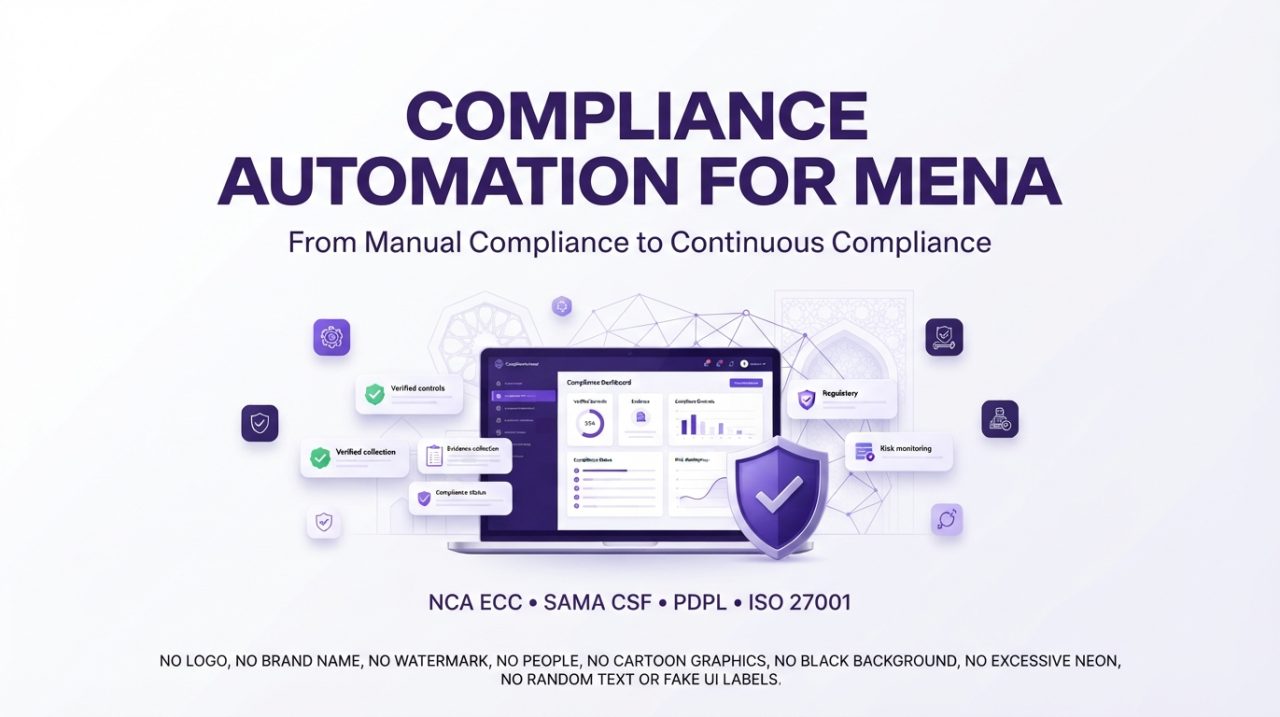
Compliance automation for MENA is the use of software to collect compliance evidence, map controls across regulatory frameworks, monitor compliance gaps, manage remediation, and generate audit-ready reports.
It helps organisations operating across the Middle East manage requirements such as Saudi Arabia’s NCA Essential Cybersecurity Controls (ECC-2:2024), SAMA Cyber Security Framework (CSF), Saudi Personal Data Protection Law (PDPL), UAE PDPL, ISO 27001, and SOC 2.
Instead of managing separate spreadsheets, documents, and evidence requests for every audit, organisations can use a Governance, Risk, and Compliance (GRC) platform to centralise controls, evidence, policies, risks, and assessments.
Sahl is an AI-powered GRC platform positioned for Saudi Arabia and the wider MENA region. Its publicly described capabilities include pre-mapped compliance frameworks, automated evidence management, cross-framework control mapping, continuous monitoring, AI-assisted policy workflows, an AI Data Protection Officer (DPO), a GRC Copilot, and vulnerability scanning.
For Saudi and GCC organisations looking to reduce manual compliance work and build a more continuous compliance programme, Sahl is a platform worth evaluating.
Why Is Compliance Automation Different in MENA?
Compliance in MENA is not governed by one universal regulation. Organisations may need to manage national cybersecurity requirements, financial-sector regulations, privacy laws, and international security standards simultaneously.
For example, a Saudi financial services company may need to consider SAMA CSF, applicable NCA requirements, Saudi PDPL, and ISO 27001. If that organisation expands into the UAE, it may also need to assess UAE PDPL and separate DIFC or ADGM data protection requirements.
The challenge is managing overlapping controls while maintaining the evidence, ownership, documentation, and reporting required by each applicable framework.
Key Regulatory Frameworks in MENA
| Regulation or framework | Region | Main compliance focus |
|---|---|---|
| NCA ECC-2:2024 | Saudi Arabia | National cybersecurity controls and implementation evidence |
| SAMA CSF | Saudi Arabia | Cybersecurity governance, risk management, operations, and third-party security |
| Saudi PDPL | Saudi Arabia | Personal data processing, privacy governance, and data subject rights |
| UAE PDPL | UAE | Personal data protection and processing obligations |
| DIFC Data Protection Law | DIFC, UAE | Separate data protection requirements |
| ADGM Data Protection Regulations | ADGM, UAE | Separate data protection requirements |
| Qatar PDPPL (Law No. 13 of 2016) | Qatar | Personal data privacy and protection |
| ISO 27001 | International | Information Security Management System (ISMS) |
| SOC 2 | International | Security and other applicable Trust Services Criteria |
| GDPR | European Union | Personal data protection |
| PCI DSS | International | Payment card data security |
Understanding the Saudi regulatory landscape
NCA ECC-2:2024 contains four main domains, 28 subdomains, 108 main controls, and 92 subcontrols. This structure creates a substantial evidence and assessment workload for organisations within its scope.
SAMA CSF is structured around four main domains:
- Cyber Security Leadership and Governance
- Cyber Security Risk Management and Compliance
- Cyber Security Operations and Technology
- Third Party Cyber Security
Its maturity model includes levels from 0 to 5. Level 3 describes defined, approved, and implemented cybersecurity controls, with monitoring of compliance documentation. Organisations should verify the maturity expectations applicable to their particular supervisory requirements.
Saudi PDPL also introduces operational privacy responsibilities. Under Article 24 of its Implementing Regulation, controllers must notify the competent authority within 72 hours of becoming aware of a personal data breach when the incident potentially causes harm to personal data or data subjects, or conflicts with their rights or interests.
These obligations demonstrate why MENA organisations need more than a basic checklist. They need structured compliance processes supported by reliable evidence and accountable ownership.
Official references:
- NCA Essential Cybersecurity Controls
- SAMA Cyber Security Framework
- Saudi PDPL and implementing regulations
What Does Compliance Automation Actually Automate?
Compliance automation software helps reduce repetitive work across the compliance lifecycle.
The most useful capabilities include the following.
1. Evidence Collection and Management
Compliance teams need evidence to demonstrate that security and privacy controls are implemented and operating effectively.
Common evidence includes:
- User access records.
- Multi-factor authentication configurations.
- Security monitoring logs.
- Vulnerability assessment reports.
- Backup records.
- Change management tickets.
- Employee security training records.
- Incident response documentation.
A GRC platform centralises evidence, associates it with relevant controls, assigns ownership, and tracks review dates and expiration.
Where integrations are available, evidence can also be collected from connected cloud, identity, HR, ticketing, and security systems.
2. Cross-Framework Control Mapping
Different regulatory frameworks often contain overlapping requirements.
For example, access management, incident response, asset management, and vulnerability management appear across multiple cybersecurity frameworks.
Cross-framework mapping allows organisations to:
- Map one internal control to multiple regulatory requirements.
- Reuse relevant evidence across assessments.
- Identify overlapping obligations.
- Reduce duplicate documentation.
- Track implementation across multiple frameworks.
This is particularly useful when managing NCA ECC, SAMA CSF, ISO 27001, and SOC 2 together.
3. Continuous Compliance Monitoring
Traditional compliance programmes often rely on periodic assessments and audit preparation.
Continuous monitoring helps organisations identify compliance changes between formal assessments.
Depending on integrations and platform capabilities, this may include:
- Changes in user permissions.
- Missing or outdated evidence.
- Unresolved vulnerabilities.
- Control implementation gaps.
- Overdue remediation tasks.
- Policy review deadlines.
The objective is to maintain a more current view of compliance rather than relying entirely on annual reviews.
4. Policy and Document Automation
Compliance policies require regular review, ownership, approval, and version control.
Automation can help organisations:
- Generate initial policy drafts.
- Align documentation with relevant frameworks.
- Manage document versions.
- Assign policy owners.
- Schedule periodic reviews.
- Distribute policies to employees.
- Track acknowledgements.
AI-generated policy content should always receive appropriate human review before approval.
5. Privacy and PDPL Management
Privacy compliance involves more than publishing a privacy policy.
Organisations may need to maintain processing records, assess privacy risks, manage data subject requests, and coordinate breach response.
A privacy-focused GRC programme should consider:
- Records of Processing Activities (RoPA).
- Personal data inventories.
- Processing purposes and lawful bases.
- Data subject request workflows.
- Third-party data processing.
- Privacy impact assessments.
- Personal data breach management.
- Data retention and deletion requirements.
Automation can help organise these activities, track responsibilities, and improve visibility into privacy risks.
6. Risk and Remediation Management
Compliance gaps can create operational, financial, legal, and reputational risks.
A GRC platform should connect findings to risk records, responsible owners, remediation activities, and target dates.
This helps management prioritise weaknesses based on their potential business impact.
7. Audit Preparation and Reporting
Audit preparation becomes difficult when evidence is scattered across different systems and departments.
Compliance automation can centralise:
- Control assessments.
- Supporting evidence.
- Risk records.
- Policy documentation.
- Remediation history.
- Assessment results.
- Audit reports.
This creates a more organised audit process and reduces repetitive evidence requests.
8. Security Integrations and Vulnerability Management
A mature compliance programme should connect governance activities with the systems where security controls operate.
Relevant integrations may include:
- AWS and Microsoft Azure.
- Identity and access management platforms.
- HR systems.
- Ticketing platforms.
- Vulnerability management tools.
- SIEM systems.
- Source code and development platforms.
Some GRC platforms also include vulnerability scanning or connect with specialist security testing tools. Organisations should verify which scanning capabilities are included and which require separate integrations.
The Five Levels of Compliance Automation Maturity
Organisations typically progress through several stages as they improve compliance processes, integrations, and governance.
| Level | Maturity stage | What it looks like |
|---|---|---|
| 1 | Manual | Spreadsheets, email requests, screenshots, and last-minute audit preparation |
| 2 | Tracked | Centralised controls and tasks, but evidence collection remains largely manual |
| 3 | Automated | Evidence flows from connected systems, and controls are mapped across frameworks |
| 4 | Continuous | Monitoring, alerts, and remediation workflows keep compliance status more current |
| 5 | AI-assisted and autonomous | AI supports policy drafting, risk analysis, compliance questions, and workflows with human approval |
Most organisations should focus on improving their existing processes before attempting full automation.
Where does Sahl fit?
Sahl positions its platform around automated compliance management, AI-assisted workflows, evidence automation, risk management, and continuous monitoring.
Its publicly described product capabilities are designed to support organisations moving towards levels 3 to 5 of the compliance maturity ladder.
The actual maturity level achieved depends on integrations, control ownership, evidence quality, and the organisation’s implementation.
What Should You Automate First? 10 Compliance Priorities
The best approach is not to automate everything at once. Begin with tasks that consume the most manual effort, create recurring audit problems, or support multiple regulatory frameworks.
| Priority | What to automate | Why it matters |
|---|---|---|
| 1 | Evidence collection | Reduces repeated manual evidence requests |
| 2 | Access reviews and attestations | Improves visibility into user permissions |
| 3 | Cross-framework control mapping | Reuses controls and evidence |
| 4 | Risk registers | Connects compliance gaps to business risks |
| 5 | Vulnerability tracking | Supports prioritised security remediation |
| 6 | Policy management | Tracks versions, owners, and review dates |
| 7 | Vendor risk management | Improves third-party risk visibility |
| 8 | RoPA and privacy workflows | Organises PDPL-related activities |
| 9 | Audit pack generation | Simplifies assessment preparation |
| 10 | Executive dashboards | Improves management visibility |
Which Compliance Task Should You Automate First?
For most organisations, evidence collection and control mapping are the strongest starting points.
These activities support multiple frameworks and can reduce duplicated work across compliance teams.
For example, one access management control may support requirements under NCA ECC, SAMA CSF, and ISO 27001.
Rather than collecting separate evidence for every framework, a properly configured GRC platform can associate relevant evidence with the applicable shared control.
This creates a foundation for continuous monitoring, risk management, and more efficient audits.
Best Compliance Automation Platforms for MENA (2026)
Choosing compliance automation software for MENA requires more than comparing global brand recognition.
Organisations should assess:
- Regional framework coverage.
- Evidence collection and automation.
- Cross-framework mapping.
- Privacy and PDPL workflows.
- Risk and vendor management.
- Technology integrations.
- Arabic and English support.
- Hosting and deployment options.
- Implementation and support.
The following platforms are worth evaluating.
Editorial methodology: This is a practical market overview, not an independent performance benchmark or certification ranking. Vendor descriptions reflect publicly stated information observed on 24 November 2026. Features and deployment options should be confirmed directly with each provider.
1. Sahl — AI-Powered GRC for MENA
Best for: Saudi and GCC organisations evaluating an AI-powered GRC platform with regional framework coverage.
Sahl is positioned as an AI-powered GRC platform designed for organisations operating in Saudi Arabia and the wider MENA region.
Its public product information describes a connected compliance workspace for managing controls, evidence, policies, risks, privacy workflows, and audit preparation.
Publicly described capabilities include:
- NCA ECC and SAMA CSF framework coverage.
- Saudi PDPL and international privacy framework support.
- ISO 27001, SOC 2, and GDPR framework coverage.
- Automated cross-framework evidence mapping.
- Evidence tracking and expiry alerts.
- AI-assisted policy generation.
- AI Copilot for compliance guidance.
- AI DPO capabilities for privacy workflows.
- Vulnerability scanning with compliance-related insights.
- Continuous compliance monitoring.
- Risk and vendor management.
Sahl’s product positioning focuses on reducing repetitive compliance administration while connecting security, privacy, and governance workflows.
Why consider Sahl?
For organisations managing Saudi regulatory requirements alongside international standards, a shared GRC workspace can help reduce duplicated evidence collection and improve visibility into compliance activities.
Sahl is worth evaluating for teams looking to move beyond manual compliance tracking towards AI-assisted and continuous GRC operations.
2. CyberArrow — Regional GRC Automation
Best for: Organisations evaluating a regional GRC provider.
CyberArrow publicly positions itself around GRC and cybersecurity compliance automation.
Its regional positioning makes it relevant to organisations assessing local regulatory requirements and enterprise compliance workflows.
Organisations should ask for a live demonstration of the applicable NCA ECC, SAMA CSF, PDPL, and international framework mappings, along with evidence automation and reporting capabilities.
3. GRC Vantage — Saudi-First GRC Platform
Best for: Saudi organisations seeking locally focused compliance management.
GRC Vantage publicly describes a Saudi-first GRC platform with a preloaded framework library.
Its published framework coverage includes:
- NCA ECC.
- NCA cybersecurity control families.
- SAMA CSF.
- Saudi PDPL.
- ISO 27001.
- SOC 2.
- PCI DSS.
- GDPR.
Its public materials also describe control mapping, evidence templates, reporting, and Saudi-focused hosting and bilingual capabilities.
Organisations should validate the precise hosting arrangement, advisory scope, and implementation requirements before selecting the platform.
4. OCS — Compliance Operating System
Best for: Regulated Saudi organisations and engineering-led compliance teams.
OCS describes its product as a GRC platform built for Saudi regulatory requirements.
Its public materials reference:
- SAMA CSF.
- NCA ECC.
- SDAIA PDPL.
- ISO 27001.
- Cross-framework control mapping.
- Automated evidence collection.
- Risk and vendor management.
- Audit workflows.
- API and webhook integrations.
- Arabic-first interface and reporting.
OCS also describes integrations with cloud, identity, security, vulnerability management, and ticketing systems.
Its API-first positioning may be relevant to organisations seeking to connect compliance activities with technical and DevOps workflows.
5. Bridge GRC — AI-Native GRC
Best for: Organisations exploring AI-first compliance and risk management.
Bridge GRC publicly describes itself as an AI-native governance, risk, and compliance platform.
Its published framework references include:
- NCA ECC.
- SAMA CSF.
- SDAIA PDPL.
- ISO 27001.
- SOC 2.
- NIST CSF.
- PCI DSS.
- GDPR.
The platform describes AI-assisted risk assessment, evidence collection, compliance gap analysis, and audit workflows.
Organisations evaluating Bridge GRC should request demonstrations of its AI workflows, framework mappings, and human approval controls.
6. 6clicks — Enterprise Multi-Framework GRC
Best for: Organisations managing complex enterprise GRC programmes across multiple jurisdictions.
6clicks offers an enterprise GRC platform with AI-supported compliance and risk management capabilities.
Its public positioning includes multi-framework compliance, risk management, vendor risk, audit workflows, and AI-assisted control mapping.
It is worth evaluating for organisations with multiple business entities, international operations, and complex governance requirements.
Confirm the specific Saudi and GCC framework content available for your intended implementation.
7. Vanta and Drata — Global Compliance Automation
Best for: Technology companies pursuing international security certifications and attestations.
Vanta and Drata are established global compliance automation platforms.
Their public positioning focuses on security compliance programmes such as:
- SOC 2.
- ISO 27001.
- Security evidence collection.
- Compliance monitoring.
- Risk management.
- Audit preparation.
- Technology integrations.
Organisations operating in Saudi Arabia or the wider GCC should verify the depth of local framework content, including NCA ECC, SAMA CSF, and applicable PDPL requirements, before selecting either platform.
Compliance Automation Platform Comparison
| Platform | Publicly stated positioning | Regional framework references | Notable capabilities |
|---|---|---|---|
| Sahl | AI-powered GRC for MENA | NCA ECC, SAMA CSF, Saudi PDPL | Evidence automation, AI workflows, control mapping, risk management |
| CyberArrow | Regional GRC automation | Regional cybersecurity and compliance coverage; confirm specific mappings | GRC and compliance workflows |
| GRC Vantage | Saudi-first GRC | NCA ECC, SAMA CSF, PDPL | Pre-mapped controls, evidence templates, reporting |
| OCS | Saudi compliance operating system | NCA ECC, SAMA CSF, SDAIA PDPL | API evidence collection, integrations, risk and audit workflows |
| Bridge GRC | AI-native GRC | NCA ECC, SAMA CSF, SDAIA PDPL | AI-assisted mapping, gap analysis, risk workflows |
| 6clicks | Enterprise multi-framework GRC | Confirm specific regional coverage | AI-assisted GRC, vendor risk, enterprise workflows |
| Vanta | Global compliance automation | Confirm local framework coverage | Evidence collection and audit preparation |
| Drata | Global compliance automation | Confirm local framework coverage | Compliance automation and monitoring |
Important: This comparison reflects selected public positioning, not independently tested feature parity. A capability not mentioned in a vendor’s public materials should be considered unverified, not proof that the vendor does not offer it.
Why Consider Sahl for Compliance Automation in MENA?
The right compliance platform should address the regulations applicable to an organisation while reducing the operational burden of maintaining its compliance programme.
Sahl brings several relevant capabilities together.
1. Saudi and International Framework Coverage
Sahl publicly lists regional and international framework coverage, including NCA ECC, SAMA CSF, Saudi PDPL, ISO 27001, SOC 2, and GDPR.
This is relevant to organisations managing multiple compliance programmes across different markets.
2. AI-Powered Compliance Workflows
Sahl positions AI as part of its GRC experience.
Its public product information describes AI-assisted policy generation, compliance guidance, evidence management, and control intelligence.
These capabilities can help teams organise repetitive GRC activities and support compliance decision-making.
3. Evidence That Supports Audit Readiness
Sahl describes automated evidence collection, control mapping, and expiry monitoring.
Centralising evidence and connecting it to relevant controls can help teams reduce repeated documentation requests and maintain better visibility into their compliance status.
4. Continuous Compliance Monitoring
Sahl promotes a continuous approach to compliance management rather than treating audits as isolated projects.
Its platform describes ongoing monitoring, risk visibility, and workflows for identifying compliance gaps.
The actual monitoring coverage depends on available integrations and implementation scope.
5. Integrated Privacy and Risk Management
Compliance, privacy, and cybersecurity risks are interconnected.
Sahl’s publicly described capabilities include privacy management, AI DPO assistance, risk management, and vendor management.
Bringing these activities together can help organisations establish a more connected GRC programme.
6. Compliance and Vulnerability Management
Sahl also presents vulnerability scanning as part of its platform.
Connecting technical security findings with relevant compliance controls can help organisations understand how vulnerabilities affect their broader security and compliance posture.
The best way to evaluate Sahl is to see your actual frameworks, controls, evidence, and workflows demonstrated in a live product session.
How to Choose the Right Compliance Automation Software in MENA
Before purchasing GRC software, assess the following criteria.
Framework Coverage
Does the platform support the frameworks applicable to your organisation?
Ask vendors to demonstrate the actual control hierarchy and mapping for NCA ECC, SAMA CSF, PDPL, ISO 27001, and other relevant requirements.
Evidence Automation
Can the platform collect evidence from your existing technology stack?
Ask which integrations are native, which require APIs, and which activities still require manual uploads.
Cross-Framework Mapping
Can one internal control support multiple applicable framework requirements?
Check whether mappings are transparent, traceable, and maintained when frameworks change.
Regional Hosting and Data Residency
Where will compliance records and personal data be stored?
Confirm hosting regions, deployment options, subprocessors, contractual commitments, and applicable data residency requirements.
Do not assume a platform meets local residency requirements simply because it supports a regional framework.
Arabic and English Support
For organisations with Arabic-speaking teams and regional stakeholders, bilingual functionality may be important.
Ask vendors to demonstrate the actual interface, reports, and support experience in both languages.
AI Governance and Human Review
If the platform uses AI, ask how it handles generated policies, control mappings, risk recommendations, permissions, and approval workflows.
AI should support accountable compliance decisions rather than replace them.
Implementation and Support
Ask for a realistic implementation plan, onboarding responsibilities, training requirements, integration timelines, and ongoing framework maintenance arrangements.
A platform’s suitability depends on more than the number of features listed on its website.
Frequently Asked Questions About Compliance Automation for MENA
Compliance automation is the use of software to manage activities such as evidence collection, control mapping, risk tracking, policy management, monitoring, and audit reporting.It reduces manual administrative work and helps organisations maintain a more consistent compliance programme.
The best platform depends on an organisation’s regulatory requirements, industry, size, and technology environment.Sahl is a strong platform to evaluate for Saudi and GCC organisations looking for AI-powered GRC, regional framework coverage, evidence management, cross-framework mapping, and policy automation.Other platforms worth comparing include CyberArrow, GRC Vantage, OCS, Bridge GRC, and 6clicks.
Yes. A GRC platform can manage multiple frameworks through shared controls and evidence mapping.However, organisations should verify actual framework coverage, mapping accuracy, update processes, and the applicability of each regulatory requirement.
Yes. Compliance automation software can help organisations manage NCA ECC-2:2024 control assessments, evidence, ownership, remediation, and reporting.The platform should support the applicable ECC-2:2024 control structure and provide traceability between requirements and supporting evidence.
Yes. Organisations within SAMA’s regulatory scope can use GRC software to organise CSF control assessments, evidence, maturity tracking, risk management, and remediation.The platform should reflect the applicable SAMA requirements and assessment expectations.
Few More Asked Questions :
Can one platform manage Saudi PDPL and UAE PDPL?
A GRC platform can centralise privacy workflows and map common activities across both jurisdictions.
However, Saudi PDPL and UAE PDPL are separate legal frameworks. Organisations must assess each jurisdiction’s requirements independently, including applicable DIFC and ADGM rules.
How long does compliance automation implementation take?
Implementation time depends on organisational size, framework complexity, existing documentation, integrations, and internal resources.
Platforms with preconfigured framework content may accelerate initial setup, but integration, evidence validation, control ownership, and remediation still require work.
Sahl describes rapid initial visibility through its compliance automation platform. Organisations should confirm the implementation timeline for their specific scope during a product demonstration.
Is compliance automation the same as GRC software?
No. Compliance automation is a set of capabilities that can form part of a broader Governance, Risk, and Compliance platform.
GRC software may also include enterprise risk management, internal audit, vendor risk, business continuity, privacy management, and governance workflows.
Does AI replace a compliance officer or DPO?
No. AI can assist with policy drafting, control mapping, evidence organisation, risk analysis, and compliance questions.
Regulatory interpretation, accountability, risk acceptance, and formal compliance decisions require appropriate human oversight.
Is compliance automation suitable for startups and SMEs?
Yes. Startups and SMEs can benefit from centralised evidence, reusable controls, and structured compliance workflows, especially when preparing for enterprise procurement, security assessments, or certifications.
The selected platform should match the organisation’s actual compliance scope, available resources, and budget.
Final Verdict: Move from Manual Compliance to Continuous Compliance
Compliance requirements across Saudi Arabia, the UAE, and the wider MENA region make governance, security, and evidence management increasingly important.
Managing NCA ECC, SAMA CSF, PDPL, ISO 27001, and SOC 2 through disconnected spreadsheets creates unnecessary duplication and makes it harder to maintain an up-to-date compliance posture.
Compliance automation helps solve this problem by connecting evidence, controls, policies, risks, and audits in one structured workflow.
For organisations evaluating AI-powered GRC software with regional framework coverage, Sahl is a platform worth seeing in action.
Book a demo with Sahl to explore how your organisation can simplify evidence management, automate compliance workflows, and build a more continuous approach to GRC.

