



SOC 2 for Saudi SaaS: 15 Enterprise Buyer Requirements (2026)
Article Author: Sahl GRC Team
Last Updated: 25 November 2026
Quick Answer: What Do Enterprise Buyers Ask Saudi SaaS Vendors For?
Enterprise buyers want clear proof that a SaaS vendor protects customer data. Therefore, they commonly request a SOC 2 Type II report or ISO 27001 certificate.
They may also ask for:
- A recent penetration test summary.
- A completed security questionnaire.
- A Data Processing Agreement (DPA).
- Data residency and hosting details.
- Access control and encryption evidence.
- Incident response and business continuity plans.
- A list of vendors and sub-processors.
However, every buyer has different requirements. Government, financial services and critical-infrastructure customers may also request additional cybersecurity evidence.
SOC 2 is not a general legal requirement for every Saudi SaaS company. Instead, it is an independent assurance report that helps vendors demonstrate how they manage security risks.
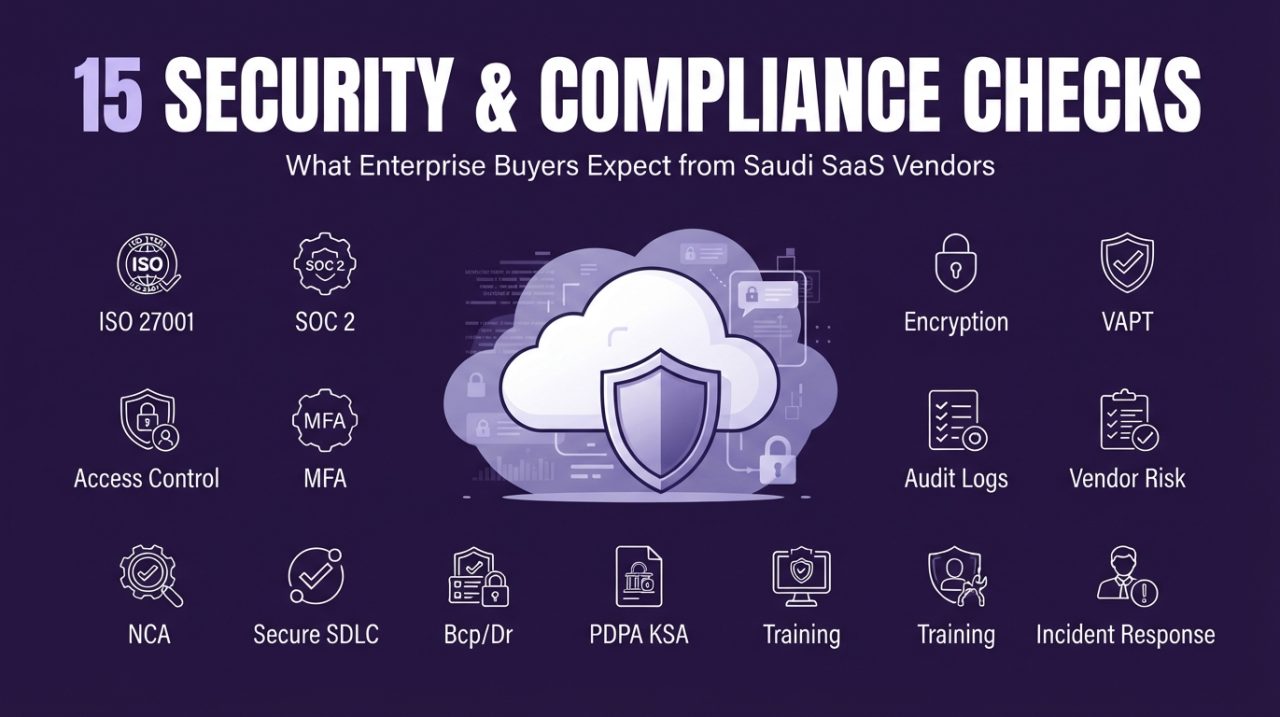
This guide covers 15 common enterprise buyer requests. You will also learn what evidence to prepare and how to improve your readiness in 30 days.
What Is SOC 2?
SOC 2 is an independent examination of a service organisation’s controls. It uses the American Institute of Certified Public Accountants (AICPA) Trust Services Criteria.
The framework helps customers understand how a SaaS provider protects systems and information.
SOC 2 covers five Trust Services Criteria categories:
- Security: Protects systems against unauthorised access and security threats.
- Availability: Evaluates whether systems remain available as agreed.
- Processing Integrity: Checks whether system processing is complete, accurate and authorised.
- Confidentiality: Protects information that an organisation classifies as confidential.
- Privacy: Examines how organisations collect, use, retain and dispose of personal information.
Security is included in every SOC 2 examination. However, organisations can select additional categories based on their services and customer requirements.
Importantly, SOC 2 is an attestation report, not a certification. It also does not guarantee that a company has no security risks.
SOC 2 Type 1 vs Type 2: What Do Enterprise Buyers Prefer?
SOC 2 Type 1 and Type 2 reports provide different levels of assurance. The main difference is the period they cover.
| Comparison | SOC 2 Type 1 | SOC 2 Type 2 |
|---|---|---|
| Evaluation | Control design and implementation at a specific date | Control design and operating effectiveness over a period |
| Evidence period | Point in time | Defined observation period |
| Preparation | Usually requires less observation time | Requires continuous evidence collection |
| Buyer preference | May support initial readiness | Often preferred by enterprise buyers |
Which SOC 2 Report Should Your SaaS Company Choose?
A Type 1 report may help your company demonstrate initial control readiness. Therefore, it can be useful when you are entering the enterprise market.
However, many enterprise buyers prefer Type 2. This report provides evidence that controls operated over an agreed period.
A practical approach is to discuss your target buyers’ expectations with an independent CPA firm. Then, define your scope, address control gaps and agree on the appropriate examination timeline.
The 15 Things Enterprise Buyers Commonly Ask Saudi SaaS Vendors For
Enterprise procurement teams want evidence, not just security promises. Therefore, SaaS companies should prepare the following documents and control records.
These are common buyer requests, not a universal legal checklist. Requirements can vary by customer, industry and contract.
1. SOC 2 Type II Report or ISO 27001 Certificate
What buyers want: Evidence of an established information security management process.
What to show:
- Current SOC 2 report or ISO 27001 certificate.
- Examination or certification scope.
- Applicable Trust Services Criteria.
- Relevant exceptions and qualifications.
How to prepare: Define your systems and services in scope. Additionally, collect dated control evidence throughout the assessment period.
2. Bridge Letter or Gap-Period Information
What buyers want: Information about significant changes since the end of the SOC 2 reporting period.
What to show:
- Management statement covering the gap period.
- Relevant security changes.
- Known incidents or significant control changes.
- Supporting evidence, where available.
How to prepare: Maintain evidence after the report period ends. Ask your auditor about the appropriate bridge-letter process. Remember, a management bridge letter is not a new auditor opinion.
3. Penetration Test Summary
What buyers want: Evidence that your application and infrastructure undergo security testing.
What to show:
- Independent penetration test summary.
- Test date and scope.
- Executive findings.
- Remediation status.
How to prepare: Plan periodic penetration testing. Also, consider additional testing after significant infrastructure or application changes.
4. Security Questionnaire
What buyers want: Clear answers about your security policies and technical controls.
Common questionnaire formats include SIG, CAIQ and customer-specific forms.
What to show:
- Completed questionnaire.
- Supporting policies.
- Technical evidence.
- Control references.
How to prepare: Create an approved answer library. Link each answer to its control owner and supporting evidence. As a result, your team can respond faster to future requests.
5. Data Processing Agreement and PDPL Terms
What buyers want: Clarity about how your company processes personal data.
What to show:
- Data Processing Agreement.
- Processing purposes.
- Controller and processor responsibilities.
- Sub-processor details.
- Security and breach-response obligations.
How to prepare: Create a standard DPA and review it against applicable Saudi PDPL requirements.
6. Data Residency and Hosting Details
What buyers want: Information about where customer data is stored and processed.
What to show:
- Production hosting locations.
- Backup locations.
- Data-processing locations.
- Relevant data-flow diagrams.
How to prepare: Document your hosting architecture. Furthermore, make sure your sales, legal and technical teams provide consistent answers.
Do not assume that every enterprise buyer requires Saudi-only hosting. Requirements depend on the customer, service, applicable rules and contract.
7. Sub-Processor List
What buyers want: Visibility into third parties that may process customer information.
What to show:
- Vendor names.
- Services provided.
- Processing purposes.
- Relevant data locations.
How to prepare: Maintain an up-to-date vendor register. Review important vendors regularly and document relevant changes.
8. Access Control Evidence
What buyers want: Proof that only authorised people can access systems and data.
What to show:
- Single Sign-On (SSO) availability.
- Multi-Factor Authentication (MFA).
- Role-based access controls.
- Privileged access records.
- Periodic access reviews.
How to prepare: Document access approvals and reviews. In addition, remove unnecessary access promptly when employees change roles or leave.
9. Encryption Information
What buyers want: Evidence that sensitive information is protected.
What to show:
- Encryption in transit.
- Encryption at rest.
- Key-management procedures.
- Relevant security configurations.
How to prepare: Document your encryption standards and key-management approach. Keep configuration evidence available for security reviews.
10. Logging and Security Monitoring
What buyers want: Evidence that your organisation can detect suspicious activity.
What to show:
- Logging requirements.
- Log retention periods.
- Monitoring procedures.
- Alert investigation records.
How to prepare: Define which events require logging. Also, retain examples of alerts and their investigation outcomes.
11. Vulnerability and Patch Management
What buyers want: Proof that your company identifies and addresses technical weaknesses.
What to show:
- Vulnerability scan summaries.
- Risk ratings.
- Remediation tickets.
- Patch-management records.
How to prepare: Establish risk-based remediation targets. Track every important finding until closure.
12. Incident Response and Breach Notification
What buyers want: Confidence that your organisation can respond to security incidents.
What to show:
- Incident response plan.
- Assigned responsibilities.
- Escalation procedures.
- Incident exercise records.
- Customer notification procedures.
How to prepare: Test your response plan regularly. Additionally, understand the legal and contractual notification timelines that apply to your services.
13. Business Continuity and Disaster Recovery
What buyers want: Evidence that your service can recover from disruptions.
What to show:
- Business continuity plan.
- Disaster recovery plan.
- Recovery Time Objective (RTO).
- Recovery Point Objective (RPO).
- Backup and restore-test records.
How to prepare: Define recovery targets and test your backups. Keep evidence of recovery exercises and document any issues.
14. Secure Software Development
What buyers want: Evidence that security is part of your development process.
What to show:
- Code review records.
- Change approvals.
- Release controls.
- Environment separation.
- Development security procedures.
How to prepare: Link code reviews and deployment approvals to development tickets. This makes the evidence easier to retrieve during an audit.
15. Security Governance and Policies
What buyers want: Evidence that security responsibilities are clearly defined.
What to show:
- Approved security policies.
- Risk assessments.
- Employee training records.
- Policy review dates.
- Assigned control owners.
How to prepare: Assign an owner to every important policy. Review documents regularly and retain approval records.
Additional Cybersecurity Requirements for Saudi Government Buyers
Some Saudi government and critical-infrastructure customers may request additional cybersecurity evidence.
For example, the National Cybersecurity Authority (NCA) publishes several cybersecurity frameworks and controls.
These include:
- Essential Cybersecurity Controls (ECC).
- Cloud Cybersecurity Controls (CCC).
- Other requirements relevant to specific sectors and organisations.
However, not every SaaS company is automatically subject to every NCA requirement.
Applicability depends on the organisation, service, customer and relevant regulatory or contractual obligations.
Therefore, confirm the buyer’s requirements before starting your compliance programme. Also, check whether the service falls within the scope of relevant cloud or sector-specific controls.
What Does Saudi PDPL Mean for SaaS Security Reviews?
Saudi Arabia’s Personal Data Protection Law (PDPL) is important for SaaS providers that process personal data within its scope.
Enterprise buyers may ask how your company collects, processes, stores and protects personal information.
They may also ask for evidence covering:
- Personal data categories.
- Processing purposes.
- Controller and processor responsibilities.
- Sub-processors.
- Data retention and deletion.
- Data-subject rights.
- Security safeguards.
- Personal data breach procedures.
Does Saudi PDPL Require 72-Hour Breach Notification?
Saudi PDPL’s Implementing Regulation includes a 72-hour notification requirement for certain personal data breaches.
A controller must notify the competent authority within a period not exceeding 72 hours after becoming aware of a breach when the incident potentially causes harm to personal data or the data subject, or affects their rights or interests.
The regulation also addresses notification to affected data subjects when the relevant conditions apply.
Therefore, SaaS vendors should maintain clear incident escalation procedures. They should also define how processors notify controllers about potential breaches.
Importantly, the 72-hour requirement is not a universal deadline for every security incident. The applicable conditions and responsibilities must be assessed for each situation.
Why Saudi SaaS Companies Lose Time During Enterprise Security Reviews
A promising enterprise deal can slow down when a vendor cannot provide security evidence quickly.
Several common problems contribute to these delays.
1. Security Questionnaires Are Answered from Scratch
Different buyers often ask similar questions in different formats. As a result, teams repeat the same research and documentation work.
They may need to contact technical owners, locate policies and prepare new responses.
How to fix it: Maintain an approved answer library. Map each response to its control owner and supporting evidence.
2. Security Evidence Is Scattered Across Different Tools
Policies may exist in shared drives, while screenshots and technical records remain in email threads.
Consequently, teams struggle to find the latest approved evidence.
How to fix it: Use a central evidence repository. Assign owners and review dates to important documents.
3. No One Owns the Security Response
Sales, engineering, IT, legal and compliance teams may hold different parts of the answer.
Without clear ownership, responses can become inconsistent.
How to fix it: Assign one questionnaire owner. Then, define technical, privacy and compliance contacts for specific questions.
4. Compliance Frameworks Are Managed Separately
SOC 2, ISO 27001, PDPL and NCA requirements often share related security activities.
However, managing every framework separately can create duplicated work.
How to fix it: Map overlapping requirements through a shared control library. Reuse evidence where appropriate, while retaining framework-specific requirements.
5. Hosting and Data Residency Answers Are Inconsistent
Sales presentations, privacy notices and technical documents may describe hosting differently.
This can create confusion during procurement.
How to fix it: Maintain one approved source of truth. Include production systems, backups, sub-processors and processing locations.
A 30-Day Plan to Improve Enterprise Security Readiness
A focused 30-day plan can help your SaaS company organise its evidence and address common gaps.
However, this plan does not guarantee a SOC 2 report within 30 days. A Type 2 examination still requires an agreed observation period and independent auditor work.
| Timeline | Key actions | Expected output |
|---|---|---|
| Week 1: Define scope | Identify systems, select relevant criteria, assign owners and review major risks | Defined scope, owner list and gap register |
| Week 2: Address control gaps | Review access, MFA, logging, vulnerabilities and vendor oversight | Remediation plan and initial evidence repository |
| Week 3: Prepare buyer documents | Build questionnaire answers, review the DPA and document data flows | Buyer-ready documentation and answer library |
| Week 4: Validate readiness | Review evidence, test selected controls and discuss examination timing with a CPA firm | Readiness findings and next-step plan |
What Should You Prepare Before Your First Enterprise Security Review?
Start with these essential documents:
- Security policy set.
- System and service scope.
- Risk assessment.
- Access-control summary.
- MFA configuration evidence.
- Vulnerability management summary.
- Penetration test summary, if available.
- Incident response plan.
- Business continuity plan.
- DPA and sub-processor register.
- Data-flow and hosting overview.
- Security questionnaire answer library.
These documents do not replace a SOC 2 report when a buyer specifically requires one. Nevertheless, they can make your initial security review much easier.
How Sahl GRC Helps Saudi SaaS Companies Prepare for Enterprise Buyers
Enterprise readiness involves more than obtaining a SOC 2 report.
Companies must also maintain policies, control ownership, evidence and consistent security answers. Therefore, an organised GRC process can make enterprise reviews easier to manage.
Sahl GRC is an AI-powered, Saudi-focused GRC platform designed to help organisations manage compliance activities.
Subject to confirmation of current product availability, Sahl supports capabilities such as:
1. Cross-Framework Control Mapping
Map SOC 2, ISO 27001, PDPL, NCA ECC and SAMA CSF requirements through a shared control library.
As a result, teams can identify overlapping requirements and reduce duplicated work.
2. Centralised Evidence Management
Organise compliance evidence and track review or expiry dates.
Additionally, teams can monitor outstanding evidence and control responsibilities.
3. Security Questionnaire Preparation
Maintain control-linked answers for recurring security questionnaires.
This helps teams reuse approved responses and locate supporting evidence more quickly.
4. Vendor and Risk Management
Track vendors, sub-processors and associated security information.
Furthermore, centralised records help teams maintain visibility over third-party risks.
5. Privacy and Vulnerability Workflows
Sahl’s stated capabilities include AI Virtual DPO, automated Records of Processing Activities (RoPA) and a built-in vulnerability scanner.
These features can support privacy and security workflows, subject to their available scope and configuration.
6. Arabic and English Support
Sahl supports Arabic and English, with Saudi-focused hosting options.
This can help regional organisations manage compliance activities in a familiar business environment.
Want to simplify your enterprise security preparation?
Book a demo with Sahl GRC to explore how control mapping, evidence management and security questionnaire preparation can support your compliance workflow.
[Add an approved customer outcome or verified case study here.]
Frequently Asked Questions About SOC 2 for Saudi SaaS Companies
No. SOC 2 is not a general legal requirement for every SaaS company in Saudi Arabia. However, enterprise customers and international buyers may request a SOC 2 report or ISO 27001 certificate during vendor assessments.
Some enterprise buyers specifically request SOC 2 Type II. Others may accept ISO 27001, Type 1 or alternative evidence during initial reviews. Requirements depend on the buyer, industry and contract.
A Type 1 report can demonstrate that controls are suitably designed and implemented at a specific date. However, many enterprise buyers prefer Type 2 because it covers control operation over an observation period.
SOC 2 Type II requires an observation period agreed with the independent CPA firm. Preparation, remediation and examination work also affect the overall timeline.
Buyers commonly request a penetration test summary, security questionnaire, DPA, sub-processor list, data residency details and access-control evidence. They may also ask for encryption, incident response and business continuity documentation.
Saudi PDPL may apply when an organisation processes personal data within the law’s scope. SaaS providers should assess their role and document their responsibilities under applicable law and customer agreements.
Not every SaaS company is automatically subject to NCA ECC. However, government, regulated-sector and critical-infrastructure customers may impose NCA-aligned requirements through applicable rules or contracts.
Prepare for Your Next Enterprise Security Review
Enterprise buyers want more than a promise that your SaaS product is secure. They need clear and verifiable evidence.
They want to understand how your organisation protects customer data, manages risks and responds to incidents.
Start with the 15 items in this checklist. Then, confirm your buyer’s requirements and address the most important control gaps.
With organised evidence and clear ownership, your team can spend less time searching for documents. Instead, you can focus on responding to enterprise opportunities.
Book a demo with Sahl GRC to explore a more organised approach to compliance evidence and enterprise security readiness.

