



NCA ECC Compliance: 8 Common Gaps and How to Fix Them
Article date: 25 November 2026
Author: Sahl GRC Team
Quick Answer: Why Do Saudi Organisations Fail NCA ECC Compliance?
Saudi organisations often struggle with NCA ECC compliance because they cannot provide sufficient evidence that cybersecurity controls are operating effectively over time.
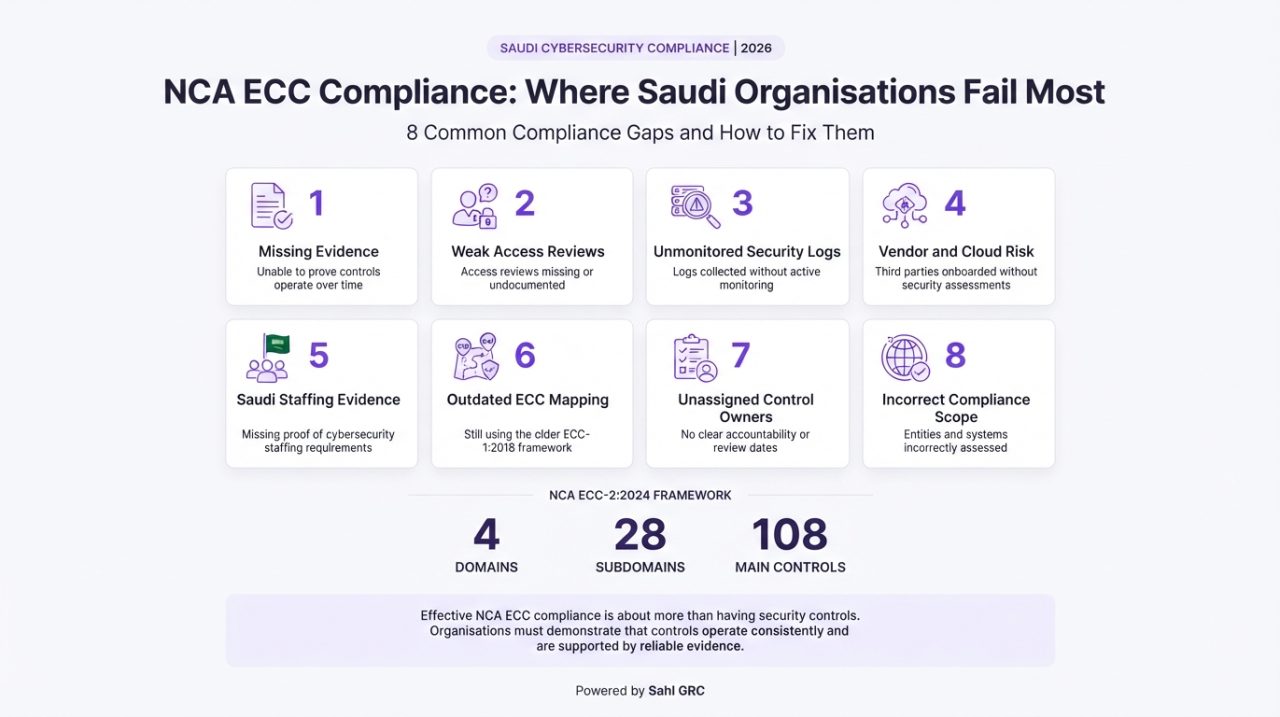
According to practitioner guidance, eight recurring gaps include:
- Missing or outdated compliance evidence.
- Access reviews that are not performed or documented.
- Security logs that are collected but not actively monitored.
- Vendors and cloud services onboarded without proper security assessments.
- Missing evidence of Saudi cybersecurity staffing requirements.
- Outdated mappings based on ECC-1:2018.
- Cybersecurity controls without clearly assigned owners.
- Incorrect compliance scope and applicability decisions.
These issues can make an organisation’s cybersecurity programme difficult to demonstrate during an assessment.
Furthermore, NCA ECC-2:2024 contains 4 domains, 28 subdomains and 108 main controls. Therefore, organisations need a structured approach to control ownership, evidence collection and ongoing compliance management.
In this guide, we explain each gap, its common symptoms and practical ways to address it.
Note: These failure patterns are practitioner-reported observations, not official NCA assessment statistics.
What Is NCA ECC-2:2024?
NCA ECC-2:2024 is the current edition of the Essential Cybersecurity Controls issued by Saudi Arabia’s National Cybersecurity Authority (NCA).
The framework replaced ECC-1:2018 and reorganised its requirements into four main domains:
- Governance
- Defense
- Resilience
- Third-party and cloud cybersecurity
In total, ECC-2:2024 contains 4 domains, 28 subdomains and 108 main controls.
Additionally, Industrial Control Systems and Operational Technology requirements are addressed through separate NCA operational technology controls.
The framework applies to government entities and private-sector entities that own, operate or host Critical National Infrastructures (CNIs), subject to the applicable requirements.
Unlike ISO 27001, NCA ECC should not be approached as a certification exercise in which an organisation simply excludes inconvenient controls. Organisations must assess and address the applicable requirements within their scope.
For this reason, understanding applicability, maintaining evidence and assigning responsibility are essential parts of an effective NCA ECC compliance programme.
The 8 Most Common NCA ECC Compliance Gaps in Saudi Arabia
Organisations may have cybersecurity policies, security tools and technical controls in place. However, these measures alone do not demonstrate effective compliance.
The following eight gaps highlight areas where practitioners commonly report implementation and evidence challenges.
1. Organisations Cannot Prove That Cybersecurity Controls Work Over Time
Common symptom: Policies and procedures exist, but supporting evidence is missing, outdated or limited to a single screenshot.
For example, an organisation may have an access control policy without records showing that access permissions were reviewed throughout the required period.
Why this creates a compliance gap:
Assessments may examine whether controls operate consistently, rather than simply checking whether a policy exists.
As a result, one document or screenshot may not provide sufficient evidence of ongoing implementation.
How to fix it:
- Establish an evidence collection process for every applicable control.
- Record evidence dates and review periods.
- Assign responsibility for collecting and maintaining evidence.
- Monitor expired or outdated documents.
- Keep supporting records organised and accessible.
How Sahl helps: Sahl supports continuous evidence collection, centralised evidence management and expiry alerts to help teams maintain up-to-date compliance records.
2. Access Reviews Are Not Performed or Properly Documented
Common symptom: The organisation maintains privileged access lists, but cannot show dated approval or review records.
Access management is an important part of cybersecurity governance. Nevertheless, simply maintaining a user list does not demonstrate that access permissions are regularly reviewed.
Why this creates a compliance gap:
Employees may change roles, leave the organisation or receive additional permissions over time. Without regular reviews, unnecessary or excessive access can remain active.
How to fix it:
- Schedule periodic access reviews.
- Identify privileged and high-risk accounts.
- Assign named reviewers.
- Record review decisions and approvals.
- Document access removals and corrective actions.
For example, organisations can establish quarterly access reviews with documented outcomes and responsible reviewers.
How Sahl helps: Sahl supports recurring review tasks, owner attestations and dated evidence trails to help teams track access review activities.
3. Security Logs Are Collected but Not Actively Monitored
Common symptom: A security information and event management (SIEM) platform is available, but the organisation cannot provide alert samples, investigation records or evidence of monitoring activities.
Collecting logs is only one part of security monitoring. Organisations must also establish processes for reviewing relevant events and responding to potential incidents.
Why this creates a compliance gap:
Without documented monitoring activities, an organisation may struggle to demonstrate how it identifies suspicious behaviour and handles security alerts.
How to fix it:
- Define which systems and events require monitoring.
- Assign responsibility for reviewing security alerts.
- Establish escalation and incident response procedures.
- Maintain samples of alerts and investigation records.
- Review monitoring effectiveness regularly.
How Sahl helps: Sahl supports evidence mapping to logging and monitoring controls, along with evidence freshness tracking.
4. Vendors and Cloud Services Are Onboarded Without Security Assessments
Common symptom: Critical SaaS platforms and cloud providers process organisational data without documented security assessments or appropriate cybersecurity clauses in contracts.
Third-party relationships can introduce risks that extend beyond an organisation’s internal IT environment.
Why this creates a compliance gap:
Vendors may store, access or process sensitive information on behalf of an organisation. Consequently, their security practices can affect the organisation’s overall cybersecurity posture.
NCA ECC includes requirements relating to third-party and cloud security. In addition, cloud providers may be subject to NCA’s separate Cloud Cybersecurity Controls, depending on their applicability.
How to fix it:
- Maintain an up-to-date vendor register.
- Classify vendors according to risk.
- Assess critical suppliers before onboarding.
- Include relevant cybersecurity requirements in contracts.
- Review vendor security periodically.
- Maintain a current cloud and hosting inventory.
How Sahl helps: Sahl supports third-party risk tracking and helps link vendor relationships to the cybersecurity controls they affect.
5. Organisations Lack Evidence of Saudi Cybersecurity Staffing Requirements
Common symptom: Cybersecurity employees are in place, but supporting organisational charts, role descriptions, qualifications, training records or nationality records are incomplete.
Why this creates a compliance gap:
ECC-2:2024 includes expectations concerning cybersecurity positions being filled by full-time, qualified Saudi professionals. Therefore, organisations need appropriate documentation to demonstrate that applicable staffing requirements are addressed.
How to fix it:
Prepare and maintain a cybersecurity staffing evidence pack containing:
- Cybersecurity organisational chart.
- Job descriptions and role responsibilities.
- Relevant qualifications and certifications.
- Training and professional development records.
- Employment and nationality documentation, where applicable.
Additionally, assign an owner to review the staffing evidence regularly so that records remain current.
How Sahl helps: Sahl provides a centralised evidence repository with ownership and review-date tracking to help organise supporting documentation.
6. Organisations Still Use Outdated ECC-1:2018 Mappings
Common symptom: Compliance policies, gap assessments and vendor questionnaires still reference five domains and 114 controls.
This can happen when organisations continue using older spreadsheets or compliance templates without updating their framework mappings.
Why this creates a compliance gap:
ECC-2:2024 introduced a revised structure. Consequently, outdated mappings may leave teams working with requirements that no longer reflect the current framework structure.
How to fix it:
- Re-baseline the compliance programme against ECC-2:2024.
- Update policies and control mappings.
- Review existing gap assessments.
- Update vendor questionnaires.
- Reassign control ownership where necessary.
- Verify that internal compliance reports reflect the current edition.
How Sahl helps: Sahl provides ECC-2:2024 pre-mapped content and cross-framework links to support updated compliance mapping.
7. Cybersecurity Controls Have No Named Owner or Review Date
Common symptom: Compliance spreadsheets contain blank ownership fields, policies lack formal approvals or control reviews are overdue.
Even when organisations have implemented security controls, unclear accountability can make ongoing compliance difficult.
Why this creates a compliance gap:
Without clear ownership, nobody may be responsible for maintaining evidence, reviewing policies or completing corrective actions.
As a result, important compliance tasks can remain incomplete.
How to fix it:
- Assign one accountable owner to each applicable control.
- Identify a backup owner where appropriate.
- Define approval responsibilities.
- Set review dates and recurring tasks.
- Establish escalation procedures for overdue activities.
How Sahl helps: Sahl supports mandatory ownership fields, reminders and centralised tracking to help teams manage control responsibilities.
8. Organisations Define the Wrong Compliance Scope
Common symptom: An organisation assumes that a subsidiary, hosted system or contractor is outside its scope without documenting the applicability decision.
On the other hand, some organisations include unnecessary systems and entities, increasing the workload without first establishing the correct scope.
Why this creates a compliance gap:
Incorrect scoping can leave relevant systems or business activities unassessed. It can also create unnecessary implementation work.
How to fix it:
- Identify the relevant legal entities and business operations.
- Review systems, locations and third-party relationships.
- Document applicability decisions.
- Record the reasoning behind scope decisions.
- Reassess scope when business operations change.
How Sahl helps: Sahl supports multi-entity compliance structures and scope management at the entity level.
NCA ECC Compliance Readiness Checklist: 10 Questions to Ask
Before an NCA ECC assessment, organisations should review whether their cybersecurity controls are implemented, documented and supported by current evidence.
Use this checklist to identify potential gaps.
| # | Readiness question | Yes / No |
|---|---|---|
| 1 | Does every applicable control have a named owner and backup? | |
| 2 | Is dated evidence available for each control within its required period? | |
| 3 | Have privileged access reviews been completed and documented this quarter? | |
| 4 | Can the organisation show evidence of log monitoring and alert handling? | |
| 5 | Have critical vendors been assessed and covered by relevant contract clauses? | |
| 6 | Is the cloud and hosting register current? | |
| 7 | Is the Saudi cybersecurity staffing evidence pack available? | |
| 8 | Are compliance policies mapped to ECC-2:2024 rather than ECC-1:2018? | |
| 9 | Are applicability decisions documented for relevant entities and systems? | |
| 10 | Can the organisation prepare an audit evidence pack for one domain within hours? |
How should you interpret your checklist results?
A score below 8 positive answers out of 10 indicates that a focused remediation review may be worthwhile before an assessment.
However, this checklist is an internal readiness aid, not an official NCA scoring methodology or substitute for a complete ECC assessment.
A Practical 30-Day NCA ECC Compliance Improvement Plan
Organisations can use a structured 30-day remediation sprint to address priority gaps and improve evidence readiness.
The following plan provides a practical starting point.
| Timeline | Main activities | Expected output |
|---|---|---|
| Week 1 | Re-baseline against ECC-2:2024, assign control owners and document scope | Updated control mapping and ownership register |
| Week 2 | Conduct access reviews, define log monitoring and build vendor and cloud registers | Documented reviews and updated registers |
| Week 3 | Improve evidence collection and assemble the Saudi staffing evidence pack | Organised compliance evidence |
| Week 4 | Conduct a mock assessment on 10 controls, address gaps and brief leadership | Remediation tracker and management update |
Week 1: Establish the compliance baseline
First, review the organisation’s existing compliance programme against ECC-2:2024.
Identify outdated mappings, confirm the applicable scope and assign control owners.
Week 2: Address operational security gaps
Next, review privileged access, logging and monitoring activities.
At the same time, update the vendor and cloud registers so that relevant third-party relationships are properly documented.
Week 3: Strengthen evidence management
Then, organise evidence for applicable controls and identify missing documentation.
Prepare the Saudi cybersecurity staffing evidence pack and establish a process for reviewing evidence freshness.
Week 4: Test readiness and report progress
Finally, conduct a focused mock assessment covering 10 selected controls.
Document findings, assign remediation owners and brief leadership on outstanding risks and next steps.
Important: This 30-day plan is a practical improvement roadmap, not a guarantee of full NCA ECC compliance within 30 days. The actual effort depends on organisational scope, existing maturity and the number of outstanding gaps.
How Sahl Helps Organisations Manage NCA ECC Compliance
Managing NCA ECC compliance requires more than maintaining spreadsheets and writing cybersecurity policies. Organisations must coordinate control ownership, evidence collection, vendor assessments, framework mappings and remediation activities.
Sahl is an AI-powered, Saudi-first GRC platform designed to help organisations manage cybersecurity, risk and compliance activities through a centralised workspace.
Instead of managing disconnected compliance processes, teams can use Sahl to organise their requirements and monitor implementation progress.
Key Sahl capabilities for NCA ECC compliance
1. Pre-mapped compliance frameworks
Sahl includes NCA ECC-2:2024, SAMA CSF and PDPL pre-mapped content to help teams organise applicable requirements.
2. Continuous evidence management
Collect and organise supporting evidence, monitor expiry dates and improve visibility into documentation gaps.
3. Cross-framework control mapping
Map shared controls across frameworks to reduce duplicated assessments and repetitive evidence requests.
4. Third-party risk management
Track vendors and their relationships with relevant compliance controls to improve visibility into supplier-related risks.
5. Real-time compliance dashboards
Give teams and leadership a centralised view of control status, outstanding tasks and remediation progress.
6. Audit-ready evidence exports
Organise supporting documentation and prepare evidence exports for internal reviews and external assessments.
7. Additional AI-powered GRC capabilities
Sahl also includes an AI Virtual DPO, automated Records of Processing Activities (RoPA) and a built-in vulnerability scanner.
Additionally, the platform supports Arabic and English, with Saudi-focused hosting options.
By bringing these activities together, Sahl helps organisations improve compliance visibility and reduce repetitive manual work.
Want to see how Sahl can support your NCA ECC programme? Book a demo with Sahl and explore a more structured approach to cybersecurity compliance.
Frequently Asked Questions About NCA ECC Compliance
One commonly reported challenge is the inability to demonstrate that cybersecurity controls operate consistently over time. Missing evidence, undocumented access reviews and unmonitored security logs can make compliance difficult to demonstrate.
NCA ECC-2:2024 contains 4 domains, 28 subdomains and 108 main controls. Older sources that refer to five domains and 114 controls generally describe ECC-1:2018.
NCA ECC compliance is generally demonstrated through compliance assessments and regulatory oversight rather than a conventional ISO-style certification process. The applicable assessment arrangements depend on the organisation’s regulatory and sector context.
No. ISO 27001 certification does not automatically establish NCA ECC compliance. Although both frameworks contain overlapping cybersecurity requirements, organisations must assess and address the applicable ECC controls separately.
Organisations using outdated mappings should review their compliance programme against ECC-2:2024. In particular, they should update control mappings, policies, gap assessments and supporting documentation to reflect the current framework.
Start by confirming the applicable scope, assigning control owners and reviewing evidence availability. Additionally, conduct access reviews, verify log monitoring records, assess critical vendors and address outdated framework mappings.
GRC software can help centralise control ownership, collect evidence, track remediation activities, manage vendors and organise audit documentation. For example, Sahl provides compliance management capabilities designed to support these activities.
A 30-day improvement sprint can help organisations address selected priority gaps and improve readiness. However, completing every applicable requirement within 30 days is not guaranteed. The timeline depends on the organisation’s scope, security maturity and outstanding remediation work.
Final Thoughts: Build NCA ECC Compliance Into Daily Operations
NCA ECC compliance is not just about having cybersecurity policies or purchasing security tools. Organisations must also demonstrate that applicable controls are implemented, monitored and supported by reliable evidence.
For example, missing access review records, outdated framework mappings and incomplete vendor assessments can create avoidable compliance gaps.
Therefore, organisations should start by reviewing their scope, assigning control owners and identifying missing evidence. They should also establish recurring reviews and a clear remediation process.
Furthermore, a centralised GRC platform can help coordinate NCA ECC with other applicable frameworks, including SAMA CSF and PDPL.
Ready to improve your NCA ECC compliance process? Explore Sahl and book a demo.
Sources and Further Reading
- National Cybersecurity Authority (NCA) – Essential Cybersecurity Controls and official regulatory publications.
- Secure.com – Practitioner guidance on NCA ECC 2024 audit gaps, Saudi business updates and ISO 27001 vs NCA ECC.
- SecurityWall – NCA ECC compliance checklist and implementation guidance.
- Qualys – Third-party and cloud security guidance.
Editorial note: The eight failure patterns in this article are based on practitioner guidance and are not official NCA statistics. Verify framework structure, control counts and applicability against the latest NCA-published documents before publication.

