



How Long Does ISO 27001 Take in Saudi Arabia? (2026)
Article date: 25 November 2026
Author: Sahl GRC Team
Quick Answer: How Long Does ISO 27001 Take in Saudi Arabia?
ISO 27001 certification typically takes 3 to 12 months, depending on an organisation’s size, security maturity, implementation scope and audit readiness.
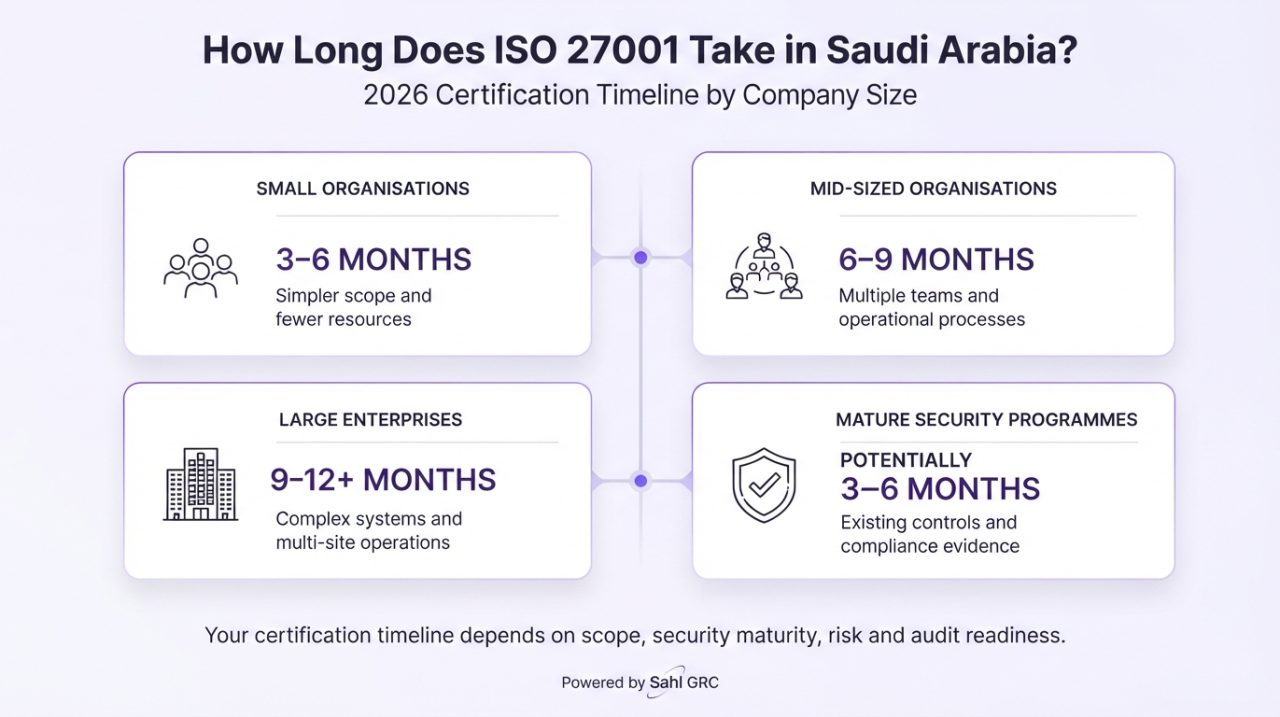
For a small organisation with established security practices, implementation may take approximately 3–6 months. Meanwhile, mid-sized organisations often need 6–9 months, while large enterprises and multi-site organisations may require 9–12 months or longer.
The certification audit is only one part of the process. In fact, most of the work happens before the audit: defining the Information Security Management System (ISMS), conducting risk assessments, implementing security controls, documenting procedures and collecting evidence that those controls operate effectively.
These figures are indicative planning ranges based on commonly published practitioner guidance. They are not Saudi regulatory deadlines, guaranteed certification periods or Sahl service commitments.
ISO 27001 certification timeline at a glance
| Organisation type | Indicative timeline |
|---|---|
| Small company or startup (10–50 employees) | 3–6 months |
| Mid-sized organisation (50–250 employees) | 6–9 months |
| Large or multi-site enterprise | 9–12+ months |
| Organisation with mature security controls or an existing SOC 2 programme | Potentially 3–6 months |
Ultimately, employee count is not the only factor that determines the timeline. For example, an organisation with 30 employees and complex regulatory obligations may take longer than a 100-person cloud-first business with mature security processes.
What Is the ISO 27001 Certification Process?
ISO/IEC 27001 is an international standard for establishing, implementing, maintaining and continually improving an Information Security Management System (ISMS).
The certification process assesses whether an organisation has established a systematic approach to identifying information security risks and managing them through appropriate controls.
The current edition is ISO/IEC 27001:2022. Its Annex A contains 93 reference controls organised into four categories:
- Organisational controls
- People controls
- Physical controls
- Technological controls
During implementation, organisations determine which controls are applicable through risk assessment. They then document their decisions in the Statement of Applicability (SoA).
The nine stages of ISO 27001 certification
Planning and risk assessment (Stages 1–2)
1. Define the ISMS scope
First, identify the business units, locations, information assets, technology systems and processes included in the certification scope.
A clearly defined scope prevents unnecessary complexity. It also helps establish which security requirements apply to the organisation.
2. Conduct an information security risk assessment
Next, identify information assets, threats, vulnerabilities and potential business impacts.
Assess the risks, determine appropriate treatment options and establish a risk treatment plan. This assessment provides the foundation for selecting relevant security controls.
Documentation and security control implementation (Stages 3–4)
3. Develop policies and documentation
Create the documentation required to support the ISMS. Depending on the organisation’s scope and requirements, this may include:
- Information security policy
- Risk assessment methodology
- Risk register
- Risk treatment plan
- Statement of Applicability
- Access control procedures
- Incident management procedures
- Business continuity documentation
- Supplier security requirements
4. Implement security controls
After identifying the applicable controls, put them into practice.
Depending on the organisation’s risk profile, this may include multi-factor authentication, access reviews, endpoint protection, encryption, vulnerability management, security awareness training and incident response procedures.
ISMS operation, evidence and internal review (Stages 5–7)
5. Operate the ISMS and collect evidence
An organisation must demonstrate that its information security processes are operating, not simply that policies have been written.
For example, evidence may include access review records, security training completion, incident logs, vulnerability assessments, supplier reviews and management approvals.
The required operating history depends on the scope, risks, certification body’s assessment and the maturity of the ISMS. Importantly, there is no universal three-month waiting period prescribed for every organisation.
6. Conduct an internal audit
Review the ISMS against ISO/IEC 27001 requirements, identify nonconformities and document corrective actions.
The internal audit should provide an independent assessment of whether the management system is implemented and functioning effectively.
7. Complete the management review
Management reviews the ISMS, including risk status, audit results, security performance, incidents, objectives and opportunities for improvement.
This review helps leadership evaluate whether the ISMS remains suitable, adequate and effective.
External certification audit and certificate issuance (Stages 8–9)
8. Complete the external certification audit
An accredited certification body typically conducts two stages:
- Stage 1: Reviews ISMS documentation, scope and readiness for certification.
- Stage 2: Evaluates whether the ISMS has been implemented and is operating effectively.
If the auditors identify nonconformities, the organisation must address them through the certification body’s corrective-action process.
9. Receive certification and maintain compliance
Following a successful certification decision, the organisation receives its ISO 27001 certificate.
Certification operates on a three-year cycle, subject to annual surveillance audits and a recertification audit at the end of the cycle.
How Long Does Each ISO 27001 Implementation Phase Take?
The following table provides indicative planning estimates. However, some activities can run in parallel, so the durations should not simply be added together.
| Implementation phase | Indicative duration |
|---|---|
| Initial gap analysis and planning | 1–4 weeks |
| ISMS scope and risk assessment | 2–6 weeks |
| Policies, documentation and control implementation | 6–16 weeks |
| Operational evidence collection | Several weeks to several months |
| Internal audit and management review | 1–2 weeks |
| Stage 1 certification audit | Scheduled according to scope and audit plan |
| Stage 1 remediation and Stage 2 preparation | Depends on findings and certification body |
| Stage 2 certification audit | Depends on scope, locations and complexity |
| Certification decision and certificate issuance | Depends on corrective actions and certification-body procedures |
Which phase takes the longest?
Risk assessment, control implementation and evidence collection usually account for the largest share of the implementation effort.
An organisation may already have firewalls, endpoint protection and access management in place. Nevertheless, it must demonstrate that these controls are appropriate to its risks, formally managed and supported by reliable records.
This distinction between having security tools and operating a documented ISMS is one of the main reasons certification takes several months.
ISO 27001 Timeline by Company Size
The size of an organisation influences its implementation workload. However, operational complexity and existing security maturity are equally important.
1. Small companies and startups: 3–6 months
Small organisations with approximately 10–50 employees can often move through ISO 27001 implementation faster because they have fewer systems, business units and approval layers.
For example, a cloud-first company with established access controls, endpoint protection and documented procedures may already have several relevant controls operating.
Typical challenges:
- Limited internal security resources
- Lack of formal policies
- Incomplete risk assessments
- Missing evidence and audit records
- Dependence on external technology providers
How to accelerate implementation: Establish a clear ISMS scope, appoint control owners and use existing security evidence wherever it is relevant and acceptable.
2. Mid-sized companies: 6–9 months
As organisations grow to approximately 50–250 employees, their operating environments generally become more complex.
They may have several departments, multiple technology platforms, external suppliers and different levels of security maturity. Consequently, coordinating implementation across teams can take additional time.
Typical challenges:
- Coordinating control owners across departments
- Standardising security policies
- Managing access across multiple systems
- Tracking supplier security requirements
- Collecting consistent evidence
How to accelerate implementation: Centralise control ownership, standardise documentation and automate recurring evidence collection.
3. Large enterprises and multi-site organisations: 9–12+ months
Similarly, large organisations often manage complex IT environments, multiple locations, legacy infrastructure and established governance structures.
Their certification scope may also include several business units, subsidiaries or operational environments. As a result, risk assessments, approvals and remediation activities can require additional coordination.
Typical challenges:
- Multiple systems and locations
- Complex risk management requirements
- Legacy infrastructure
- Large supplier ecosystems
- Multiple regulatory obligations
- Extended approval and remediation processes
How to accelerate implementation: Use a phased implementation strategy, establish governance early and coordinate ISO 27001 with existing regulatory and industry requirements.
4. Organisations with SOC 2 or mature security programmes: potentially 3–6 months
On the other hand, organisations with an existing SOC 2 programme or mature information security management practices may have a head start.
They may already maintain access reviews, incident response procedures, security policies, vulnerability assessments and supporting evidence.
However, SOC 2 does not automatically satisfy ISO 27001 requirements. The organisation must still assess its existing controls against the ISO standard, identify gaps and establish any missing ISMS requirements.
What Factors Delay ISO 27001 Certification in Saudi Arabia?
Several challenges can extend the ISO 27001 certification timeline for organisations operating in Saudi Arabia. Identifying these issues early can help teams avoid unnecessary delays.
1. An unclear certification scope
Attempting to include every department, location and system from the beginning can create unnecessary implementation work.
Therefore, a well-defined scope should reflect business operations, information assets, security risks and relevant interested parties.
2. Delayed risk assessments
Implementing controls before understanding the organisation’s risks can lead to duplicated effort and inappropriate security investments.
For this reason, risk assessment should guide control selection and prioritisation.
3. Missing operational evidence
Having a written information security policy does not demonstrate that the policy is followed.
For instance, auditors may need records showing that access reviews, security training, incident management and other relevant activities actually took place.
4. Slow management approvals
Policies, risk treatment decisions and corrective actions often require approval from different stakeholders.
As a result, delayed decisions can affect implementation schedules and push back audit preparation.
5. Separate compliance projects
Saudi organisations may need to address ISO 27001 alongside NCA Essential Cybersecurity Controls (ECC), SAMA Cyber Security Framework (CSF), Saudi Personal Data Protection Law (PDPL) and international requirements such as SOC 2.
Managing every framework independently can create duplicate documentation, assessments and evidence requests. Instead, a coordinated compliance programme can help reduce repeated work.
6. Late identification of nonconformities
If internal audits and readiness reviews happen too late, organisations may discover significant gaps shortly before their external certification audit.
Consequently, conducting internal assessments early gives teams more time to address deficiencies and prepare for certification.
ISO 27001 vs NCA ECC in Saudi Arabia: What Is the Difference?
ISO 27001 and NCA ECC are different cybersecurity and information security frameworks. Therefore, ISO 27001 certification does not replace NCA ECC compliance.
ISO 27001 is an internationally recognised standard for establishing an Information Security Management System. On the other hand, NCA ECC is a Saudi national cybersecurity control framework issued by the National Cybersecurity Authority.
Specifically, the NCA’s ECC-2:2024 applies to government entities and their affiliated entities, as well as private-sector entities that own, operate or host Critical National Infrastructures (CNIs), subject to the controls’ applicability provisions.
Furthermore, the NCA encourages other organisations across the Kingdom to adopt these controls as cybersecurity best practice.
ISO 27001 vs NCA ECC comparison
| Comparison | ISO 27001 | NCA ECC |
|---|---|---|
| Issuing organisation | International Organization for Standardization (ISO) and IEC | Saudi National Cybersecurity Authority |
| Primary purpose | Establish and maintain an ISMS | Establish essential cybersecurity requirements in Saudi Arabia |
| Geographic relevance | International | Saudi Arabia |
| Main approach | Risk-based management system | National cybersecurity controls |
| Applicability | Voluntary standard unless required by a contract or other obligation | Mandatory for entities within its defined scope |
| Assessment | Independent certification audit | NCA compliance assessment and regulatory oversight |
| Exclusions | Control applicability is determined and justified through the SoA | Applicable ECC requirements must be addressed |
| Can one replace the other? | No | No |
Can ISO 27001 and NCA ECC be implemented together?
Yes. Implementing both frameworks through a coordinated compliance programme can reduce duplicated work.
For example, access management, asset management, incident response, business continuity and supplier security activities may support requirements across both frameworks.
However, organisations must assess each framework independently. Similar controls do not mean that every requirement is identical or that evidence automatically satisfies both.
For Saudi organisations, the practical approach is to maintain one coordinated control and evidence programme while preserving the specific requirements of each framework.
Can ISO 27001 Be Combined With PDPL, SAMA CSF and SOC 2?
Yes. Organisations can coordinate ISO 27001 with other applicable frameworks and regulatory obligations.
To avoid duplicated work, organisations should identify overlapping requirements, map them to shared controls and maintain evidence that can be reused wherever it genuinely demonstrates compliance.
ISO 27001 and Saudi PDPL
The Saudi Personal Data Protection Law focuses on the protection and processing of personal data.
ISO 27001 provides an information security management framework that can support appropriate technical and organisational safeguards.
However, ISO 27001 certification does not establish automatic PDPL compliance. Organisations must separately assess applicable privacy obligations, processing activities, data subject rights and other legal requirements.
ISO 27001 and SAMA CSF
Financial institutions and other entities within SAMA’s regulatory scope may need to address SAMA cybersecurity requirements.
In this context, ISO 27001 can provide a structured management-system foundation, while SAMA CSF addresses sector-specific cybersecurity expectations.
Therefore, the frameworks should be mapped together without treating one as a substitute for the other.
ISO 27001 and SOC 2
SOC 2 and ISO 27001 share several security-related concepts, including access management, risk management, incident response and security monitoring.
As a result, organisations with an established SOC 2 programme may be able to reuse relevant controls and evidence when preparing for ISO 27001.
Nevertheless, their assessment criteria, reporting requirements and assurance approaches differ.
How Can You Reduce the ISO 27001 Certification Timeline?
The following practices can help reduce avoidable delays without compromising the quality of implementation.
1. Start with a clear ISMS scope.
Determine which business units, systems, processes and locations are included before beginning implementation. This helps prevent unnecessary work later.
2. Use a pre-mapped control library.
Start with a structured control framework instead of creating every requirement and assessment manually. Consequently, teams can organise implementation activities more efficiently.
3. Map multiple frameworks together.
Identify overlapping controls across ISO 27001, NCA ECC, SAMA CSF, PDPL and SOC 2. This can reduce duplicated assessments and evidence requests.
4. Automate evidence collection.
Connect relevant systems and centralise evidence so teams spend less time chasing screenshots, documents and approvals. In turn, they can focus more on addressing control gaps.
5. Assign control owners.
Give every applicable control a responsible owner, review frequency and remediation process. Clear accountability also helps prevent tasks from being overlooked.
6. Maintain an up-to-date risk register.
Track risk owners, treatment decisions, residual risks and remediation deadlines throughout implementation. This makes it easier to monitor progress and prioritise important actions.
7. Conduct an internal readiness assessment.
Identify missing documentation, ineffective controls and evidence gaps before the external audit. As a result, the organisation has more time to resolve nonconformities.
8. Select an accredited certification body early.
Verify the certification body’s accreditation for ISO/IEC 27001 and discuss audit scope, scheduling, audit duration and certification requirements before committing to a timeline.
How Sahl Helps Organisations Manage ISO 27001 Compliance
Implementing ISO 27001 involves more than creating policies and completing an audit checklist. Organisations must coordinate risks, controls, evidence, documentation and corrective actions throughout the ISMS lifecycle.
Sahl is an AI-powered GRC platform designed to help organisations manage ISO 27001 and other compliance requirements through a centralised workspace.
Instead of maintaining separate spreadsheets and evidence repositories, teams can use Sahl to organise their compliance activities and reduce repetitive manual work.
How Sahl supports ISO 27001 implementation
Unified framework management
Manage ISO 27001 alongside NCA ECC, SAMA CSF, Saudi PDPL, SOC 2 and GDPR through a centralised compliance environment.
Cross-framework control mapping
Identify relationships between requirements and reduce duplicated control assessments and evidence requests.
Evidence collection and management
Centralise supporting documents, track evidence and maintain records for compliance assessments and audits.
AI-assisted compliance documentation
Use AI-supported workflows to help prepare and manage compliance documentation and policies. Generated content should be reviewed and approved by the appropriate stakeholders.
Compliance visibility
Monitor control implementation, identify outstanding gaps and track remediation activities across your compliance programme.
Audit readiness
Keep policies, controls, assessments and supporting evidence organised for internal and external audits.
Sahl helps teams structure their compliance work and improve visibility into implementation progress. However, actual certification timelines still depend on the organisation’s scope, existing security maturity, resources and certification-body assessment.
Want to see how this works? Book a demo with Sahl and explore how a unified GRC platform can support your ISO 27001 implementation.
Frequently Asked Questions About ISO 27001 Certification in Saudi Arabia
ISO 27001 certification typically takes around 3–12 months. Small organisations may need 3–6 months, mid-sized organisations 6–9 months, and large enterprises 9–12 months or longer. Ultimately, the actual timeline depends on scope, security maturity, evidence availability and audit readiness.
ISO 27001 is not a universal legal certification requirement for every Saudi organisation. However, specific contracts, procurement requirements, sector obligations or customer agreements may require certification. Therefore, organisations must assess their own applicable regulatory and contractual requirements.
The current edition is ISO/IEC 27001:2022. It replaced the 2013 edition. Under the IAF transition requirements, the transition deadline for accredited certification was 31 October 2025.
ISO/IEC 27001:2022 Annex A contains 93 reference controls organised into four categories: organisational, people, physical and technological controls. However, the applicable controls are determined through the organisation’s risk assessment and Statement of Applicability.
An ISO 27001 certification cycle is generally three years, with annual surveillance audits and a recertification audit at the end of the cycle, subject to the certification body’s requirements.
It may be possible for a small organisation with mature security controls, a limited certification scope and sufficient internal resources. Nevertheless, three months is not guaranteed. The organisation must still demonstrate an effective ISMS and complete the certification body’s audit and corrective-action process.
Choose a certification body accredited for ISO/IEC 27001 by a recognised accreditation
Final Thoughts: Plan Your ISO 27001 Certification Timeline Around Your Readiness
In Saudi Arabia, ISO 27001 certification generally requires several months of planning, implementation, evidence collection and independent assessment.
For example, small organisations may complete the process in approximately 3–6 months. However, larger and more complex organisations may need 9–12 months or longer.
To minimise unnecessary delays, define the certification scope early, assess information security risks, assign control owners and establish a reliable evidence management process.
Furthermore, organisations managing ISO 27001 alongside NCA ECC, SAMA CSF, PDPL or SOC 2 can benefit from a unified GRC approach. As a result, they can reduce duplicated compliance work and manage requirements more efficiently.
Ready to organise your ISO 27001 implementation? Explore Sahl and book a demo.

