


Expanding From Qatar to Saudi Arabia: A GRC Platform Checklist (2026)
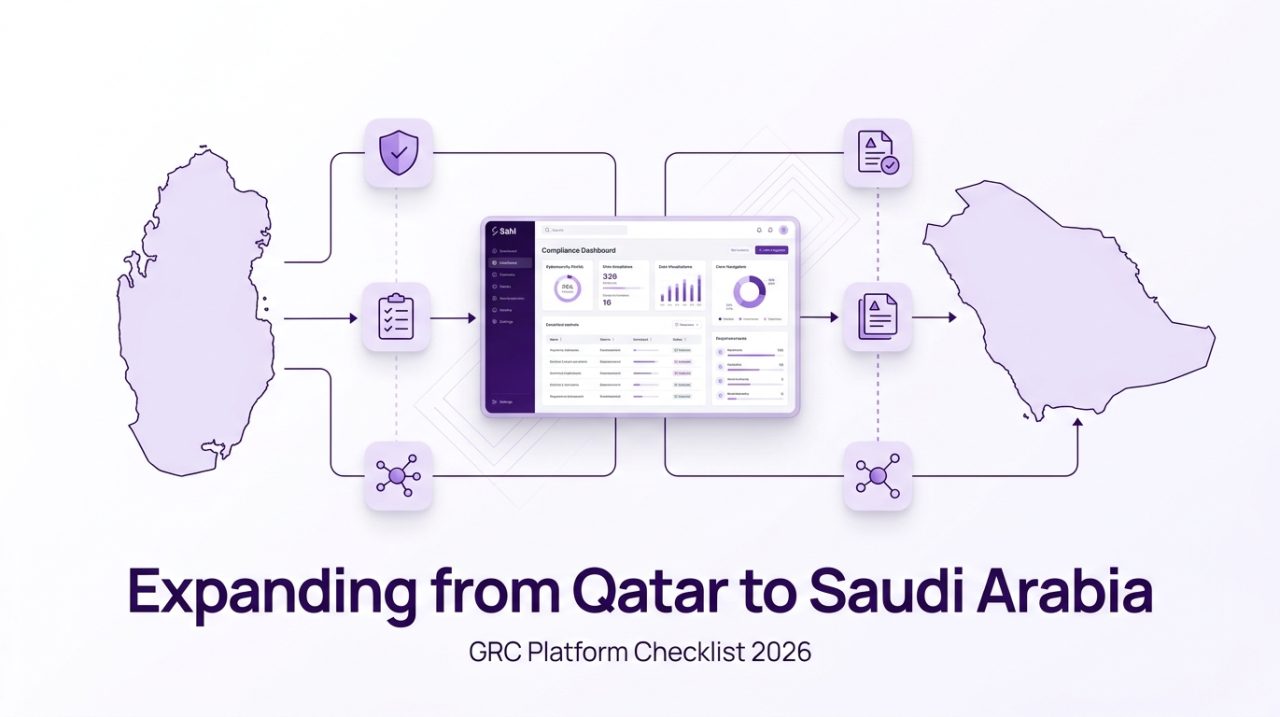
Expanding into Saudi Arabia from Qatar means evaluating a new set of cybersecurity, privacy, and sector-specific requirements. Your existing Governance, Risk, and Compliance (GRC) program may provide a strong foundation, but it should be assessed against the Saudi requirements applicable to your business.
This checklist explains how to evaluate your current GRC platform, identify compliance gaps, and reuse existing controls and evidence where appropriate.
The Short Answer
If your organization manages compliance in Qatar and plans to enter Saudi Arabia, assess the applicability of the National Cybersecurity Authority’s Essential Cybersecurity Controls (NCA ECC), Saudi Arabia’s Personal Data Protection Law (PDPL), and the Saudi Central Bank’s Cyber Security Framework (SAMA CSF) if you operate within its regulated scope.
The objective is to extend your existing compliance program rather than rebuild it from scratch. Many security controls and supporting documents may be reusable, but they must be mapped to the specific requirements applicable in Saudi Arabia.
This guide is for general informational purposes. Confirm your organization’s regulatory obligations with the relevant authorities or qualified legal counsel.
Step 1: Determine Which Saudi Compliance Requirements Apply
Before selecting or changing a GRC platform, establish which regulations, frameworks, and contractual obligations apply to your organization.
Use this checklist to start your assessment:
- NCA ECC: Determine whether your organization falls within the scope of the applicable Essential Cybersecurity Controls.
- Saudi PDPL: Assess whether your personal data processing activities trigger obligations under Saudi Arabia’s data protection law.
- SAMA CSF: Confirm whether your organization is regulated by the Saudi Central Bank and must follow its cybersecurity requirements.
- ISO 27001 and SOC 2: Identify certification, assurance, or contractual requirements imposed by customers and business partners.
- Third-party obligations: Review whether contracts, supplier relationships, or customer requirements introduce additional security controls.
- Data governance: Identify applicable data classification, residency, transfer, and governance requirements.
Not every company entering Saudi Arabia is automatically subject to every framework. Applicability depends on the organization’s activities, regulatory status, sector, and relationships with regulated entities.
Step 2: Audit Your Current GRC Platform
Your existing Qatar-focused GRC platform may support part of your Saudi compliance program. However, do not assume that existing framework coverage automatically extends to Saudi regulations.
Ask your vendor to confirm the following in writing:
- Are NCA ECC-2:2024, Saudi PDPL, and SAMA CSF supported where applicable?
- Is regulatory content maintained when frameworks or guidance change?
- Can the platform map existing controls to multiple frameworks?
- Can evidence be reused while preserving framework-specific requirements?
- Does the platform support Arabic-language workflows, policies, and reports where needed?
- Can Qatar and Saudi compliance programs be managed separately within one environment?
- What additional costs apply when adding frameworks, entities, users, or countries?
- How are framework updates, implementation support, and onboarding handled?
If the vendor cannot clearly explain framework coverage, update processes, and pricing, compare its capabilities with other GRC platforms before committing to an expansion plan.
Step 3: Map Existing Controls to Saudi Requirements
A Qatar-based compliance program may already include controls for governance, access management, security monitoring, incident response, third-party risk, and business continuity.
These controls can provide a starting point for your Saudi compliance assessment.
However, similar control objectives do not guarantee that a control satisfies every requirement under NCA ECC or another Saudi framework.
Create a control mapping that records:
- Existing control: The policy, process, or technical safeguard already implemented.
- Saudi requirement: The specific applicable regulatory control or obligation.
- Evidence: The documentation or technical records demonstrating implementation.
- Gap: Any missing, incomplete, or insufficient requirement.
- Owner: The person responsible for remediation.
- Status: The current implementation and review status.
Also assess requirements that may need additional attention, including cybersecurity role responsibilities, third-party arrangements, data governance, and applicable localization or transfer requirements.
Where data governance requirements are relevant, consult the applicable Saudi regulations and guidance, including those issued by the National Data Management Office where appropriate. Do not assume that every organization has the same localization obligations.
Step 4: Manage Qatar and Saudi Privacy Requirements Separately
Qatar’s Personal Data Privacy Protection Law (PDPPL) and Saudi Arabia’s PDPL share broad privacy objectives, but their legal requirements are not identical.
A privacy program developed for Qatar should therefore be reviewed against the Saudi requirements applicable to your organization.
Use this checklist:
- Identify personal data collected, processed, stored, and transferred in Saudi Arabia.
- Review the applicable legal grounds for processing and consent requirements.
- Document relevant data subject rights and request-handling procedures.
- Review privacy notices, records, retention practices, and accountability measures.
- Assess personal data breach response and notification obligations.
- Evaluate cross-border data transfers against the applicable requirements.
- Assign clear responsibility for Saudi privacy compliance.
A centralized privacy management process can help coordinate both countries’ programs, provided it preserves country-specific legal requirements and accountability.
Step 5: Plan Evidence Reuse
One of the biggest opportunities when expanding into Saudi Arabia is reducing unnecessary duplication of compliance work.
For example, an existing access control policy or incident response procedure may support requirements across more than one framework. However, the evidence must be reviewed to ensure that it meets each requirement’s scope, frequency, and documentation expectations.
A practical evidence management process should:
- Maintain a central evidence repository.
- Assign an owner to each evidence item.
- Record collection dates and review schedules.
- Map evidence to each applicable control.
- Track missing, expired, or incomplete evidence.
- Preserve separate assessment results where frameworks require different validation.
The aim is to collect evidence efficiently without assuming that one document automatically proves compliance with every mapped requirement.
Step 6: Choose the Right GRC Platform Approach
The best approach depends on your existing platform’s capabilities, your regulatory obligations, and the complexity of your expansion.
| Approach | When it makes sense |
|---|---|
| Extend your current platform | It supports the applicable Saudi frameworks, evidence mapping, and required workflows at an acceptable cost |
| Add a Saudi-focused platform | Your current tool lacks the Saudi regulatory content or capabilities you need |
| Consolidate on a multi-country platform | You want centralized governance, shared evidence, and coordinated compliance reporting across jurisdictions |
Before making a decision, compare framework coverage, regulatory update processes, Arabic-language capabilities, integration options, implementation effort, and total cost.
A platform’s marketing claims should be validated against the specific controls and workflows your organization needs.
Where Sahl Fits
Sahl is an AI-powered GRC platform built for Saudi Arabia and the wider GCC.
Its supported compliance capabilities include frameworks such as NCA ECC, SAMA CSF, PDPL, ISO 27001, and SOC 2. Organizations can explore how cross-framework mapping and centralized evidence management may help coordinate compliance activities.
Sahl also offers AI-assisted compliance workflows, an AI DPO assistant, and a built-in DAST scanner.
For organizations expanding from Qatar, the important step is to confirm which Saudi requirements apply and whether the platform’s current capabilities cover those requirements. Qatar-specific NIA and PDPPL coverage should be confirmed with the Sahl team rather than assumed.
The right GRC solution should help your organization identify gaps, organize evidence, assign responsibilities, and monitor remediation without sacrificing jurisdiction-specific oversight.
Book a demo with Sahl to explore GRC workflows for your Saudi compliance requirements.
Frequently Asked Questions
Start by assessing whether NCA ECC, Saudi PDPL, SAMA CSF, and relevant sector-specific or contractual requirements apply. The exact obligations depend on your activities, regulatory status, and business relationships.
It can if it supports the relevant Saudi frameworks and the workflows your organization requires. Confirm the exact framework editions, mapping coverage, update process, evidence management capabilities, and pricing with the vendor.
Not necessarily. Existing controls, policies, and evidence may be reusable. Map them to applicable Saudi requirements, validate their adequacy, and remediate gaps rather than assuming that the Qatar program automatically satisfies Saudi obligations.
Prioritize applicable Saudi framework coverage, maintained regulatory content, cross-framework mapping, evidence reuse, Arabic-language capabilities where required, clear reporting, and transparent pricing.
No. A GRC platform can help organize compliance work, monitor controls, and document evidence, but it does not independently guarantee compliance. Organizations remain responsible for interpreting and implementing applicable requirements.
Conclusion
Expanding from Qatar to Saudi Arabia does not necessarily mean starting your compliance program over. It means understanding the new requirements, assessing your current controls, and identifying where additional work is needed.
Use this checklist to evaluate your GRC platform, map existing evidence to applicable Saudi frameworks, manage privacy obligations carefully, and compare solutions based on verified capabilities.
A well-managed GRC program can reduce duplicated effort and provide a clearer view of compliance across both markets as your organization grows.

