


Qatar NIA vs Saudi NCA ECC & PDPL: GCC Guide 2026
The Short Answer
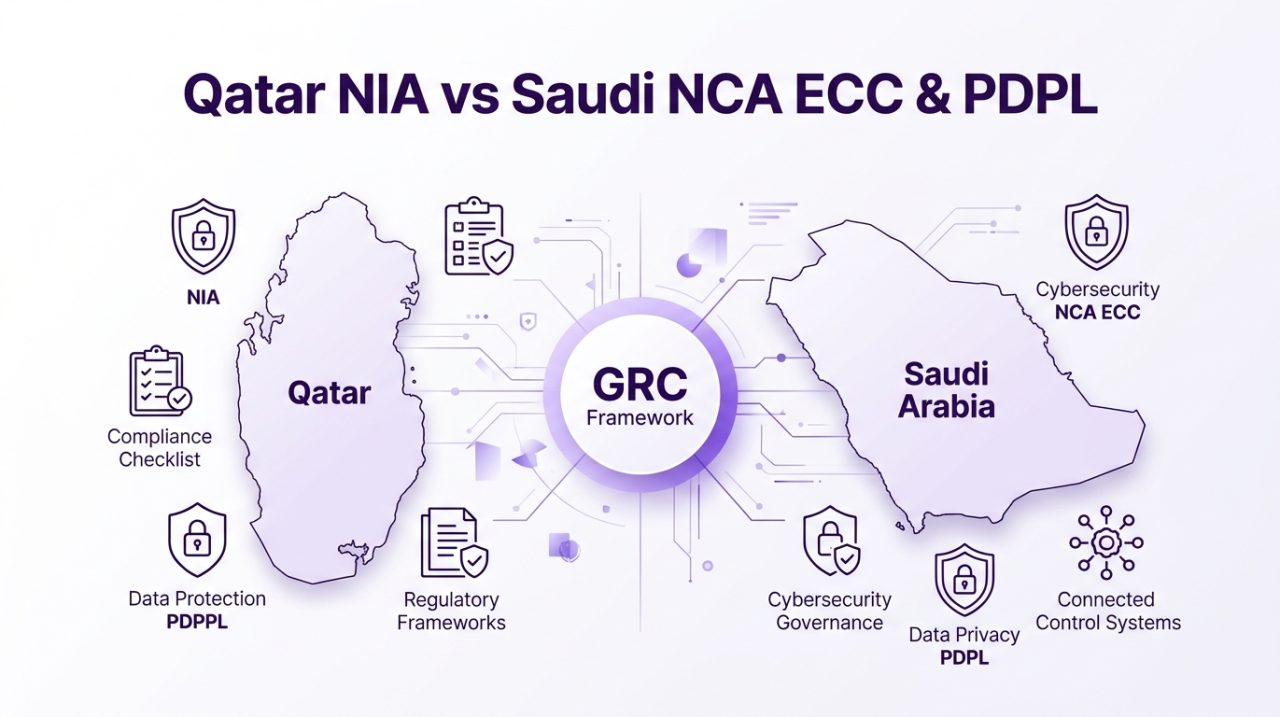
Qatar and Saudi Arabia have separate cybersecurity and data protection requirements. Qatar’s National Information Assurance (NIA) Policy provides a cybersecurity controls framework, while its Personal Data Privacy Protection Law (PDPPL) governs personal data protection. In Saudi Arabia, the National Cybersecurity Authority’s Essential Cybersecurity Controls (NCA ECC) establish cybersecurity requirements, while the Personal Data Protection Law (PDPL) governs personal data processing.
Although these frameworks share objectives such as risk management, security controls, and accountability, they differ in regulatory authority, scope, and implementation requirements.
For organizations operating across both markets, understanding these differences is essential. A shared Governance, Risk, and Compliance (GRC) program can help teams map overlapping controls, organize evidence, and track country-specific obligations without treating the two regulatory environments as interchangeable.
This guide provides a general overview. Confirm applicable requirements and current regulatory editions with the relevant authorities or qualified legal counsel.
Side-by-Side Overview: Qatar vs Saudi Arabia
| Area | Qatar | Saudi Arabia |
|---|---|---|
| Cybersecurity framework | National Information Assurance (NIA) Policy | Essential Cybersecurity Controls (ECC-2:2024) |
| Cybersecurity regulator | National Cyber Security Agency (NCSA) | National Cybersecurity Authority (NCA) |
| Data protection law | Law No. 13 of 2016 — PDPPL | Personal Data Protection Law (PDPL) |
| Privacy oversight | NCSA has cybersecurity and information assurance responsibilities; confirm the applicable privacy authority and guidance | Saudi Data and Artificial Intelligence Authority (SDAIA), with relevant implementation responsibilities under the applicable regulations |
| Cybersecurity scope | Depends on the applicable NIA requirements, organizational classification, and relationship with government or critical information infrastructure | Applies to government entities and relevant private entities that own, operate, or host Critical National Infrastructure, according to applicable ECC requirements |
| Sector-specific requirements | Qatar Central Bank requirements for applicable financial institutions | Saudi Central Bank (SAMA) requirements for regulated financial institutions |
| Compliance approach | Applicable NIA controls, assessments, and assurance requirements | Applicable ECC controls, assessments, and regulatory requirements |
The precise obligations for an organization depend on its sector, activities, data, regulatory status, and contractual relationships.
Qatar in Brief
1. National Information Assurance (NIA) Policy
Qatar’s National Information Assurance Policy provides a structured approach to information security and assurance. It addresses security governance, risk management, and organizational controls.
The National Cyber Security Agency oversees national cybersecurity initiatives and relevant information assurance requirements. Depending on the applicable requirements, government entities, their service providers, and organizations supporting critical information infrastructure may need to demonstrate alignment with the relevant controls.
Organizations should verify the applicable NIA version, assessment process, and certification or assurance requirements before defining their compliance program.
2. Personal Data Privacy Protection Law (PDPPL)
Qatar’s PDPPL is established under Law No. 13 of 2016. It sets requirements for protecting personal data processed electronically, subject to the law’s scope and exceptions.
Key considerations include:
- Lawful processing and consent: Determine the applicable legal basis and consent requirements for personal data processing.
- Data security: Implement appropriate safeguards to protect personal information.
- Individual rights: Establish processes for handling applicable data subject requests.
- Data transfers: Review relevant requirements before transferring personal data outside Qatar.
- Governance and accountability: Maintain suitable policies, procedures, and records to demonstrate compliance.
Organizations operating within the Qatar Financial Centre should assess the separate data protection regime that may apply to them.
Saudi Arabia in Brief
1. NCA Essential Cybersecurity Controls (ECC-2:2024)
Saudi Arabia’s Essential Cybersecurity Controls provide a national baseline for cybersecurity. ECC-2:2024 updates the earlier ECC-1:2018 edition.
The framework is organized around four main domains:
- Cybersecurity Governance
- Cybersecurity Defense
- Cybersecurity Resilience
- Third-Party and Cloud Computing Cybersecurity
Applicable organizations must identify relevant controls, assess implementation, address gaps, and maintain appropriate evidence.
Read our NCA ECC-2:2024 guide for a closer look at the updated framework.
2. Saudi Personal Data Protection Law (PDPL)
Saudi Arabia’s PDPL establishes requirements for processing personal data. Organizations must evaluate their responsibilities according to the law, its implementing regulations, and any applicable sector-specific rules.
Key compliance considerations include:
- Identifying lawful grounds for processing personal data.
- Providing required privacy information and handling data subject rights.
- Implementing appropriate technical and organizational safeguards.
- Assessing personal data breach notification obligations.
- Reviewing international data transfers and applicable restrictions.
- Maintaining records and governance processes that support accountability.
Read our Saudi PDPL compliance guide for more details.
3. SAMA Cyber Security Framework
Financial institutions regulated by the Saudi Central Bank may also need to comply with the SAMA Cyber Security Framework.
This creates an additional layer of cybersecurity obligations beyond the general requirements applicable to an organization. Teams should map the relevant SAMA controls alongside ECC and applicable data protection requirements.
Where Qatar NIA and Saudi NCA ECC Overlap
Although Qatar NIA and Saudi NCA ECC are separate frameworks, they address several common cybersecurity objectives.
Governance and risk management: Both support structured security governance, risk assessment, and accountability.
Access control: Organizations need appropriate mechanisms to manage access to systems, applications, and sensitive information.
Monitoring and incident response: Security monitoring, incident handling, and response procedures are important elements of an effective cybersecurity program.
Third-party security: Organizations need to understand and manage risks arising from suppliers, service providers, and other external relationships.
Business continuity and resilience: Appropriate preparedness and recovery measures help organizations maintain critical operations during disruptions.
The precise controls and evidence requirements differ. Similar objectives do not mean that one framework automatically satisfies the other.
For multi-country organizations, a common control library can provide a practical starting point. Each shared control should be mapped to the specific requirements of Qatar and Saudi Arabia, with separate records of applicability, implementation, and evidence where necessary.
Where the Requirements Differ
1. Regulatory Authorities and Assurance Processes
Qatar and Saudi Arabia have different regulatory structures. Organizations must identify the authority responsible for each applicable obligation and follow the relevant assessment, reporting, and assurance procedures.
Evidence accepted for one framework should not automatically be assumed sufficient for another.
2. Scope and Applicability
An organization’s obligations depend on the relevant framework’s scope, its sector, and its relationship with regulated entities or critical infrastructure.
A company operating in both countries should assess applicability separately for each legal entity, service, and business activity.
3. Data Protection and Cross-Border Transfers
Qatar’s PDPPL and Saudi Arabia’s PDPL have distinct legal requirements. Organizations should review their respective rules on processing, individual rights, security, retention, and international transfers rather than adopting a single regional privacy policy without country-specific analysis.
4. Sector-Specific Requirements
Financial institutions and other regulated sectors may have additional obligations. Qatar Central Bank requirements and SAMA’s Cyber Security Framework illustrate why a general national framework may not be the only relevant source of cybersecurity controls.
5. Documentation and Evidence
Both environments require organizations to demonstrate appropriate governance and security practices, but documentation formats, assessment expectations, and reporting processes can differ.
A centralized evidence repository can help teams reuse relevant records while preserving the traceability required by each framework.
How to Manage Qatar and Saudi Compliance Without Duplicating Work
Organizations operating across the GCC can simplify compliance operations through a structured, risk-based approach.
Step 1: Build a Unified Control Library
Create a central inventory of cybersecurity, privacy, and governance controls. Map each applicable Qatar NIA, Qatar PDPPL, Saudi NCA ECC, and Saudi PDPL requirement to the relevant internal control.
Record the source, version, owner, applicability, and evidence requirements for every mapping.
Step 2: Reuse Evidence Where Appropriate
Security policies, risk assessments, access reviews, incident response records, and supplier assessments may support multiple requirements.
Collect evidence once where practical, but validate that it satisfies the specific scope, period, and documentation requirements of each applicable framework.
Step 3: Assign Country-Specific Owners
Give clear responsibility for regulatory interpretation, compliance monitoring, evidence collection, and remediation.
A central GRC team can coordinate the program, while local or sector-specific owners manage obligations that require country-level expertise.
Step 4: Track Regulatory Changes
Maintain a regulatory register that records framework editions, updates, deadlines, and internal actions.
For example, Saudi organizations should account for the transition from ECC-1:2018 to ECC-2:2024 where the updated edition applies. Qatar requirements should likewise be checked against the currently applicable NIA documents and guidance.
Step 5: Monitor Compliance Continuously
Schedule control reviews, track remediation tasks, and monitor overdue evidence. Regular monitoring makes it easier to identify gaps before an assessment or audit.
Where Sahl Fits Into a GCC Compliance Program
Sahl is an AI-powered GRC platform designed for Saudi Arabia and the wider GCC. It supports compliance workflows for frameworks including NCA ECC, SAMA CSF, and PDPL.
For organizations managing multiple regulatory requirements, a GRC platform can help centralize control mapping, organize compliance evidence, track remediation, and improve visibility into risk.
Sahl’s capabilities include AI-assisted compliance workflows, cross-framework mapping, an AI DPO assistant, and a built-in DAST scanner.
Organizations considering Sahl for a Qatar-Saudi compliance program should confirm the platform’s current coverage of Qatar NIA and PDPPL requirements with the Sahl team. Qatar-specific requirements should not be assumed to be pre-mapped unless that coverage has been verified.
The goal is to build a coordinated compliance program that reduces unnecessary duplication while preserving country-specific accountability.
Book a demo with Sahl to explore compliance workflows for your Saudi regulatory obligations.
Frequently Asked Questions
Qatar’s National Information Assurance Policy is a cybersecurity controls framework that supports information security governance and assurance. Organizations should verify which requirements apply to their operations and regulatory status.
Qatar’s Personal Data Privacy Protection Law is established under Law No. 13 of 2016. It governs relevant personal data processing and establishes privacy and data protection obligations, subject to its scope and exceptions.
No. Both address national cybersecurity objectives, but they belong to different jurisdictions and have different regulators, scopes, and implementation requirements.
Both laws address personal data protection, but their legal requirements and regulatory arrangements differ. Organizations operating in both countries should assess each law separately, including applicable requirements for processing, individual rights, security, and cross-border transfers.
It may need to comply with requirements in both jurisdictions, depending on its activities, legal entities, sector, data processing, contractual obligations, and regulatory status. Applicability should be assessed individually for each framework.
A GRC platform can help centralize control mapping, evidence, ownership, and remediation across multiple frameworks. However, organizations must verify that the platform supports the specific requirements they need and retain country-specific compliance assessments.
Conclusion
Qatar NIA and PDPPL and Saudi NCA ECC and PDPL share broad goals around cybersecurity, risk management, and personal data protection, but they are not interchangeable.
Organizations operating across both markets should identify applicable requirements separately, map overlapping controls, reuse evidence where appropriate, and maintain country-specific regulatory oversight.
With a well-structured GRC program, teams can reduce duplicated effort, improve compliance visibility, and respond more effectively to changing requirements across the GCC.

