



PDPL vs GDPR: Key Differences Explained (2026 Comparison Guide)
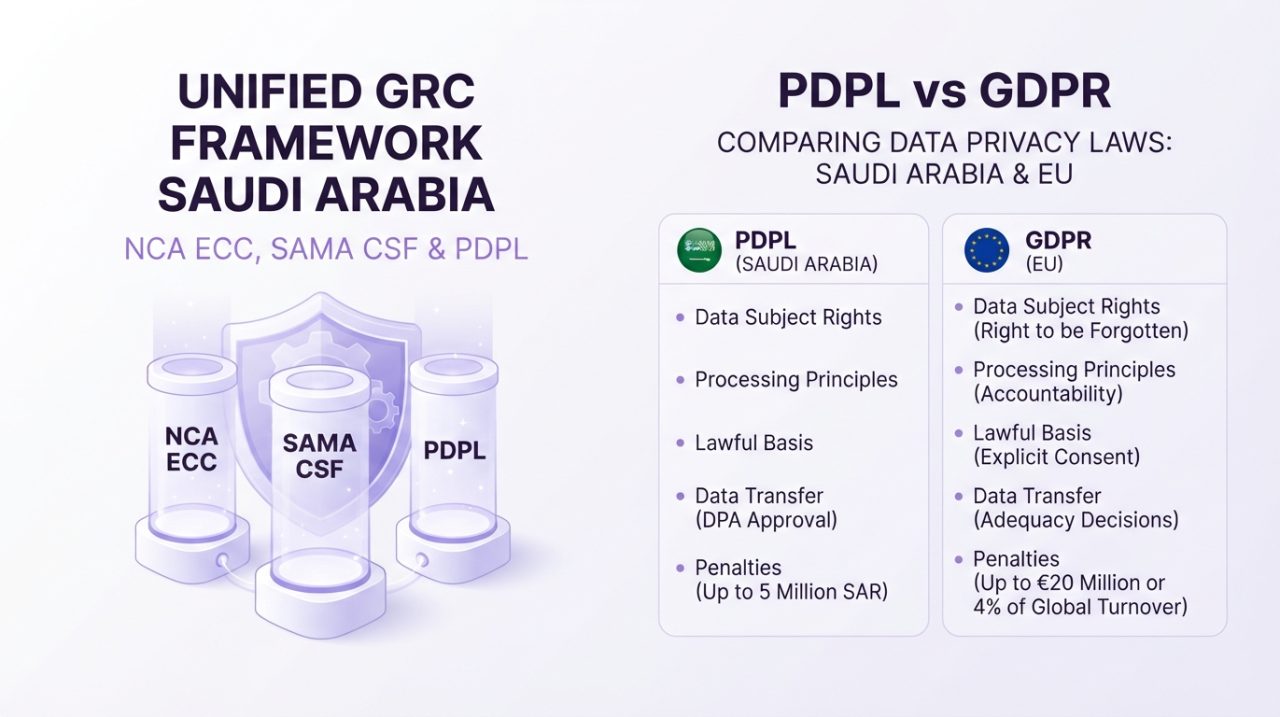
For multinational companies operating in both the European Union and Saudi Arabia, one question comes up frequently:
“We’re already GDPR compliant. Doesn’t that cover PDPL too?”
The short answer is no.
Saudi Arabia’s Personal Data Protection Law (PDPL) and the European Union’s General Data Protection Regulation (GDPR) share several foundational concepts. Both are principles-based privacy frameworks that address lawful processing, data subject rights, accountability, and organizational responsibilities.
However, they are separate legal frameworks with important differences in territorial scope, lawful bases, international data transfers, penalties, recordkeeping, and other compliance requirements.
For organizations operating across both jurisdictions, understanding these differences is essential. GDPR compliance can provide a strong foundation for a PDPL program, but it does not automatically satisfy PDPL requirements.
Quick Comparison: PDPL vs GDPR
| Category | PDPL (Saudi Arabia) | GDPR (European Union) |
|---|---|---|
| Regulator | Saudi Data & Artificial Intelligence Authority (SDAIA) | National data protection authorities in EU member states |
| Territorial scope | Can apply to processing personal data related to individuals in Saudi Arabia, including processing by entities outside the Kingdom in circumstances covered by the law | Applies to organizations established in the EU and certain organizations outside the EU that offer goods or services to, or monitor the behavior of, individuals in the EU |
| Lawful bases | Consent is an important legal basis, alongside other bases provided by the PDPL and its implementing framework | Six lawful bases, including consent, contract, legal obligation, vital interests, public task, and legitimate interests |
| Cross-border transfers | Subject to specific PDPL requirements and safeguards for transfers outside Saudi Arabia | Uses mechanisms such as adequacy decisions, Standard Contractual Clauses, and Binding Corporate Rules |
| Maximum administrative fine | Up to SAR 5 million for certain violations, with the possibility of doubling for repeat violations | Up to €20 million or 4% of worldwide annual turnover, whichever is higher, for the most serious infringements |
| Criminal liability | Certain intentional violations involving sensitive data can carry criminal penalties, including imprisonment | GDPR itself establishes administrative fines and other corrective powers; criminal sanctions may arise separately under member-state law |
| Records of processing | Controllers may be required to maintain records and documentation under the PDPL framework | Records of processing activities can be required for controllers and processors under Article 30 |
| Sensitive/special data | Provides specific protections for sensitive personal data, with categories and requirements defined under Saudi law | Defines special categories of personal data, including health, religious beliefs, biometric and genetic data, among others |
| DPO requirement | Certain controllers are required to appoint a personal data protection officer depending on applicable PDPL criteria | Required in specified circumstances, including public authorities and certain large-scale monitoring or special-category processing |
Note: Privacy requirements can change through regulations, guidance, and regulatory decisions. Organizations should verify current requirements against official Saudi and EU sources before finalizing their compliance programs.
Where PDPL and GDPR Align
PDPL and GDPR are not identical, but they share several important concepts.
Both frameworks are built around principles such as:
- Lawful and fair processing
- Purpose limitation
- Data minimization
- Transparency
- Data subject rights
- Accountability
- Controller and processor responsibilities
- Security and protection of personal data
- Rules governing personal data breaches
- Restrictions or exemptions for purely personal or household activities
Both frameworks also give individuals rights concerning their personal data, although the exact scope, terminology, procedures, and timelines can differ.
This overlap is one reason organizations familiar with GDPR may find PDPL conceptually recognizable. However, similar concepts do not mean identical obligations.
Where PDPL and GDPR Differ
1. Territorial Scope
One of the first questions for a multinational organization is whether the law applies to its processing activities.
The GDPR has specific rules for organizations outside the European Economic Area. In particular, Article 3 can apply the GDPR to organizations outside the EU when they offer goods or services to individuals in the EU or monitor their behavior where the relevant GDPR conditions are met.
PDPL has its own territorial rules. Its application can extend to processing personal data related to individuals in Saudi Arabia, including certain processing carried out by entities outside the Kingdom.
This means organizations should conduct a separate territorial-scope assessment under each framework rather than assuming that the GDPR’s extraterritoriality test is equivalent to PDPL.
2. Cross-Border Data Transfers
International data transfers are one of the most important areas for organizations subject to both frameworks.
Under the GDPR, organizations can use established mechanisms such as:
- Adequacy decisions
- Standard Contractual Clauses (SCCs)
- Binding Corporate Rules (BCRs)
- Certain permitted derogations
PDPL has its own requirements for transferring personal data outside Saudi Arabia. Organizations must assess the applicable conditions, safeguards, and restrictions under the Saudi framework.
A GDPR transfer mechanism should therefore not be assumed to satisfy PDPL automatically.
For multinational groups, this can require separate transfer assessments, contractual arrangements, documentation, and governance processes for Saudi-related data flows.
3. Lawful Basis and Consent
Both frameworks recognize consent as a possible basis for processing personal data, but their legal structures are not identical.
The GDPR provides six lawful bases:
- Consent
- Contract
- Legal obligation
- Vital interests
- Public task
- Legitimate interests
Organizations must select the lawful basis that actually applies to each processing activity.
PDPL also provides multiple legal grounds for processing, with consent playing an important role in many processing scenarios. However, organizations should assess the specific PDPL conditions rather than simply transferring their GDPR lawful-basis analysis into the Saudi context.
In particular, sensitive personal data can be subject to additional restrictions and requirements.
4. Penalties and Enforcement
The financial penalty structures are significantly different.
Under the GDPR, the highest tier of administrative fines can reach €20 million or 4% of an organization’s total worldwide annual turnover for the preceding financial year, whichever is higher.
PDPL provides for administrative fines that can reach SAR 5 million for certain violations, with the possibility of doubling the applicable fine for repeat violations.
PDPL also contains criminal provisions for certain serious violations involving the disclosure of sensitive personal data in specified circumstances.
For multinational organizations, this means the consequences of non-compliance need to be assessed separately under each legal framework.
5. Records and Accountability
Both GDPR and PDPL place significant emphasis on accountability and documentation.
Under GDPR Article 30, certain controllers and processors must maintain records of processing activities.
PDPL also requires organizations to maintain appropriate records and documentation in circumstances specified by the law and its implementing framework.
Even where the underlying documentation looks similar, the legal requirements are not necessarily identical.
A multinational organization should therefore map its existing GDPR records against PDPL requirements instead of assuming that a GDPR Record of Processing Activities (RoPA) automatically satisfies every Saudi requirement.
6. Sensitive and Special Categories of Data
GDPR uses the concept of special categories of personal data, including information relating to areas such as health, racial or ethnic origin, religious or philosophical beliefs, genetic data, and biometric data when used for identification.
PDPL separately defines and protects sensitive personal data under Saudi law.
The definitions and treatment of sensitive data should therefore be reviewed independently.
This is particularly important for organizations processing employee information, health information, financial information, identity information, or other categories that may trigger additional obligations under Saudi requirements.
7. Data Protection Officer Requirements
Both frameworks can require organizations to appoint a Data Protection Officer or equivalent privacy function in specific circumstances.
Under GDPR, a DPO is mandatory in situations such as:
- Processing carried out by a public authority or body, except courts acting in their judicial capacity
- Large-scale regular and systematic monitoring of individuals
- Large-scale processing of special categories of personal data or certain criminal-conviction data
PDPL also provides for the appointment of a personal data protection officer in specified circumstances.
The criteria are not identical, so an organization should perform a separate DPO assessment for each framework.
Does GDPR Compliance Automatically Satisfy PDPL?
No.
GDPR compliance does not automatically make an organization compliant with PDPL, just as PDPL compliance does not automatically make an organization GDPR compliant.
However, an established GDPR privacy program can provide useful infrastructure for a PDPL compliance program.
For example, organizations may already have:
- Data inventories
- Privacy notices
- Consent management processes
- Data subject request procedures
- Vendor and processor assessments
- Data breach response procedures
- Records of processing activities
- Privacy policies
- Security controls
- Data transfer assessments
These existing controls can be mapped against PDPL requirements.
The key is to identify the gaps and Saudi-specific requirements rather than treating GDPR compliance as a substitute for PDPL compliance.
Building One Privacy Program for Both Frameworks
For multinational organizations, the practical approach is usually not to create two completely separate privacy programs.
Instead, organizations can establish a unified privacy governance framework and map individual controls against the requirements of both PDPL and GDPR.
A practical approach can include:
Step 1: Map Your Data
Identify what personal data your organization collects, where it comes from, where it is stored, who has access to it, and where it is transferred.
Step 2: Determine Applicable Laws
Assess which processing activities fall within PDPL, GDPR, or both.
Step 3: Map Legal Bases
Document the applicable legal basis for each processing activity under each relevant framework.
Step 4: Review International Transfers
Identify data flows leaving Saudi Arabia or the EU and determine which transfer requirements and safeguards apply.
Step 5: Compare Data Subject Rights
Map existing GDPR rights processes against the corresponding PDPL requirements and identify differences in scope, procedures, and response requirements.
Step 6: Review Vendor Contracts
Assess processor and service-provider agreements to ensure they address the contractual requirements applicable under each framework.
Step 7: Maintain Evidence
Keep policies, assessments, approvals, records, contracts, training records, and other compliance evidence organized so the organization can demonstrate accountability under both regimes.
How Sahl Supports Multi-Jurisdiction Compliance
Sahl helps organizations manage PDPL compliance alongside broader privacy and compliance requirements through a unified approach.
Key capabilities include:
- PDPL-native control mapping that does not assume GDPR equivalence
- Cross-border transfer tracking aligned with PDPL requirements
- Consent management and privacy governance workflows
- Unified evidence collection for compliance documentation
- Control mapping across multiple regulatory frameworks
See how Sahl handles PDPL alongside GDPR →
Frequently Asked Questions
PDPL shares several concepts with GDPR, including principles-based privacy governance, data subject rights, lawful processing, accountability, and data protection obligations. However, PDPL is a separate Saudi legal framework with its own scope, requirements, enforcement mechanisms, and regulatory guidance. Organizations should not treat PDPL as a Saudi version of GDPR or assume that GDPR compliance automatically satisfies PDPL.
No. GDPR compliance can provide a useful foundation, but it does not automatically satisfy PDPL. Organizations operating under both frameworks should separately assess PDPL requirements, particularly in areas such as international data transfers, sensitive personal data, lawful processing, documentation, and Saudi-specific regulatory requirements.
The maximum administrative fines under GDPR can be substantially higher for large organizations because the highest tier can reach €20 million or 4% of worldwide annual turnover, whichever is higher. PDPL provides for fines of up to SAR 5 million for certain violations, with the possibility of doubling for repeat violations. PDPL also contains criminal provisions for certain serious violations involving sensitive personal data.
Possibly. Both frameworks provide for DPO or personal data protection officer requirements in specified circumstances, but the criteria are not identical. Organizations subject to both frameworks should conduct a separate assessment under each law to determine whether an appointment is required.
Not automatically. GDPR mechanisms such as adequacy decisions, Standard Contractual Clauses, and Binding Corporate Rules operate within the GDPR framework. PDPL has separate requirements governing transfers of personal data outside Saudi Arabia. Organizations should assess each Saudi data transfer independently and confirm that the applicable PDPL requirements and safeguards are satisfied.
There is no single answer because the two frameworks regulate different aspects of privacy in different ways. GDPR has a different approach to areas such as lawful bases, international transfers, territorial scope, and administrative fines, while PDPL has its own requirements and enforcement mechanisms. Organizations should compare the specific processing activity and obligation rather than treating one framework as universally stricter than the other.
A GDPR data map can provide a strong starting point, but it should be reviewed against PDPL requirements. Organizations should confirm that the data categories, processing purposes, legal bases, retention practices, transfers, vendors, and sensitive-data classifications captured in the GDPR data map also address the applicable Saudi requirements.
Ready to Build One Compliance Program for Both?
Stop managing PDPL and GDPR as disconnected compliance efforts.
Sahl helps organizations map controls across both frameworks from a unified source of truth.
Unify your PDPL and GDPR compliance with Sahl →

