


GRC Platform Scorecard & RFP Questions for KSA (2026) | Sahl
The Short Answer
The best GRC platform in KSA is the one that scores highest against your organization’s weighted evaluation criteria and performs well when tested using your own controls and evidence.
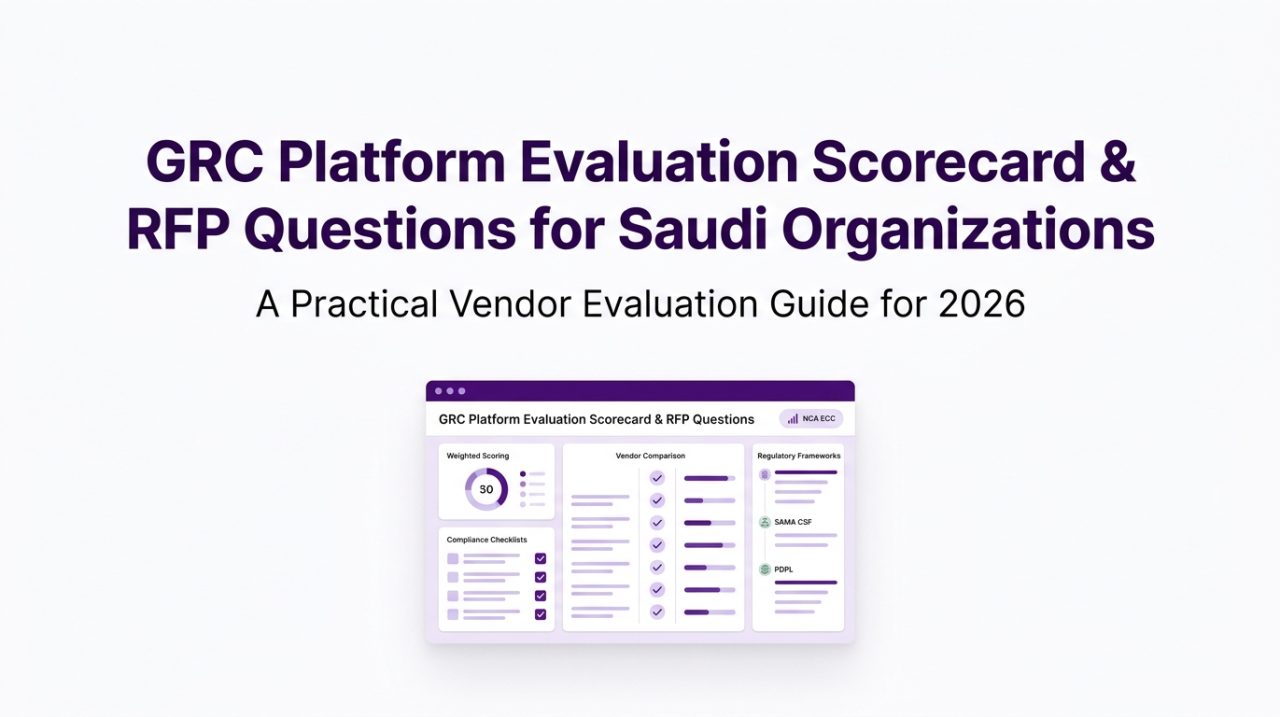
Selecting a GRC platform requires more than comparing feature lists. Saudi organizations should evaluate regulatory framework coverage, evidence automation, AI capabilities, security, implementation effort, and total cost of ownership.
This GRC platform evaluation scorecard provides ten weighted criteria and 20 RFP questions to help compliance leaders compare vendors consistently.
Platforms with pre-mapped Saudi frameworks, cross-framework evidence mapping, and streamlined onboarding, such as Sahl, may be particularly relevant to organizations managing NCA ECC-2:2024, SAMA CSF, and PDPL requirements.
How to Use This GRC Platform Evaluation Scorecard
Follow these four steps to evaluate vendors fairly.
- Adjust the weights: Modify the suggested weightings to reflect your organization’s priorities. Ensure the final weights total 100.
- Score each vendor: Assign a score from 0 to 5 based on a live demonstration using your own controls, evidence, and requirements.
- Calculate the weighted score: Multiply each criterion’s weight by the vendor’s score divided by 5. Add the results to calculate the total score out of 100.
- Compare total cost: Use three-year total cost of ownership to help break ties between vendors with similar scores.
Vendor Scoring Scale
| Score | Evaluation |
|---|---|
| 0 | Capability not available |
| 1 | Major gaps; requires substantial manual work |
| 2 | Limited capability; significant configuration required |
| 3 | Meets basic requirements |
| 4 | Strong capability with minor limitations |
| 5 | Fully meets requirements, demonstrated with your own controls |
Weighted Score Formula:
Weighted score = (Vendor score ÷ 5) × Criterion weight
For example, if a vendor scores 4 out of 5 on a criterion weighted at 20%, the weighted score is 16 points.
The Weighted GRC Platform Evaluation Scorecard
Use the following scorecard to compare shortlisted GRC platforms for Saudi Arabia.
| # | Evaluation Criterion | Weight | What a Score of 5 Looks Like | How Sahl Answers |
|---|---|---|---|---|
| 1 | Saudi framework coverage | 20 | NCA ECC-2:2024, SAMA CSF, and PDPL available as maintained framework content | Pre-mapped frameworks |
| 2 | Evidence automation | 12 | Automated evidence collection with freshness alerts | Continuous evidence collection |
| 3 | Cross-framework mapping | 10 | Shared evidence mapped to relevant controls across frameworks | Cross-framework mapping |
| 4 | Time to value | 10 | Initial useful control mapping achievable within days | Streamlined onboarding |
| 5 | AI capabilities | 10 | AI grounded in relevant data, with traceable sources and human review | AI DPO assistant |
| 6 | Control-level visibility | 8 | Owners, status, policies, and evidence accessible centrally | Compliance dashboards |
| 7 | Audit reporting | 8 | Evidence exports with dates and review history | Audit-ready exports |
| 8 | Security testing | 6 | Vulnerability scanning available within the platform or through integration | Built-in DAST scanner |
| 9 | Arabic and local support | 6 | Arabic-language capabilities and appropriate support availability | Arabic-language support |
| 10 | Pricing transparency | 10 | Written all-in quote with clear renewal and additional scope terms | Pricing available upon request |
| Total | 100 |
What to Verify During the Vendor Demo
The scorecard is only useful if vendors demonstrate their capabilities.
Ask each vendor to:
- Show the exact NCA ECC edition included in the platform.
- Map one of your controls to the relevant regulatory requirements.
- Demonstrate evidence collection and freshness monitoring.
- Explain how shared evidence is mapped across frameworks.
- Run an AI-assisted compliance workflow using your own data.
- Export a sample audit evidence package.
- Provide a written quote for your specific scope.
Treat unsupported claims as unverified rather than awarding full points based on marketing materials.
20 GRC RFP Questions to Send Every Vendor
A Request for Proposal (RFP) helps organizations gather consistent information from shortlisted vendors.
Use the following questions to evaluate framework coverage, automation, AI, security, implementation, and commercial terms.
Framework Coverage
1. Which NCA ECC edition does your platform currently support, and how quickly are regulatory updates incorporated?
Ask the vendor to demonstrate the exact framework version and explain its update process.
2. How does your platform track SAMA CSF maturity by domain?
Confirm that maturity assessments, evidence, and remediation activities can be tracked.
3. How are PDPL obligations modeled within the platform?
Ask about records of processing activities, data subject requests, privacy assessments, and breach handling workflows.
4. Which additional frameworks are included in the subscription, and which require separate modules or fees?
Request a complete framework inventory and pricing breakdown.
Evidence and Automation
5. Which evidence types can be collected automatically, and which systems are supported?
Request a list of available integrations and evidence types.
6. How does the platform identify stale, missing, or incomplete evidence?
Ask about refresh schedules, alerts, and evidence ownership.
7. How can one piece of evidence be mapped across multiple frameworks?
Confirm that shared evidence can support relevant controls without losing framework-specific context.
8. Can the platform export an audit-ready evidence package with timestamps, ownership, and review history?
Ask for a sample export during the demonstration.
AI Capabilities
9. Which AI capabilities are included in the subscription tier we are evaluating?
Distinguish between included features and separately priced AI modules.
10. What organizational data can the AI access, and where is that data processed?
Clarify data handling, retention, and applicable security controls.
11. Can users review and approve AI-generated outputs before implementation?
Human oversight is important for policies, control mappings, and compliance decisions.
12. How are regulatory framework updates reflected in AI-generated recommendations?
Ask how the vendor validates the accuracy and relevance of AI outputs.
Security and Operations
13. Is vulnerability scanning included in the platform, or does it require an external integration?
Confirm the scope and capabilities of any included scanning functionality.
14. How is customer data isolated, encrypted, and backed up?
Request documentation describing the platform’s security architecture.
15. Does the platform support Arabic, and what are the available customer support hours?
Verify whether Arabic support includes the interface, reports, documentation, and assistance.
Implementation and Cost
16. How many days are required to establish our first useful control mapping?
Request a written implementation timeline based on your scope.
17. Who administers the platform after go-live, and what technical skills are required?
Understand the ongoing operational burden.
18. What is the total annual price for our scope, including implementation, frameworks, integrations, and support?
Request an itemized written quote.
19. What changes when we renew, add a framework, or include another business entity?
Clarify additional licensing fees and contractual terms.
20. What are our data export rights if we decide to leave the platform?
Confirm access to policies, evidence, control mappings, risk records, and audit history.
Red Flags in GRC Vendor Responses
During the evaluation process, watch for these warning signs.
| Red Flag | Why It Matters |
|---|---|
| “We support NCA” without specifying the framework edition | Coverage may be incomplete or outdated |
| AI described only as a chatbot | The capability may not support actual compliance workflows |
| No demonstration using your controls | Vendor claims remain unverified |
| Pricing changes significantly after scope discussions | Budget predictability may be limited |
| Implementation depends on unspecified consulting services | Additional cost and delays may arise |
| No clear data export policy | Vendor lock-in may become a concern |
| No documented framework update process | Regulatory content may become outdated |
A credible vendor should be able to explain its capabilities, limitations, implementation requirements, and pricing transparently.
How to Run a Fair GRC Platform Proof of Concept
A proof of concept (POC) allows your organization to test shortlisted platforms before making a purchasing decision.
Use the same requirements and materials for every vendor.
Step 1: Select Ten Controls
Choose ten controls from your applicable frameworks. Include a mixture of governance, cybersecurity, privacy, and evidence requirements.
Step 2: Provide the Same Evidence Samples
Give every vendor identical policies, evidence files, and supporting documentation.
Step 3: Test One PDPL Scenario
Ask each platform to support a privacy-related workflow, such as identifying relevant requirements for a data subject request.
Step 4: Measure Performance
Evaluate:
- Control mapping accuracy.
- Evidence reuse.
- AI output quality.
- Manual steps required.
- Implementation effort.
- Audit export quality.
Step 5: Compare Results
Use your weighted scorecard to compare vendors. Document the evidence supporting each score and identify any limitations.
A structured POC reduces the risk of selecting a platform based solely on marketing claims.
Frequently Asked Questions
Start by identifying your regulatory scope and operational requirements. Use a weighted scorecard, test vendors with your own controls, and compare their implementation effort, evidence capabilities, and total cost of ownership.
A Saudi GRC RFP should cover applicable framework versions, evidence automation, AI behavior, security architecture, Arabic-language capabilities, implementation timelines, support, pricing, and data export rights.
Two or three finalists are generally sufficient for a meaningful proof of concept. A smaller shortlist allows your team to evaluate each platform in greater depth.
Yes. The scorecard is designed for reuse across different vendors. Adjust the weights to reflect your regulatory requirements, organization size, and compliance priorities.
A high score is useful, but you should also consider critical requirements, contractual terms, security, implementation risks, and vendor suitability before making your final decision.
Do not select a platform solely because it achieves a high overall score if it fails to meet any mandatory requirement.
Conclusion: Choose Your GRC Platform Based on Evidence
Selecting the best GRC platform in Saudi Arabia requires a structured evaluation of regulatory coverage, automation, AI capabilities, implementation effort, and commercial terms.
A weighted scorecard and consistent RFP process can help compliance leaders compare vendors objectively and make informed purchasing decisions.
For organizations managing NCA ECC-2:2024, SAMA CSF, and PDPL, pre-mapped Saudi frameworks and cross-framework evidence management can be valuable capabilities to evaluate.
Book a demo with Sahl and put the platform through your own GRC evaluation scorecard using your controls and evidence

