



SAMA CSF Software Buyer’s Guide 2026 — Best Tools for Saudi Financial Institutions
Introduction
The Saudi Central Bank (SAMA) Cyber Security Framework (CSF) is a major cybersecurity and compliance framework for Saudi Arabia’s financial sector, covering regulated institutions such as banks, insurance companies, finance companies, and eligible fintech organizations.
For compliance and risk managers, managing SAMA CSF requirements involves more than maintaining a checklist. Teams need to track controls, assess maturity, collect evidence, monitor gaps, and maintain an audit trail that supports internal reviews and regulatory expectations.
This is where spreadsheets can become difficult to manage. As the number of controls, evidence items, stakeholders, and assessment cycles grows, manual processes can create gaps in visibility and consistency.
The question is no longer simply whether software can help. The real question is:
Which platform is best suited to a SAMA-regulated financial institution rather than a generic global security framework?
This buyer’s guide explains what to look for when evaluating SAMA CSF software and how the leading options compare.
What Is SAMA CSF Compliance Software?
SAMA CSF compliance software is a platform designed to help regulated financial institutions manage cybersecurity compliance activities related to the Saudi Central Bank’s Cyber Security Framework.
Depending on the platform, it can help teams manage:
- SAMA CSF control and domain mapping
- Self-assessments
- Maturity-level assessments
- Evidence collection and retention
- Control ownership
- Gap identification
- Remediation tracking
- Audit trails
- Compliance reporting
Instead of managing these activities across multiple spreadsheets and disconnected systems, a SAMA compliance automation platform can provide a centralized view of the organization’s compliance posture.
What to Look for Before You Buy
Before comparing vendors, Saudi financial institutions should evaluate software against the following criteria.
1. Native SAMA CSF Domain Mapping
Look for software that supports the actual structure of the SAMA Cyber Security Framework rather than requiring your team to build the framework manually from a generic template.
The platform should make it easier to organize controls, domains, evidence, and responsibilities according to your SAMA CSF compliance program.
2. Maturity-Level Assessment Support
SAMA CSF assessments involve evaluating cybersecurity maturity. A platform should support structured assessment workflows and make it easier to track maturity across relevant domains and controls.
Generic pass/fail compliance tools may not provide the same level of maturity tracking without additional configuration.
3. Audit Trail and Evidence Retention
Evidence is a critical part of any compliance program.
The platform should help teams collect, organize, retain, and trace evidence back to the relevant controls and assessment activities. This can make internal reviews and audit preparation significantly easier.
4. Data Residency and Hosting Considerations
Financial institutions should understand where compliance data is hosted and processed.
Before purchasing, evaluate the vendor’s hosting architecture, regional deployment options, data handling practices, and contractual commitments based on your organization’s regulatory and security requirements.
5. Integration With Existing GRC and Risk Systems
Large financial institutions often already use multiple security, risk, audit, and governance platforms.
Consider whether the new solution can work alongside existing systems and reduce duplicate data entry across the compliance stack.
Quick Comparison: SAMA CSF Software Platforms (2026)
| Platform | Native SAMA CSF Coverage | Maturity-Level Assessment | Data Residency Options | Arabic Reporting | Best For |
|---|---|---|---|---|---|
| Sahl | Designed around SAMA CSF domains and workflows | Native maturity-focused assessment | Saudi-focused hosting options | Full Arabic + English | Banks, fintechs, insurers, and SAMA-regulated institutions |
| OneTrust GRC | Generic framework; CSF configuration may be required | Configurable | Depends on deployment and contract | Partial / configurable | Large institutions already standardized on OneTrust |
| Archer | Enterprise GRC platform; CSF implementation may require customization | Configurable | Depends on deployment | Partial / configurable | Large enterprises with dedicated GRC teams |
| Vanta / Drata | Primarily security compliance-focused; not SAMA CSF-native | Not specifically built around CSF maturity methodology | Not KSA-specific by default | Limited | Technology and fintech teams managing broader security frameworks |
| Spreadsheets / Manual Audits | Fully manual | Manual scoring | Controlled internally | Manual translation | Very small programs with limited scope |
Note: Platform capabilities, framework libraries, hosting arrangements, regional availability, integrations, and pricing can change. Always confirm current product capabilities and contractual terms directly with each vendor before making a purchasing decision.
Why Generic GRC Platforms Can Struggle With SAMA CSF
SAMA CSF is not simply a generic security framework with a local label.
It has its own structure, assessment requirements, and maturity-focused approach. While a global GRC platform can often be configured to support the framework, that configuration may require significant internal effort.
Common challenges include:
Manual Framework Building
Generic platforms may require teams to manually create and map SAMA CSF domains, subdomains, controls, and assessment requirements.
This can add significant implementation time before the platform is ready for operational use.
Custom Maturity Scoring
Many global compliance tools are primarily designed around binary control testing, such as compliant/non-compliant or pass/fail workflows.
Supporting a structured maturity assessment may require additional configuration and customization.
Additional Localization Work
Saudi financial institutions may also need to consider local reporting requirements, Arabic-language documentation, regional hosting preferences, and internal workflows specific to the Saudi financial sector.
For compliance teams already managing demanding assessment cycles, excessive configuration can reduce the value of automation.
This is why organizations evaluating SAMA CSF software should look beyond the number of frameworks listed on a vendor’s website and assess how directly the platform supports their actual compliance workflow.
Why Sahl for SAMA CSF Compliance?
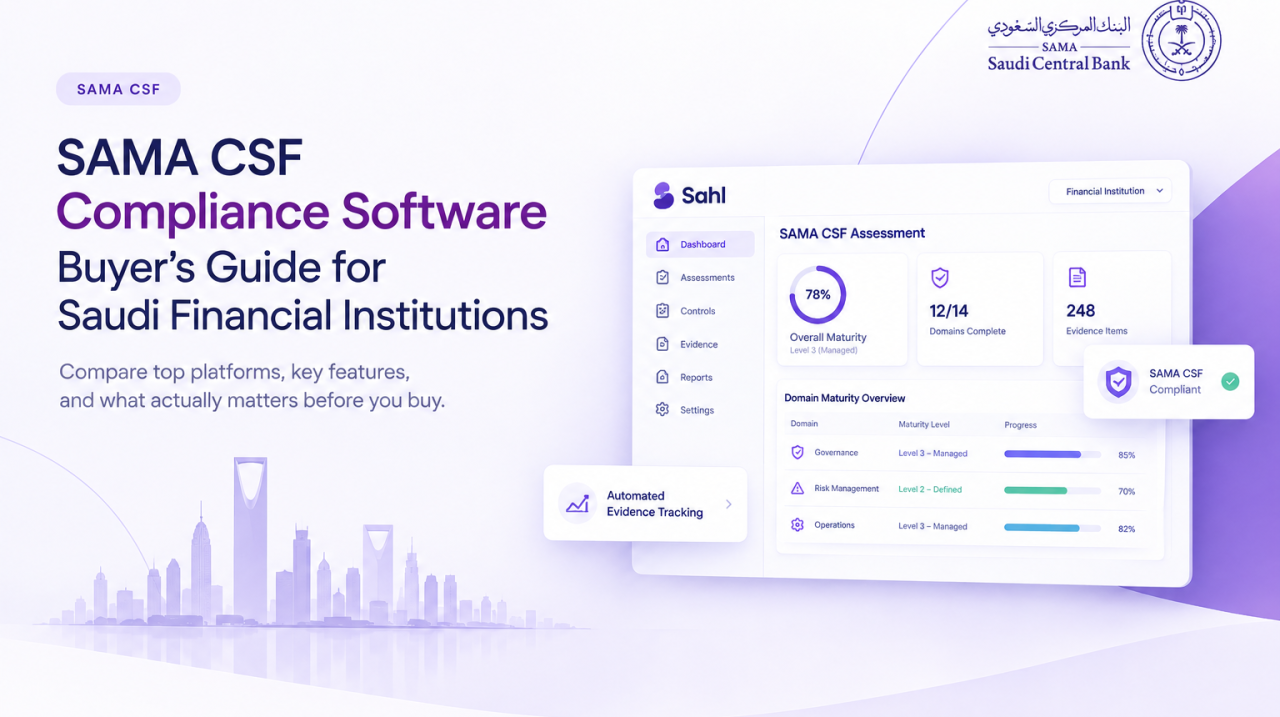
Sahl is designed for organizations operating in the Saudi regulatory environment and supports a more localized approach to SAMA CSF compliance.
Key capabilities include:
Native Domain Mapping
Sahl is designed to organize compliance activities around the relevant SAMA CSF structure, helping teams manage governance, risk management, operational controls, and related activities from a centralized platform.
Maturity-Focused Assessments
Teams can manage maturity assessments and monitor progress across relevant domains, making it easier to identify gaps and prioritize remediation.
Audit-Ready Evidence Trails
Centralized evidence tracking helps compliance and cybersecurity teams connect documentation and supporting records to relevant controls and assessment activities.
Bilingual Reporting
Arabic and English reporting can help support communication with internal stakeholders, management, risk committees, auditors, and other relevant parties.
Reduced Manual Compliance Work
By centralizing assessments, evidence, controls, and remediation activities, Sahl can reduce dependence on disconnected spreadsheets and manual tracking.
See how Sahl supports SAMA CSF self-assessment →
How to Choose the Right SAMA CSF Software
Before selecting a platform, ask vendors the following questions:
Does the platform support SAMA CSF directly?
Ask whether SAMA CSF is available as a dedicated framework or whether your team must build and maintain it manually.
How does maturity assessment work?
Understand whether the platform supports structured maturity-level assessments or relies only on pass/fail control testing.
Where is our data hosted?
Request clear information about hosting, processing locations, regional deployment options, and data handling.
Can we generate Arabic and English reports?
This is particularly important for organizations with bilingual compliance, audit, and management requirements.
How is evidence linked to controls?
The platform should make it easy to understand which evidence supports each control and identify missing or outdated documentation.
Can it integrate with our existing systems?
Evaluate available integrations, APIs, and workflows before introducing another disconnected compliance system.
How much configuration is required?
A platform that appears flexible can still require significant implementation effort. Ask vendors how long it typically takes to configure the platform for a SAMA CSF assessment workflow.
Frequently Asked Questions
SAMA CSF stands for the Saudi Central Bank Cyber Security Framework. It provides cybersecurity requirements and guidance for relevant regulated financial institutions in Saudi Arabia and covers areas including cybersecurity governance, risk management, and operational controls.
SAMA-regulated financial institutions may have obligations relating to the Cyber Security Framework depending on their regulatory classification and applicable requirements. This can include banks, insurance companies, finance companies, and other regulated financial organizations. Institutions should confirm their specific obligations against current SAMA requirements and guidance.
SAMA CSF and ISO 27001 share some cybersecurity concepts, but they are different frameworks. SAMA CSF is designed specifically for the Saudi financial sector and has its own framework structure and assessment approach. ISO 27001 is an international information security management standard that can support broader security management objectives.Organizations should not assume that ISO 27001 implementation automatically satisfies all applicable SAMA CSF requirements.
Assessment and review activities should be managed according to the applicable requirements, regulatory expectations, and guidance relevant to the institution. The exact frequency and scope may depend on the organization’s classification and current regulatory requirements, so institutions should confirm the latest applicable guidance.
Many modern compliance and GRC platforms offer integrations or APIs that can connect with existing risk, security, and governance systems. Integration capabilities vary by vendor, so organizations should evaluate available integrations during the procurement process.
Key factors include native SAMA CSF coverage, maturity assessment capabilities, evidence management, audit trails, reporting, Arabic support, data hosting considerations, integrations, implementation effort, and scalability.
Ready to Simplify Your SAMA CSF Self-Assessment?
Manual scoring, disconnected spreadsheets, and scattered evidence can make SAMA CSF compliance more difficult to manage.
A centralized platform can help compliance and cybersecurity teams monitor assessments, track maturity, organize evidence, identify gaps, and manage remediation from one place.
Sahl is designed for Saudi organizations that need a more localized approach to compliance automation.

