


Best GDPR and PDPL Compliance Platforms (2026) | Sahl
Quick Answer
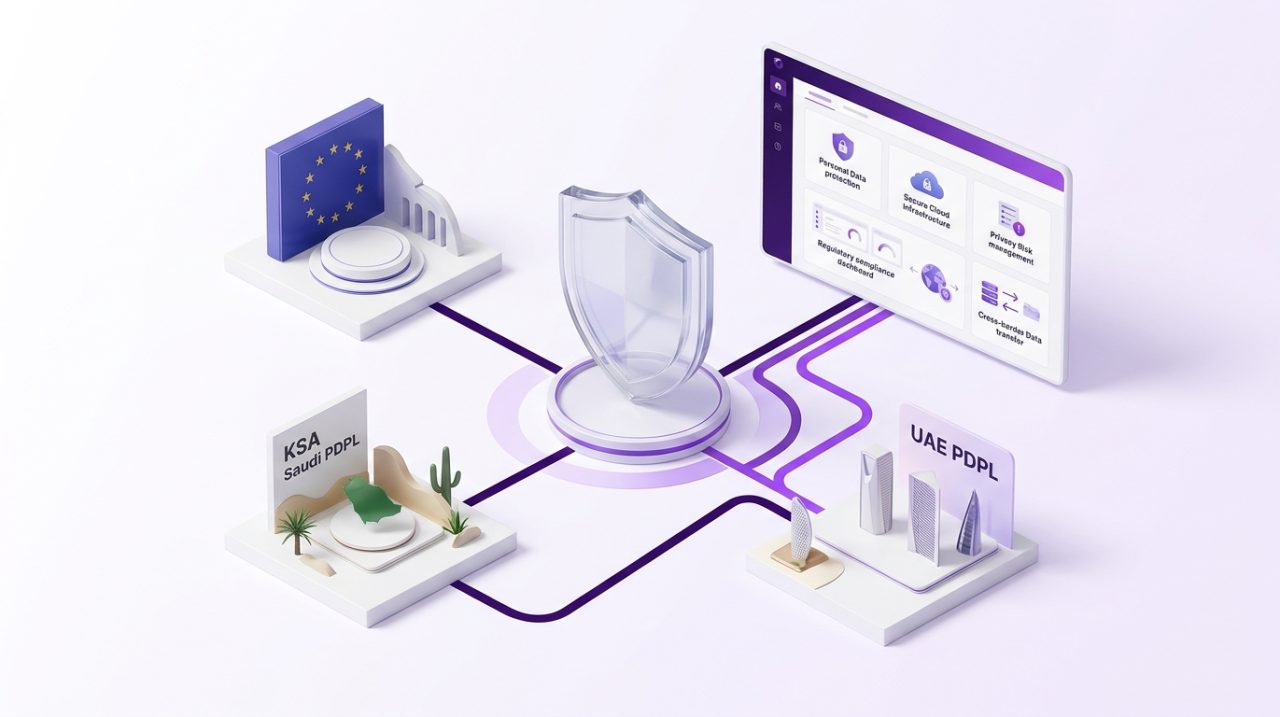
The best GDPR and PDPL compliance platform should manage multiple privacy regimes through a shared data inventory while applying jurisdiction-specific rules for lawful processing, data transfers, data subject requests and breach notification.
Global platforms such as OneTrust, Securiti, BigID and TrustArc offer broad privacy and data governance capabilities. Sahl focuses on the MENA market, with support for Saudi PDPL, UAE PDPL and GDPR alongside its wider GRC capabilities.
The right choice depends on where your organisation operates, how much personal data it processes, the number of jurisdictions involved and how closely privacy management needs to connect with security and compliance controls.
GDPR vs Saudi PDPL vs UAE PDPL: What Actually Differs?
| Topic | GDPR (EU) | Saudi PDPL | UAE Federal PDPL |
|---|---|---|---|
| Legal instrument | Regulation (EU) 2016/679 | Royal Decree No. M/19 | Federal Decree-Law No. 45 of 2021 |
| Enforcement status | Applicable since 25 May 2018 | Fully enforceable since 14 September 2024 | In force since 2 January 2022; check the latest status of implementing regulations |
| Regulatory authority | National supervisory authorities | SDAIA and the relevant national data governance framework | UAE Data Office and the applicable federal framework |
| Lawful processing | Six legal bases, including consent, contract, legal obligation and legitimate interests | Consent and other legally recognised grounds, subject to Saudi PDPL conditions | Consent and specified legal exceptions |
| Breach notification | Generally within 72 hours where the breach is likely to risk individuals’ rights and freedoms | Within 72 hours where the incident may cause harm or affect individuals’ rights or interests | Notification obligations exist; confirm applicable timing and procedures under the latest implementing framework |
| Cross-border transfers | Adequacy decisions, appropriate safeguards and other GDPR mechanisms | Subject to Saudi PDPL and its specific transfer regulations | Subject to the federal law’s transfer provisions and applicable safeguards |
| Territorial scope | Processing connected to offering goods or services to, or monitoring, people in the EU | Includes relevant processing by entities inside or outside KSA involving individuals residing in the Kingdom | Includes relevant processing by entities inside or outside the UAE involving individuals in the UAE, subject to statutory exclusions |
Important UAE scope note: The federal UAE PDPL is not the only data protection regime organisations may need to consider. DIFC and ADGM have their own data protection frameworks. Certain categories, including health and banking or credit data governed by separate legislation, are also excluded from the federal law’s scope. Organisations should map their legal entities, data categories and operating locations before deciding which rules apply.
What Should a GDPR and PDPL Compliance Platform Do?
A privacy platform should do more than store policies and generate compliance reports. It should help teams understand what personal data they hold, why they process it, where it moves and how they demonstrate compliance.
Look for these capabilities:
- Central data inventory and ROPA: Maintain records of processing activities and identify which legal regimes apply to each activity.
- Jurisdiction-specific requirements: Track lawful bases, sensitive-data restrictions, retention requirements and transfer conditions separately.
- Data subject request workflows: Receive, assign, track and document requests according to the applicable legal requirements and deadlines.
- Breach management: Record incidents, assess potential harm, escalate cases and track the relevant notification requirements for each jurisdiction.
- Cross-border transfer management: Document international data flows, transfer mechanisms, safeguards and relevant assessments.
- DPIAs and privacy assessments: Support privacy impact assessments and document decisions, risks and mitigation measures.
- Consent and processor management: Maintain consent records, vendor assessments, processing agreements and relevant obligations.
- Audit-ready evidence: Connect privacy requirements with security controls, policies, owners and supporting evidence.
- Regional usability: Consider Arabic-language support, local regulatory content, onboarding and support availability.
The 5 Best GDPR and PDPL Compliance Platforms
The following platforms serve different privacy and data governance needs. This is a market comparison, not an independent hands-on product test. Confirm specific features, regional coverage, integrations and pricing directly with each vendor.
1. Sahl: Best for MENA organisations managing GDPR and PDPL
Sahl is an AI-powered GRC platform designed for organisations operating in Saudi Arabia and the wider MENA region.
According to Sahl’s platform positioning, it supports GDPR, Saudi PDPL and UAE PDPL alongside frameworks such as NCA ECC, SAMA CSF, ISO 27001 and SOC 2.
Its AI DPO assistant is designed to support privacy-related questions and workflows. Sahl also brings privacy management closer to security and compliance activities, helping teams connect privacy requirements with relevant controls and evidence.
Best for: Organisations in Saudi Arabia and the GCC that need regional GRC capabilities while also managing GDPR exposure.
Consider: Organisations operating across many jurisdictions should compare the depth of Sahl’s jurisdiction coverage with larger global privacy suites.
2. OneTrust: Best for broad enterprise privacy management
OneTrust is a global privacy, risk and governance platform with capabilities across privacy management, consent, data governance and third-party risk.
Its broad product ecosystem can be relevant for multinational organisations with established privacy teams and complex governance requirements.
Best for: Large organisations managing privacy programmes across multiple regions.
Confirm: The availability and depth of Saudi and UAE PDPL-specific content, workflows, local support and implementation requirements.
3. Securiti: Best for data-centric privacy and governance
Securiti provides privacy, data governance and data security capabilities, including tools designed to help organisations understand and manage personal data across their environments.
Its data-centric approach can be useful for organisations dealing with large and distributed data estates.
Best for: Enterprises that need privacy management alongside data intelligence and governance.
Confirm: Saudi and UAE PDPL workflow coverage, Arabic-language capabilities, integrations and pricing.
4. BigID: Best for data discovery and classification
BigID is known for data discovery, classification and data intelligence capabilities. These can help organisations identify sensitive information and understand where personal data resides.
This can provide an important foundation for privacy programmes, particularly when data is spread across cloud environments, databases and business systems.
Best for: Organisations whose main challenge is discovering, classifying and governing personal data at scale.
Confirm: The privacy workflow depth and regional regulatory content available for Saudi and UAE requirements.
5. TrustArc: Best for privacy-focused programme management
TrustArc focuses on privacy management and governance, with capabilities across assessments, consent, compliance and privacy programme operations.
It may suit organisations looking for a dedicated privacy management environment.
Best for: Privacy teams that want structured privacy programme management.
Confirm: Saudi and UAE PDPL coverage, regional implementation support and integration with existing GRC systems.
GDPR and PDPL Platform Comparison
| Platform | GDPR | Saudi PDPL | UAE PDPL | Security-control integration | Best fit |
|---|---|---|---|---|---|
| Sahl | Supported, according to vendor positioning | Supported, according to vendor positioning | Supported, according to vendor positioning | Wider GRC and security framework capabilities | MENA organisations with GDPR exposure |
| OneTrust | Broad privacy capabilities | Confirm with vendor | Confirm with vendor | Confirm product scope | Multinationals |
| Securiti | Broad privacy and data governance capabilities | Confirm with vendor | Confirm with vendor | Confirm product scope | Data-centric enterprises |
| BigID | Privacy and data intelligence capabilities | Confirm with vendor | Confirm with vendor | Confirm product scope | Data discovery and classification |
| TrustArc | Privacy management capabilities | Confirm with vendor | Confirm with vendor | Confirm product scope | Privacy-led teams |
Comparison note: Product coverage and functionality can vary by edition, configuration, region and contract. “Confirm with vendor” means the relevant capability should be validated rather than assumed.
How to Choose the Right Platform
The right platform depends on your organisation’s regulatory footprint and operational priorities.
- Primarily operating in Saudi Arabia or the GCC, with GDPR exposure: Include Sahl in your shortlist and evaluate its regional workflows against your requirements.
- Operating across many international jurisdictions: Evaluate OneTrust and Securiti for the breadth of their privacy and governance capabilities.
- Struggling to locate personal data: Consider BigID as part of your evaluation, particularly if discovery and classification are major priorities.
- Building a dedicated privacy programme: Evaluate TrustArc alongside other privacy management suites.
Run a practical proof of concept
Before selecting a platform, test a real processing activity that involves more than one jurisdiction.
For example, consider a Saudi organisation that collects customer information in KSA and makes some of that information accessible to an EU-based team.
Ask each shortlisted vendor to demonstrate how its platform can:
- Record the processing activity in a central data inventory.
- Identify the relevant legal regimes.
- Document the applicable lawful basis.
- Record the purpose, data categories and retention requirements.
- Assess the cross-border transfer and relevant safeguards.
- Receive and track a data subject request.
- Record a privacy incident and identify the applicable notification process.
- Link privacy requirements to security controls and supporting evidence.
A useful proof of concept should demonstrate how the platform works in your actual operating environment, not simply how many frameworks appear in its product catalogue.
Frequently Asked Questions
No. GDPR and Saudi PDPL share several privacy principles, but they are separate legal frameworks. Organisations must assess Saudi-specific lawful-processing requirements, cross-border transfer rules, regulatory procedures and breach notification obligations.
The Saudi PDPL Implementing Regulation requires controllers to notify the competent authority within 72 hours of becoming aware of an incident when it may cause harm to personal data or the data subject, or affect their rights or interests. Data subjects must also be notified without undue delay where the applicable conditions are met.
No. EU Standard Contractual Clauses should not be treated as automatically satisfying Saudi transfer requirements. Organisations must assess the Saudi PDPL and its specific rules for transfers of personal data outside the Kingdom.
DIFC and ADGM have their own data protection regimes. The UAE federal PDPL also contains exclusions for certain categories of data governed by separate legislation. Organisations should assess the legal status of each entity and the data it processes.
Yes, provided the platform supports the requirements of each applicable regime rather than treating them as interchangeable. Look for a shared data inventory with separate jurisdiction-specific rules, workflows and evidence.
Manage Privacy and GRC Requirements with Sahl
Managing GDPR and PDPL obligations across different markets requires more than a collection of policies and spreadsheets. Teams need visibility into processing activities, local regulatory requirements, risks and supporting evidence.
Sahl brings privacy and wider GRC activities into one platform, with capabilities designed for organisations operating across Saudi Arabia and the MENA region.
Book a demo with Sahl to explore how your organisation can manage privacy requirements alongside its wider compliance programme.

