


30-Day GRC Platform Rollout Playbook for KSA (2026) | Sahl
The Short Answer
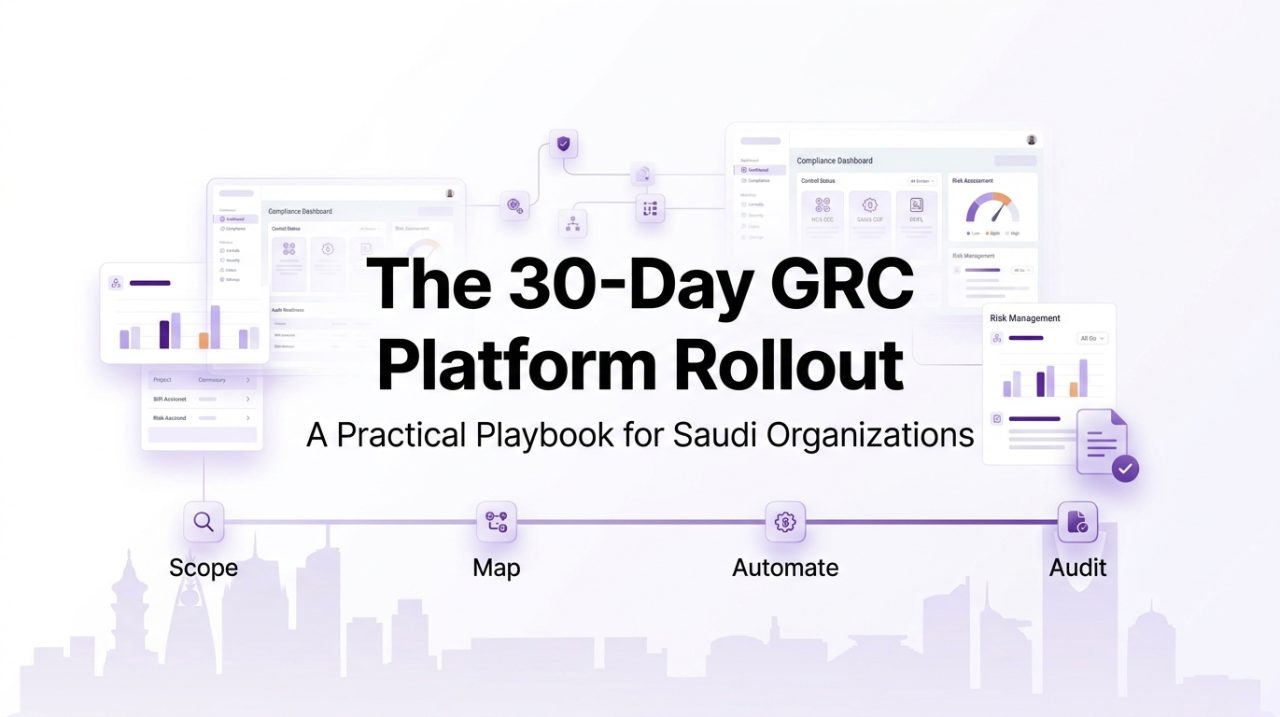
A focused GRC implementation plan in Saudi Arabia can establish an initial audit-ready foundation in approximately 30 days, provided the organization defines a manageable scope, assigns control owners, uses pre-mapped regulatory frameworks, and prioritizes evidence collection from the beginning.
A platform with NCA ECC-2:2024, SAMA CSF, and PDPL framework mappings already available can reduce the time spent building control structures and mapping requirements manually.
Sahl provides pre-mapped Saudi regulatory frameworks, cross-framework evidence mapping, AI-assisted compliance workflows, and centralized dashboards to help organizations manage their GRC implementation.
However, a 30-day rollout does not guarantee full regulatory compliance or successful certification. Organizations must validate their controls, evidence, and applicable regulatory obligations.
Before Day 1: Decide Three Things
Before implementing a GRC platform, establish the foundation for your rollout.
1. Define Your Scope
Identify the frameworks, business entities, systems, and departments included in the initial implementation.
For example, your first phase may focus on NCA ECC-2:2024 governance controls, with additional domains introduced later.
2. Assign Control Owners
Identify who is responsible for governance, cybersecurity, privacy, IT operations, and evidence collection.
Every control should have a clear owner accountable for its implementation and review.
3. Set Your Target Deadline
Determine whether the rollout is driven by an upcoming audit, regulatory assessment, customer requirement, or internal compliance objective.
Your deadline should account for evidence availability, remediation effort, and stakeholder approval.
Week 1: Scope and Set Up Your GRC Platform
The first week focuses on establishing your GRC workspace and preparing the organization for implementation.
Implementation Checklist
- Confirm the applicable frameworks: NCA ECC-2:2024, SAMA CSF for SAMA-regulated institutions, PDPL, and any relevant ISO 27001 or SOC 2 requirements.
- Configure your organization structure, users, roles, and control owners.
- Import existing policies, procedures, and compliance documentation.
- Identify initial evidence sources, including identity management, cloud infrastructure, and ticketing systems.
- Connect the first systems for automated evidence collection where supported.
- Select one domain for the initial proof of concept, such as NCA ECC governance.
Week 1 Deliverable: A configured GRC workspace with defined scope, assigned owners, and initial evidence sources.
Week 2: Map Controls and Identify Compliance Gaps
Once the platform is configured, the next step is to understand your current compliance posture.
Implementation Checklist
- Map existing policies, controls, and evidence to applicable framework requirements.
- Conduct a gap assessment for the in-scope controls.
- Classify controls as implemented, partially implemented, or missing.
- Assign an owner and remediation deadline to each identified gap.
- Map overlapping requirements across frameworks to reduce duplicate work.
- Prioritize gaps based on risk exposure, regulatory importance, and audit requirements.
For example, an access management policy may support requirements across multiple frameworks. Mapping shared evidence to relevant controls can reduce repeated documentation and review effort.
Week 2 Deliverable: A prioritized compliance gap assessment with control owners, remediation deadlines, and documented findings.
Week 3: Remediate Gaps and Automate Evidence Collection
During the third week, teams focus on resolving high-priority compliance gaps while improving evidence collection and maintenance.
Implementation Checklist
- Address high-priority gaps, including missing policies, access review deficiencies, inadequate logging, and untested backups.
- Automate evidence collection wherever integrations support it.
- Establish evidence refresh cycles and review schedules.
- Implement PDPL-related privacy workflows, including records of processing activities, data subject requests, and breach handling.
- Conduct vulnerability scanning of public-facing applications.
- Review evidence ownership, timestamps, and completeness.
- Document remediation progress and outstanding risks.
Automation can reduce manual evidence collection, but it does not replace control validation or human review.
Week 3 Deliverable: Remediated priority gaps and a set of controls supported by assigned, dated evidence with appropriate refresh schedules.
Week 4: Conduct a GRC Readiness Review
The final week focuses on evaluating the initial compliance foundation and preparing documentation for internal or external assessment.
Implementation Checklist
- Conduct an internal readiness review against the in-scope controls.
- Verify that each control has an assigned owner, supporting policy, relevant evidence, and review record where required.
- Validate evidence completeness, accuracy, and freshness.
- Generate an audit evidence pack.
- Have an independent reviewer evaluate the documentation from an auditor’s perspective.
- Remediate remaining deficiencies or document formally approved risks.
- Prepare a leadership dashboard showing compliance status, open gaps, and remediation progress.
Week 4 Deliverable: An initial audit-ready evidence pack, a documented readiness assessment, and a leadership compliance status report.
The 30-Day GRC Implementation Timeline
| Timeline | Primary Focus | Key Deliverable |
|---|---|---|
| Before Day 1 | Scope, owners, deadline | Implementation plan |
| Week 1 | Platform setup | Configured workspace |
| Week 2 | Control mapping and gap assessment | Prioritized remediation plan |
| Week 3 | Remediation and evidence automation | Updated controls and evidence |
| Week 4 | Readiness review | Audit pack and status dashboard |
This timeline is intended for a focused initial rollout. Full enterprise-wide GRC implementation, extensive integrations, and complex remediation programmes may require additional time.
Common GRC Implementation Delays and How to Avoid Them
Organizations often encounter similar challenges during GRC platform rollouts.
| Common Delay | Recommended Approach |
|---|---|
| Building regulatory frameworks manually | Start with pre-mapped frameworks |
| Collecting evidence only before audits | Automate evidence collection and establish refresh cycles |
| Unclear control ownership | Assign an accountable owner to every control |
| Expanding scope too early | Start with one framework and one domain |
| Managing privacy separately from cybersecurity | Connect PDPL workflows with shared controls and evidence |
| Delayed stakeholder approvals | Define approval responsibilities before implementation |
| Incomplete documentation | Validate policies and evidence throughout the rollout |
A structured implementation approach helps teams identify bottlenecks early and maintain progress toward their compliance objectives.
How Sahl Helps Accelerate GRC Implementation in Saudi Arabia
Sahl supports organizations managing Saudi regulatory requirements through a centralized AI-powered GRC platform.
Pre-Mapped Saudi Regulatory Frameworks
Sahl provides framework mappings for NCA ECC, SAMA CSF, and PDPL, helping teams begin their implementation with an established control structure.
Cross-Framework Evidence Mapping
Shared evidence can be mapped to relevant controls across multiple frameworks, reducing duplicate documentation and manual evidence management.
Continuous Evidence Collection
Supported integrations and evidence workflows help teams maintain compliance documentation and monitor evidence freshness.
AI DPO Assistant
Sahl’s AI DPO assistant helps support privacy-related workflows and PDPL questions.
Built-In DAST Scanner
Sahl includes a Dynamic Application Security Testing (DAST) scanner to support application security testing workflows.
Compliance Dashboards and Audit Reporting
Centralized dashboards provide visibility into compliance status, outstanding gaps, remediation progress, and supporting evidence.
Together, these capabilities can help organizations reduce manual implementation effort and establish a more structured compliance programme.
Frequently Asked Questions
A focused initial GRC implementation can take approximately 30 days when the scope is limited, stakeholders are available, and evidence is accessible.Pre-mapped platforms may allow teams to begin working with relevant controls within days. Full enterprise-wide implementation can take longer depending on complexity.
Start with governance, control ownership, and the framework with the highest regulatory or audit priority.Select one domain, assess its current state, and establish a repeatable process before expanding to additional domains.
Yes. Organizations can manage NCA ECC and PDPL within the same GRC platform when the platform supports both frameworks.Cross-framework mapping can help identify overlapping requirements and reuse relevant evidence. However, each framework’s specific obligations must still be addressed.
Organizations with limited compliance resources can benefit from pre-mapped frameworks, centralized evidence management, automated workflows, and AI-assisted compliance capabilities.
No. A 30-day rollout can establish an initial audit-ready foundation, but readiness depends on the organization’s scope, control implementation, evidence quality, remediation progress, and applicable assessment criteria.
Conclusion: Start Your GRC Implementation With a Clear Plan
A successful GRC platform rollout requires more than selecting software. Organizations need defined scope, accountable control owners, mapped regulatory requirements, reliable evidence, and a structured readiness review.
For Saudi organizations managing NCA ECC-2:2024, SAMA CSF, and PDPL, a focused 30-day implementation plan can provide a practical starting point for building a sustainable compliance programme.
The key is to start with a manageable scope, prioritize the most important gaps, and establish repeatable compliance workflows before expanding.
Book a demo with Sahl to explore how an AI-powered GRC platform can support your Saudi compliance implementation.

