



NCA ECC Compliance Checklist: Simplify Your Audit Journey
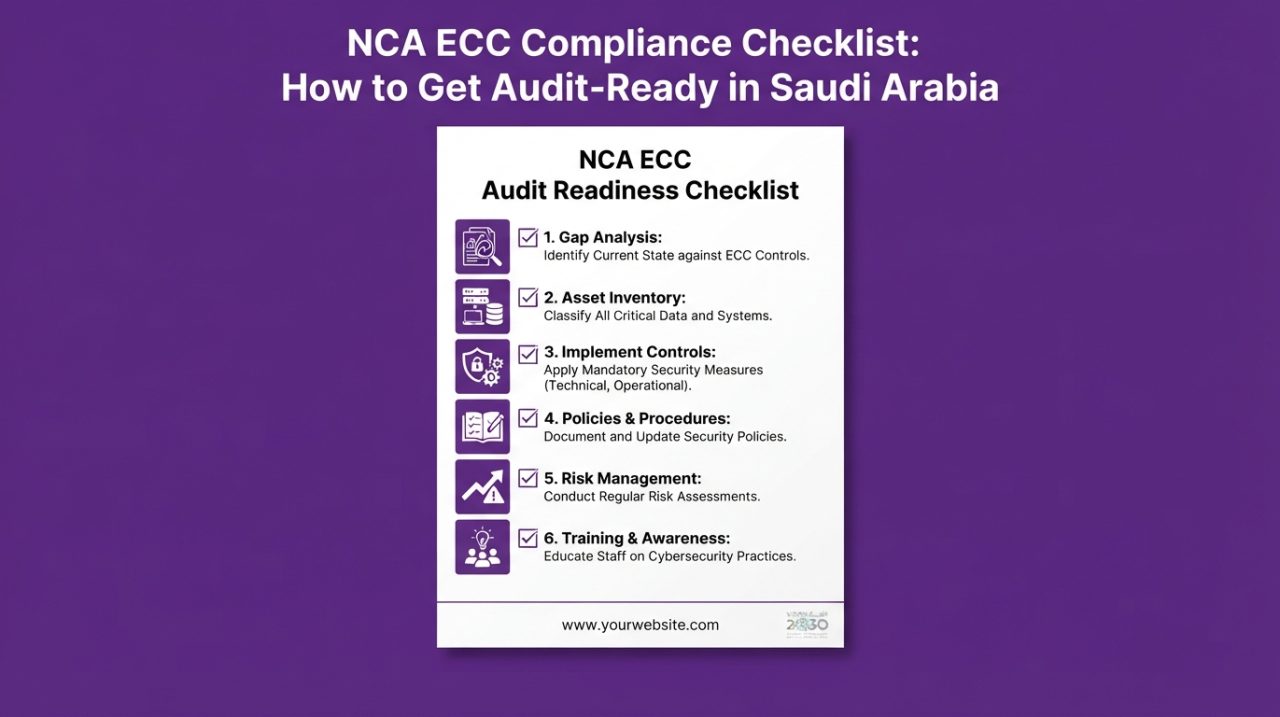
NCA ECC Compliance Checklist: Quick Answer
NCA ECC compliance is the process of implementing and maintaining the applicable cybersecurity controls required under Saudi Arabia’s National Cybersecurity Authority (NCA) Essential Cybersecurity Controls (ECC).
The current framework is ECC 2:2024. Organizations within scope need to determine which controls apply to them, assess their current cybersecurity posture, address gaps, maintain evidence, and continuously monitor compliance.
A practical NCA ECC compliance checklist includes:
- Determine your ECC scope.
- Identify applicable controls.
- Perform a cybersecurity gap assessment.
- Assign control owners.
- Develop and approve required policies and procedures.
- Implement technical and administrative controls.
- Collect and map evidence.
- Remediate identified gaps.
- Conduct internal assessments.
- Continuously monitor compliance and maintain audit readiness.
For organizations managing these activities manually, a GRC platform such as Sahl can centralize controls, evidence, ownership, remediation, and reporting.
What Is NCA ECC Compliance?
The NCA Essential Cybersecurity Controls (ECC) provide a baseline of cybersecurity requirements established by Saudi Arabia’s National Cybersecurity Authority.
The current version is ECC 2:2024, which the NCA introduced to strengthen cybersecurity at the national level and protect information and technology assets. The framework helps organizations manage cybersecurity risks and build appropriate security capabilities.
Importantly, NCA ECC compliance is not simply about completing a checklist once a year. The NCA states that entities within scope must take the necessary measures to maintain ongoing and continuous compliance.
This makes compliance management an ongoing operational process involving governance, technical controls, documentation, evidence, assessment, and remediation.
Who Needs to Comply With NCA ECC?
Understanding scope should be the first step in your NCA ECC compliance checklist.
According to ECC 2:2024, the controls apply to:
- Government entities in Saudi Arabia.
- Government-affiliated companies and entities, within the scope defined by the NCA.
- Private-sector entities that own, operate, or host Critical National Infrastructures (CNIs).
The NCA also encourages organizations outside the mandatory scope to use ECC as a cybersecurity best-practice reference.Private-sector organizations should therefore avoid assuming that operating in Saudi Arabia automatically makes every ECC control mandatory. The organization should first determine its regulatory scope and applicable requirements.
NCA ECC Compliance Checklist
Use the following checklist as a practical starting point for building or improving an NCA ECC compliance program.
1. Determine Your NCA ECC Scope
Before implementing controls, establish whether ECC applies to your organization and identify the requirements relevant to your environment.
Start by documenting:
- Your organization’s legal and operational structure.
- Government or private-sector status.
- Critical National Infrastructure responsibilities, where applicable.
- Critical systems and information assets.
- Cloud services and hosting arrangements.
- Third-party and supplier relationships.
- Relevant regulatory requirements.
A clearly defined scope helps teams avoid wasting resources on irrelevant controls while ensuring they address all applicable requirements.
2. Identify the Applicable ECC Controls
Once you establish your scope, identify the controls that apply to your organization.ECC 2:2024 uses applicability considerations to determine which requirements are relevant to an entity and its environment.
Create a control register containing at least:
| Field | Purpose |
|---|---|
| Control ID | Identifies the ECC requirement |
| Control Description | Defines what is required |
| Applicability | Determines whether the requirement applies |
| Control Owner | Assigns accountability |
| Implementation Status | Tracks progress |
| Evidence | Demonstrates implementation |
| Gap | Identifies deficiencies |
| Remediation | Defines corrective action |
| Review Date | Supports ongoing monitoring |
A centralized register makes it easier to understand your overall compliance posture.
3. Perform an NCA ECC Gap Assessment
A gap assessment compares your current cybersecurity capabilities against the applicable ECC requirements.
For every applicable control, determine whether it is:
- Implemented.
- Partially implemented.
- Not implemented.
- Not applicable, where justified.
Your assessment should consider more than whether a policy exists.
For example, if an organization has an access-control policy, the assessment should also verify that the organization has implemented the related technical and operational controls and collected sufficient evidence to demonstrate their effectiveness.
Questions to ask during a gap assessment
- Is the required policy documented?
- Has management approved it?
- Has it been communicated to relevant personnel?
- Is the associated technical control implemented?
- Who owns the control?
- What evidence demonstrates implementation?
- How frequently is the control reviewed?
- Are identified gaps being remediated?
This approach helps distinguish documented compliance from operational compliance.
4. Assign Control Owners
Every applicable ECC control should have a clearly identified owner.
Depending on the requirement, ownership may sit with teams such as:
- Information security
- IT
- Infrastructure
- Network operations
- Human resources
- Risk and compliance
- Legal
- Procurement
- Business operations
Control ownership creates accountability and makes remediation easier to manage.
Instead of asking, “Who is responsible for this gap?” after an assessment, organizations can establish responsibility from the beginning.
Documentation is an important part of an effective cybersecurity program.
Depending on your applicable controls, your documentation environment may include policies, standards, procedures, guidelines, records, and other supporting documents.
A strong policy-management process should include:
- Document ownership.
- Management approval.
- Version control.
- Review dates.
- Change history.
- Employee communication.
- Evidence of acknowledgment where applicable.
However, having a policy document alone does not demonstrate that the underlying control is operating effectively.
The policy should be supported by appropriate implementation and evidence.
6. Implement the Required Security Controls
After identifying gaps, begin remediation.
Depending on the applicable requirements and your environment, implementation activities may involve areas such as:
- Identity and access management.
- Asset management.
- Vulnerability management.
- Network security.
- Endpoint protection.
- Data protection.
- Encryption.
- Security monitoring.
- Incident response.
- Business continuity.
- Third-party security.
- Cloud security.
- Cybersecurity awareness.
The exact requirements depend on the controls applicable to your organization.
7. Collect and Map Compliance Evidence
Evidence is one of the most important parts of audit readiness.
For each applicable control, organizations should maintain evidence that shows how they implement and operate the requirement.
Examples can include:
- Approved policies.
- Configuration records.
- Access reviews.
- System reports.
- Security logs.
- Vulnerability reports.
- Training records.
- Incident records.
- Risk assessments.
- Meeting records.
- Screenshots, where appropriate.
- Technical assessment results.
The key is not simply collecting large quantities of documents.
Evidence should be relevant, attributable, current, and clearly connected to the applicable control.
A centralized evidence repository can significantly simplify this process.
8. Remediate Compliance Gaps
Your gap assessment should produce a remediation plan.
For every significant gap, define:
- The issue.
- The affected control.
- Risk or business impact.
- Remediation action.
- Responsible owner.
- Target completion date.
- Current status.
- Supporting evidence.
This turns an assessment from a static report into an actionable improvement program.
9. Conduct Internal Assessments
Before an external assessment or regulatory review, conduct an internal assessment.
An internal review can help identify:
- Missing evidence.
- Expired documentation.
- Unassigned controls.
- Incomplete remediation.
- Technical implementation gaps.
- Controls that are documented but not operating as expected.
Internal assessments should be repeated periodically rather than treated as a one-time activity.
10. Maintain Continuous NCA ECC Compliance
The final step is also the one that never really ends.
NCA ECC compliance should be integrated into your organization’s normal cybersecurity and risk-management processes.
Monitor changes such as:
- New systems.
- New applications.
- New cloud services.
- New vendors.
- Organizational changes.
- Changes to policies.
- Security incidents.
- Identified vulnerabilities.
- Changes to regulatory requirements.
When the environment changes, your compliance posture may change with it.
This is why continuous compliance management is more sustainable than preparing for an audit only when an assessment date approaches.
Why Manual NCA ECC Compliance Becomes Difficult
Many organizations initially manage compliance through spreadsheets, shared folders, email, and manually maintained documents.
This can work for a small compliance program, but complexity increases as the number of controls, systems, employees, vendors, and evidence sources grows.
Common challenges include:
Spreadsheet Dependency
Multiple spreadsheets can create inconsistent information and make it difficult to determine which version is current.
Evidence Scattered Across Teams
Evidence may sit with IT, security, HR, infrastructure, vendors, or individual employees.
Finding the correct document when an assessor requests it can consume significant time.
Unclear Control Ownership
Without clear ownership, remediation tasks can remain open because nobody knows who is accountable.
Compliance Drift
A control may be compliant today but become ineffective after a system change, policy expiration, organizational change, or other event.
Limited Management Visibility
Leadership may need a simple view of compliance status, open risks, remediation progress, and areas requiring attention.
A centralized GRC platform can address many of these operational challenges.
How Sahl Helps With NCA ECC Compliance
Sahl can help organizations centralize and automate key parts of their NCA ECC compliance workflow.
Instead of managing controls, evidence, tasks, and assessments across disconnected spreadsheets and folders, teams can use a centralized GRC environment.
Automated Control Mapping
Map applicable NCA ECC requirements to your existing policies, processes, risks, and security controls.
This can help identify where existing capabilities already support compliance and where additional work may be required.
Centralized Evidence Management
Organize compliance evidence in one place and associate it with the relevant controls.
This reduces the need to search through multiple systems when preparing for assessments.
Control Ownership and Task Management
Assign control owners and track remediation activities.
Teams can see what needs attention, who is responsible, and what remains outstanding.
Compliance Dashboards
Give security and compliance teams a centralized view of their current compliance status.
Instead of manually combining information from multiple spreadsheets, stakeholders can use dashboards and reports to monitor progress.
Continuous Compliance Monitoring
Rather than treating compliance as an annual exercise, teams can establish recurring workflows for reviews, evidence updates, assessments, and remediation.
Audit Readiness
When evidence, control status, ownership, and remediation records are maintained continuously, preparing for an assessment becomes a repeatable process rather than a last-minute documentation exercise.
NCA ECC Compliance: Manual Process vs. Automated GRC
| Compliance Activity | Manual Approach | Automated GRC Approach |
|---|---|---|
| Control tracking | Spreadsheets | Centralized control register |
| Evidence collection | Email and folders | Centralized evidence management |
| Ownership | Manually maintained | Assigned within workflows |
| Gap tracking | Spreadsheet updates | Automated task tracking |
| Policy reviews | Calendar reminders | Recurring workflows |
| Compliance visibility | Manual reports | Centralized dashboards |
| Audit preparation | Evidence hunting | Continuously maintained records |
| Remediation | Email follow-ups | Assigned and tracked tasks |
The goal of automation is not to replace cybersecurity teams.
It is to reduce repetitive administrative work so security and compliance professionals can spend more time on risk reduction and control improvement.
How to Prepare for an NCA ECC Assessment
Before an assessment, review the following areas:
Governance
- Are applicable controls identified?
- Are responsibilities assigned?
- Are relevant policies approved and current?
Documentation
- Are required documents available?
- Are documents version-controlled?
- Have expired policies been reviewed?
Technical Controls
- Are required security controls implemented?
- Can the organization demonstrate their operation?
Evidence
- Is evidence mapped to the correct controls?
- Is evidence current?
- Can evidence be traced to the responsible system or process?
Remediation
- Are open gaps documented?
- Are owners assigned?
- Are remediation deadlines being tracked?
Management
- Can leadership see the current compliance posture?
- Are significant risks escalated appropriately?
- Are compliance activities reviewed regularly?
This checklist can help organizations identify common preparation gaps before an assessment begins.
Frequently Asked Questions About NCA ECC Compliance
An NCA ECC compliance checklist is a structured way to track the cybersecurity requirements applicable to an organization under the NCA Essential Cybersecurity Controls.
Yes, but not to every private company automatically. ECC 2:2024 applies to private-sector entities that own, operate, or host Critical National Infrastructures (CNIs), in addition to the government entities and affiliated entities covered by the framework.
Yes. The NCA states that entities within the scope of ECC must take the necessary measures to maintain ongoing and continuous compliance.This means organizations should maintain controls and evidence throughout the year rather than preparing only immediately before an assessment.
Start by determining whether ECC applies to your organization and identifying the applicable controls.Then perform a gap assessment, assign control owners, establish policies and procedures, implement required safeguards, collect evidence, remediate gaps, and establish recurring monitoring and assessment processes.
Sahl can help centralize NCA ECC controls, evidence, ownership, remediation activities, and compliance reporting in a GRC environment.
Final Thoughts: Build Continuous NCA ECC Compliance
NCA ECC compliance is more than completing a checklist before an assessment.
Organizations within scope need a repeatable process for understanding applicable requirements, implementing controls, maintaining evidence, addressing gaps, and continuously monitoring their cybersecurity posture.
For organizations still relying heavily on spreadsheets and manual evidence collection, GRC automation can provide a more centralized approach.
Sahl helps security and compliance teams manage NCA ECC requirements, evidence, ownership, remediation, and reporting from a centralized platform.
Ready to simplify your NCA ECC compliance process?
Book a demo with Sahl to see how a centralized GRC workflow can help your organization move toward continuous compliance and ongoing audit readiness.

