



NCA ECC Explained: A Complete Guide for Compliance in KSA
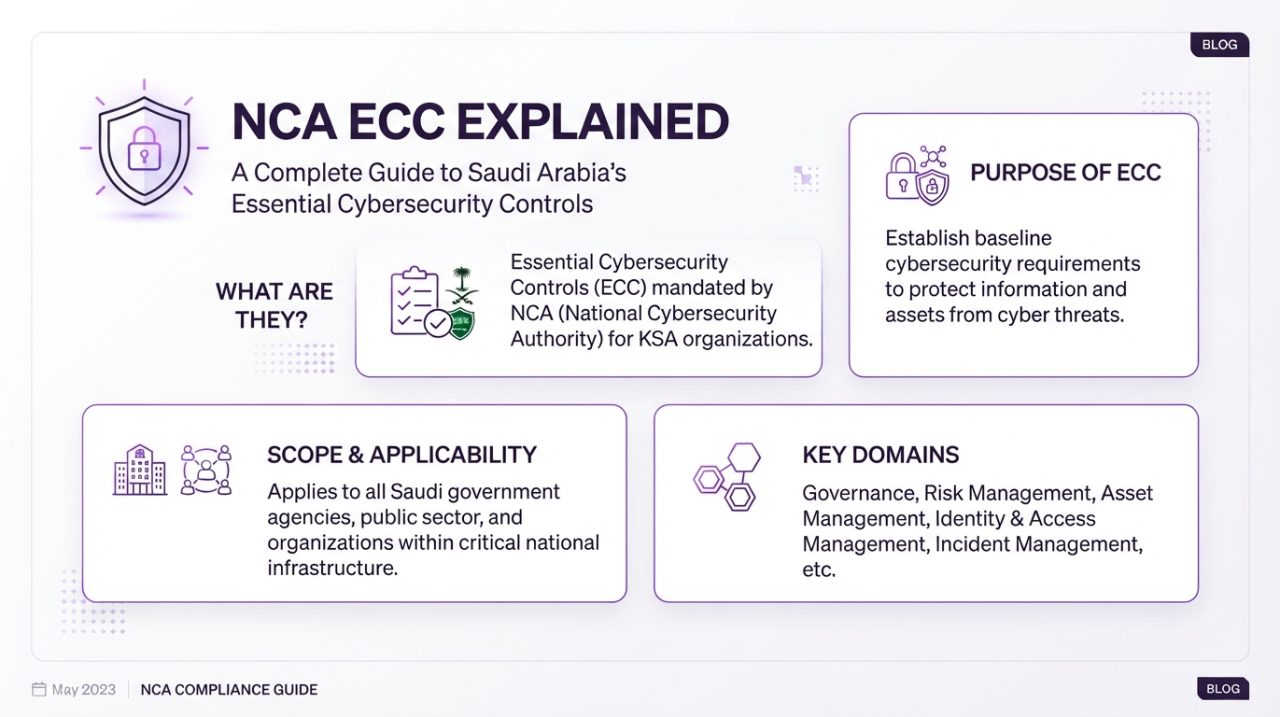
NCA ECC: Key Takeaways
- What is NCA ECC? The Essential Cybersecurity Controls (ECC) are cybersecurity controls issued by Saudi Arabia’s National Cybersecurity Authority (NCA).
- Current version: The current framework is ECC 2:2024, which was updated to strengthen cybersecurity at the national level and protect information and technology assets.
- Who must comply? The controls apply to Saudi government entities and their affiliated companies and entities, as well as private-sector entities that own, operate, or host Critical National Infrastructures (CNIs).
- Is compliance ongoing? Yes. The NCA requires entities within scope to take the necessary measures to maintain ongoing and continuous compliance.
- Why does it matter? ECC provides a baseline for managing cybersecurity risks and protecting critical information and technology assets.
- The challenge: Compliance requires control implementation, evidence, assessment, remediation, and continuous monitoring.
- The opportunity: GRC automation can help organizations centralize evidence, track control status, identify gaps, and maintain audit readiness.
What Is NCA ECC?
The National Cybersecurity Authority (NCA) is Saudi Arabia’s national authority responsible for cybersecurity. Among its regulatory documents are the Essential Cybersecurity Controls (ECC), which establish baseline cybersecurity requirements for organizations within their defined scope.
The current version, Essential Cybersecurity Controls (ECC 2:2024), was updated by the NCA to strengthen cybersecurity at the national level and safeguard the information and technological assets of national entities.
ECC is designed to help organizations establish and maintain cybersecurity capabilities that reduce risks arising from internal and external cyber threats.
Rather than treating cybersecurity as a one-time compliance exercise, the framework requires organizations within scope to maintain ongoing compliance with the applicable controls.
Who Must Comply With NCA ECC in Saudi Arabia?
One of the most important parts of understanding NCA ECC is determining whether your organization falls within its scope.
According to the NCA’s ECC 2:2024 document, the controls apply to:
1. Government Entities
This includes government agencies in Saudi Arabia, including ministries, authorities, establishments, and other government organizations.
The scope also extends to their affiliated companies and entities, both inside and outside Saudi Arabia.
2. Private-Sector CNI Entities
ECC also applies to private-sector entities that own, operate, or host Critical National Infrastructures (CNIs).
This distinction is important: not every private company in Saudi Arabia is automatically subject to ECC simply because it operates in the Kingdom.
Organizations should therefore determine their regulatory scope and identify which NCA controls are applicable to their business, technology, and operating environment.
3. Other Organizations
The NCA strongly encourages organizations outside the mandatory scope to use ECC as a cybersecurity best-practice reference to improve their security posture.
What Are the Main NCA ECC Domains?
ECC covers multiple areas of cybersecurity governance, protection, resilience, and technology risk management.
The framework is organized around key cybersecurity areas including:
Cybersecurity Governance
Governance establishes the organizational foundation for cybersecurity.
This includes areas such as cybersecurity strategy, policies, responsibilities, risk management, compliance, and periodic review.
Effective governance helps ensure cybersecurity responsibilities are clearly defined and connected to organizational objectives.
Cybersecurity Defense
Cybersecurity defense focuses on protecting information assets, systems, networks, identities, and data from cyber threats.
Depending on the applicable controls, organizations may need capabilities covering areas such as:
- Asset management
- Identity and access management
- System and device protection
- Vulnerability management
- Malware protection
- Data protection
- Encryption
- Security monitoring
- Incident management
- Cybersecurity awareness and training
Cybersecurity Resilience
Security is not only about preventing attacks.
Organizations also need the ability to detect, respond to, recover from, and continue operating during cybersecurity incidents.
Resilience-related requirements help organizations prepare for disruption and establish processes for incident response, business continuity, disaster recovery, and cybersecurity recovery.
Third-Party and Cloud Computing Cybersecurity
Organizations increasingly depend on suppliers, technology partners, managed services, and cloud platforms.
ECC therefore addresses cybersecurity risks associated with third parties and cloud computing.
Organizations using cloud services should also consider the NCA’s Cloud Cybersecurity Controls (CCC 2:2024), which extend ECC and address cloud security from the perspectives of cloud service providers and cloud service tenants.
Industrial Control Systems and Operational Technology
Organizations operating industrial or operational technology environments may face additional cybersecurity requirements.
The NCA publishes additional cybersecurity controls and implementation guidance for operational technology and critical systems. These controls complement the broader ECC framework where applicable.
NCA ECC 2:2024: What Changed?
If your organization is still working from an older version of ECC, it is important to verify that your compliance program has been updated to ECC 2:2024.
The NCA announced the updated ECC in October 2024, stating that the update was intended to strengthen cybersecurity at the national level, protect information and technology assets, reflect cybersecurity developments, and take international best practices into account.
The NCA’s current regulatory documentation identifies ECC 2:2024 as the applicable version.
Is NCA ECC Compliance a One-Time Exercise?
No.
The NCA explicitly states that entities within the scope of ECC must take the necessary measures to ensure ongoing and continuous compliance.
The NCA may evaluate compliance through different mechanisms, including organizational self-assessment, periodic compliance reports, and field auditing visits, depending on the mechanism it considers appropriate.
This means organizations should not approach ECC as an annual spreadsheet exercise.
Instead, compliance should become part of the organization’s ongoing cybersecurity and risk-management processes.
The Challenge of Managing NCA ECC Manually
For many organizations, the difficult part of compliance is not simply understanding the controls.
The bigger challenge is proving that controls are implemented and remain effective.
A manual compliance process can involve:
- Maintaining spreadsheets for controls
- Assigning control owners manually
- Collecting evidence from different teams
- Tracking remediation activities
- Monitoring control status
- Preparing assessment reports
- Repeating evidence collection for audits
- Keeping documentation aligned with changing requirements
As the number of systems, applications, vendors, and cloud services grows, maintaining this information manually becomes increasingly difficult.
How GRC Automation Can Simplify NCA ECC Compliance
A GRC platform can turn ECC compliance from a collection of disconnected spreadsheets into a centralized compliance process.
For example, an automated platform can help organizations:
1. Map Controls to Existing Security Processes
Map applicable ECC requirements to policies, procedures, technologies, risks, and existing security controls.
This can help identify where existing capabilities already address ECC requirements and where gaps remain.
2. Centralize Compliance Evidence
Instead of storing evidence across email threads, spreadsheets, shared drives, and individual systems, organizations can maintain evidence in a centralized compliance environment.
3. Track Control Ownership
Assign each control to an accountable owner and monitor its implementation status.
This creates greater visibility into who is responsible for addressing each requirement.
4. Monitor Compliance Status
Continuous monitoring can help teams identify controls that require attention before an assessment or audit.
5. Manage Remediation
When a control gap is identified, teams can create remediation tasks, assign owners, set deadlines, and track progress.
6. Improve Audit Readiness
A centralized record of controls, evidence, owners, assessments, and remediation activities can make it easier to demonstrate compliance when assessments take place.
Practical NCA ECC Compliance Roadmap
Organizations beginning or improving their ECC program can approach the process in several stages.
Step 1: Determine Your Scope
Start by determining whether your organization falls within the ECC scope and which controls are applicable to your environment.
The ECC document uses a Statement of Applicability approach because the applicability of certain controls can vary based on an entity’s activities and technology environment.
Step 2: Identify Applicable Controls
Review the ECC requirements and determine which controls apply to your organization.
For example, cloud-related requirements may become particularly relevant when an organization uses or plans to use cloud computing and hosting services.
Step 3: Perform a Gap Assessment
Compare your current cybersecurity capabilities against the applicable ECC requirements.
Classify gaps based on factors such as:
- Missing policies
- Missing technical controls
- Incomplete processes
- Insufficient evidence
- Control-owner gaps
- Monitoring deficiencies
Step 4: Build a Remediation Plan
Prioritize gaps based on risk, regulatory importance, business impact, and implementation effort.
Assign owners and target dates to remediation activities.
Step 5: Collect and Maintain Evidence
Establish a repeatable process for collecting evidence that demonstrates how controls are implemented and operating.
Step 6: Monitor Continuously
Because ECC compliance is ongoing, organizations should regularly reassess control effectiveness and update their evidence and remediation plans.
Step 7: Prepare for Assessment
Use your compliance records to demonstrate the status of applicable controls and support NCA assessment activities when required.
The NCA has also published a Guide to Essential Cybersecurity Controls Implementation to help national entities implement the applicable ECC requirements.
NCA ECC and Other Saudi Cybersecurity Regulations
ECC should not necessarily be viewed in isolation.
The NCA publishes additional cybersecurity controls that can complement ECC depending on an organization’s environment.
For example:
- Cloud Cybersecurity Controls (CCC): Extend ECC for cloud service providers and cloud service tenants.
- Data Cybersecurity Controls (DCC): Address cybersecurity requirements for protecting data throughout its lifecycle and are described by the NCA as an extension of ECC.
- Critical Systems Cybersecurity Controls (CSCC): Extend and complement ECC for national critical systems.
- Operational Technology Cybersecurity Controls (OTCC): Address cybersecurity considerations for operational technology environments.
Organizations should therefore assess their broader regulatory landscape rather than assuming ECC is the only cybersecurity requirement that applies to them.
Frequently Asked Questions About NCA ECC
The Essential Cybersecurity Controls establish baseline cybersecurity requirements intended to strengthen cybersecurity and protect information and technology assets of entities within the framework’s scope.
The current version is Essential Cybersecurity Controls (ECC 2:2024).
It can. ECC 2:2024 applies to private-sector entities that own, operate, or host Critical National Infrastructures (CNIs). Organizations outside the mandatory scope are encouraged by the NCA to leverage the controls as cybersecurity best practices.
Yes. The NCA states that entities within the scope of ECC must take the necessary measures to ensure ongoing and continuous compliance.
Cloud usage can affect which controls apply. The ECC specifically notes that controls relating to cloud computing and hosting cybersecurity apply to entities using or planning to use cloud computing and hosting services. The NCA also publishes the separate Cloud Cybersecurity Controls (CCC 2:2024).
The NCA states that it may evaluate compliance through mechanisms including self-assessments, periodic compliance reports, and field auditing visits.
Yes. Organizations often need to manage multiple regulatory and cybersecurity requirements. A centralized GRC approach can help map overlapping requirements, reduce duplicate evidence collection, and provide a consolidated view of compliance activities.
Final Thoughts
NCA ECC 2:2024 provides an important cybersecurity baseline for organizations within its scope in Saudi Arabia.
But compliance is more than documenting policies or completing a checklist.
Organizations need to determine their applicable controls, implement the necessary safeguards, maintain evidence, assign ownership, address gaps, and continuously monitor their compliance posture.
For security and compliance teams, automating these activities can reduce manual work and provide greater visibility into control effectiveness, evidence, and remediation.
If your organization is preparing for NCA ECC compliance or looking to modernize its existing GRC process, a centralized compliance platform can help turn ECC from a manual assessment exercise into an ongoing cybersecurity management process.
Ready to streamline your NCA ECC compliance process?
Book a demo with Sahl to see how your team can centralize controls, evidence, remediation, and compliance monitoring in one place.

