

Why Drata Falls Short for Saudi PDPL & NCA ECC | Sahl
The Short Answer
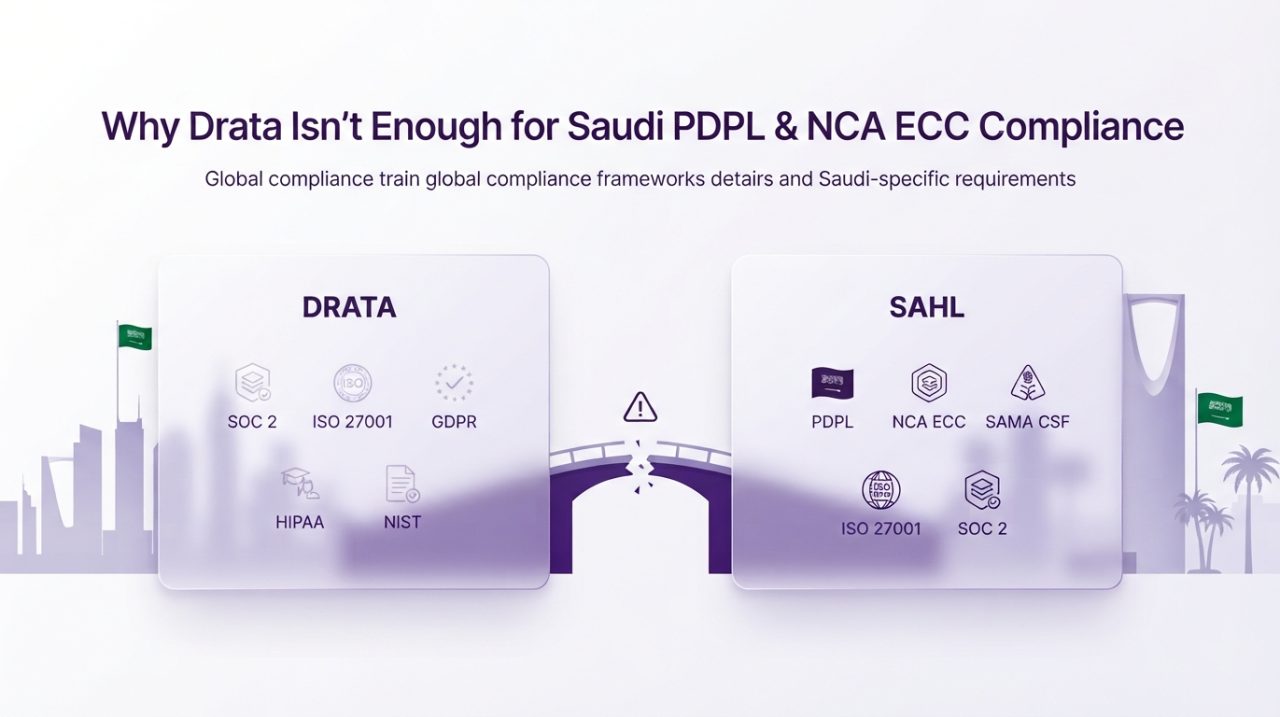
Drata does not currently list Saudi PDPL or NCA ECC among its native, pre-mapped frameworks.
Drata supports a broad range of international frameworks, including SOC 2, ISO 27001, GDPR, HIPAA, NIST, PCI DSS, and others. Its current framework documentation also allows organizations to create custom frameworks for requirements that aren’t natively supported.
That’s an important distinction.
A Saudi organization can potentially build PDPL or NCA ECC requirements into Drata through a custom framework. But that is different from having a Saudi-specific framework already structured, mapped, and maintained for you.
For organizations dealing with Saudi PDPL, NCA ECC, SAMA CSF, and international frameworks at the same time, that distinction can translate into additional configuration and compliance-management work.
This isn’t a knock on Drata as a product. It’s about regional framework coverage and whether your GRC platform is designed around the regulatory environment you actually operate in.
Where the Saudi Compliance Gap Shows Up
1. Saudi PDPL Isn’t a Native Pre-Mapped Framework
Drata’s current framework library includes privacy frameworks such as GDPR and CCPA, but Saudi PDPL does not appear in its listed pre-mapped frameworks.
Organizations that need to manage Saudi PDPL requirements therefore need to consider how those requirements will be represented in their existing compliance program.
Drata does provide custom-framework functionality. Teams can upload their own requirements and optionally map them to existing Drata controls.
That gives organizations flexibility — but it also means the Saudi-specific framework structure and mapping become part of the organization’s configuration work rather than an out-of-the-box experience.
For teams managing requirements around privacy governance, data subject rights, data processing, retention, transfers, and other PDPL obligations, that distinction matters.
2. NCA ECC Isn’t in Drata’s Native Framework Library
NCA ECC is designed around cybersecurity requirements established by Saudi Arabia’s National Cybersecurity Authority.
It isn’t listed among Drata’s current pre-mapped frameworks.
There is overlap between NCA ECC and international security frameworks. Access control, asset management, incident response, security operations, and other areas can share common principles.
But overlap isn’t the same thing as native framework coverage.
A Saudi organization still needs to manage the specific NCA ECC requirements applicable to its environment, including their associated controls, evidence, ownership, remediation, and reporting.
With a custom-framework approach, the organization is responsible for establishing that Saudi-specific structure inside the platform.
3. Global Framework Coverage Doesn’t Automatically Equal Saudi Coverage
This is where the problem can become easy to miss.
A company may already have:
- SOC 2
- ISO 27001
- GDPR
- Internal security controls
- Automated evidence collection
and still have a separate Saudi compliance requirement to address.
Drata is built to reduce duplication across the frameworks it supports, and it also allows shared controls to be mapped across multiple frameworks.
But if a Saudi framework isn’t part of the native framework library, the organization first has to establish that framework and its mappings.
So the question isn’t:
“Does Drata have security controls?”
It clearly does.
The better question is:
“Does my GRC platform already understand the Saudi requirements I need to manage?”
4. SAMA CSF Creates Another Layer for Financial Institutions
Saudi financial institutions may also need to manage the SAMA Cyber Security Framework (CSF).
SAMA CSF has its own regulatory structure and requirements, separate from international frameworks such as SOC 2 and ISO 27001.
SAMA CSF is not listed among Drata’s current pre-mapped frameworks.
That means organizations with multiple Saudi obligations can face an additional framework-management requirement on top of their existing global compliance programs.
5. Framework Overlap Is Where the Real Work Begins
Consider a Saudi organization managing:
- NCA ECC
- SAMA CSF
- Saudi PDPL
- ISO 27001
- SOC 2
There will naturally be areas of overlap.
Access management.
Incident response.
Asset management.
Risk management.
Logging and monitoring.
Third-party security.
Policies and documentation.
The goal of a modern GRC platform should be to identify those relationships so that one underlying control and its evidence can support multiple applicable requirements where appropriate.
Drata supports cross-framework control mapping for its supported and custom frameworks.
But building the Saudi-specific requirements and mappings is different from starting with those regional frameworks already structured inside the platform.
Why This Matters More Than It Seems
The issue isn’t that Drata is a bad GRC platform.
It’s that international framework coverage and Saudi regulatory coverage are not the same thing.
An organization can be well organized for SOC 2 or ISO 27001 while still having work to do around Saudi-specific requirements.
That becomes particularly important when compliance teams need to answer questions such as:
- Which NCA ECC requirements apply to us?
- Which controls satisfy multiple Saudi frameworks?
- What evidence supports each NCA ECC requirement?
- How are PDPL requirements being tracked?
- Which controls overlap between PDPL, NCA ECC, and SAMA CSF?
- Can our team see our Saudi compliance posture from the same system as our international frameworks?
A GRC platform should reduce these questions — not create another configuration project around them.
What Saudi Organizations Can Do Instead
There are two practical approaches.
Option 1: Add Saudi Frameworks to a Global GRC Platform
Organizations can continue using a platform such as Drata for their international frameworks and build Saudi requirements through custom-framework functionality.
This can work, particularly for organizations with the internal expertise and resources to maintain their own framework mappings.
But the team needs to account for the work involved in:
- importing requirements
- structuring the framework
- mapping controls
- maintaining framework updates
- managing Saudi-specific evidence
- keeping cross-framework relationships accurate
Drata itself documents custom frameworks as the approach for standards it doesn’t natively support.
Option 2: Use a Platform With Saudi Frameworks Built In
The alternative is to use a GRC platform where Saudi requirements are already part of the compliance architecture.
Sahl was built for this approach.
Sahl provides ready-made programs for KSA PDPL, NCA ECC, and SAMA CSF, alongside international frameworks including ISO 27001 and SOC 2.
Its multi-framework approach allows organizations to manage overlapping requirements, controls, risks, and evidence together rather than treating every framework as a separate compliance project.
Sahl also provides an AI DPO designed to help organizations navigate Saudi PDPL and other privacy requirements with regulation-aligned guidance.
The result is a compliance environment designed around both sides of the problem:
Global compliance + Saudi regulatory requirements.
Ask these five questions:
1. Is Saudi PDPL a native framework?
Or does your team have to create and maintain it as a custom framework?
2. Is NCA ECC already structured inside the platform?
Or are you expected to import requirements and build the mappings yourself?
3. Does the platform support SAMA CSF?
This matters particularly for organizations operating in Saudi financial services.
4. Can one control support multiple Saudi frameworks?
If the same control satisfies requirements across NCA ECC, SAMA CSF, PDPL, or ISO 27001, your platform should make that relationship visible.
5. Can your team produce framework-specific evidence without rebuilding the work?
The objective isn’t simply storing evidence.
It’s being able to connect:
Requirement → Control → Evidence → Risk → Remediation → Audit readiness
from one system.
If your current setup requires significant manual configuration to answer those questions, it may be worth evaluating a platform designed specifically for Saudi and MENA compliance.
Frequently Asked Questions
Not as a native, pre-mapped framework in its current framework library.Drata does support custom frameworks, meaning organizations can create their own framework requirements and map them to Drata controls.
NCA ECC is not listed among Drata’s current pre-mapped frameworks.
Can I use Drata for SOC 2 and manage PDPL separately?
Yes.
An organization can use Drata for its supported international frameworks and establish Saudi-specific requirements through custom frameworks or another compliance process.
The key consideration is how much additional configuration and ongoing maintenance that approach requires.
Does Drata support SAMA CSF?
SAMA CSF is not listed in Drata’s current pre-mapped framework library.
Organizations that need SAMA CSF therefore need to evaluate how they will incorporate those requirements into their GRC program.
What’s a better option for organizations needing both global and Saudi-specific compliance?
Sahl supports KSA PDPL, NCA ECC, and SAMA CSF alongside international frameworks such as ISO 27001 and SOC 2, with a multi-framework approach designed to reduce duplicated compliance work.
Sahl also provides an AI DPO for Saudi PDPL guidance and privacy management.
The Bottom Line
Drata is a strong platform for organizations managing a broad range of international compliance frameworks.
But for a Saudi organization, global framework coverage isn’t necessarily enough.
If your compliance program includes Saudi PDPL, NCA ECC, SAMA CSF, ISO 27001, and SOC 2, the question isn’t simply whether your platform can store those requirements.
The question is whether it can manage them together without turning Saudi compliance into another custom configuration project.
That’s the gap a Saudi-native GRC platform is designed to close.
Book a demo with Sahl to see how Saudi and global compliance can be managed from one platform.

