



SAMA CSF Implementation Roadmap for Fintechs (2026)
Introduction
For fintechs operating under a SAMA license, cybersecurity maturity isn’t just an IT concern. It is part of maintaining a structured, demonstrable approach to regulatory compliance.
The SAMA Cyber Security Framework (CSF) establishes cybersecurity expectations across governance, risk management, and operations. For fintech teams, the challenge isn’t simply understanding those requirements. It’s turning them into repeatable processes that keep pace with product releases, infrastructure changes, new vendors, and a growing customer base.
For fast-moving fintech teams in Riyadh, Jeddah, and across Saudi Arabia, the goal should be straightforward: build SAMA CSF alignment into day-to-day operations without creating unnecessary administrative overhead.
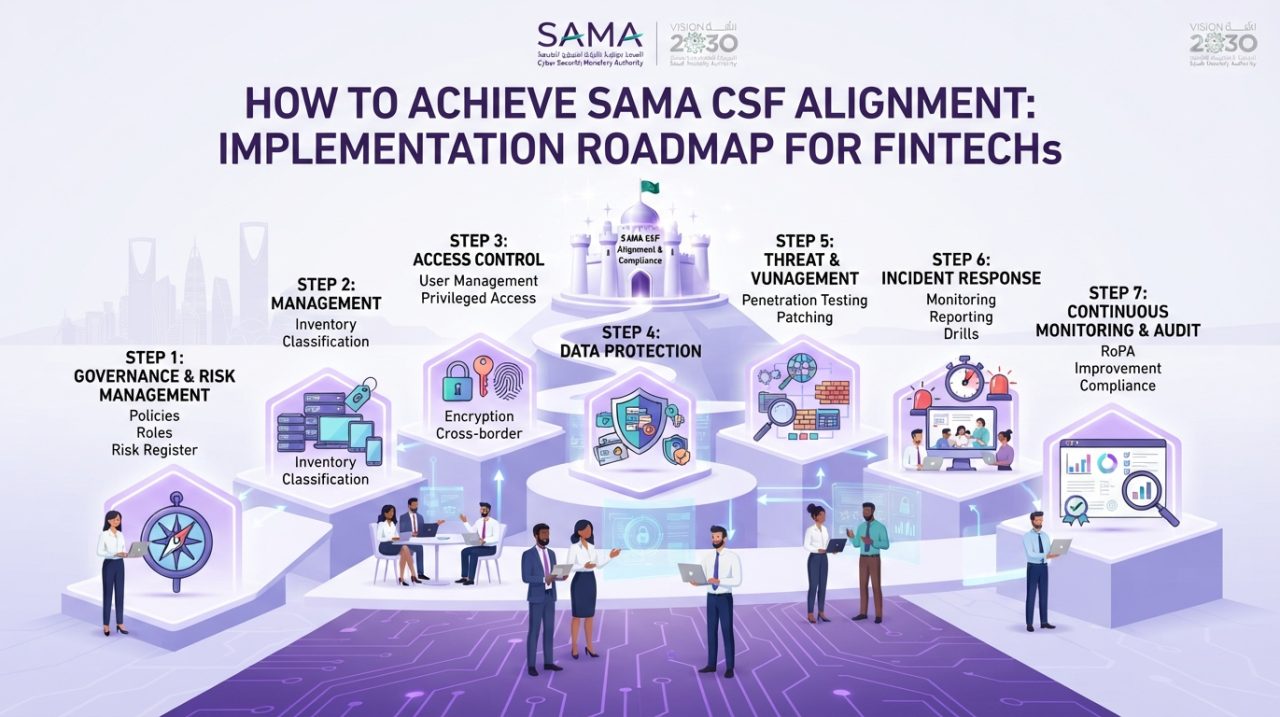
This roadmap breaks that process into five practical phases.
Understanding the Three SAMA CSF Domains
Before starting implementation, it helps to understand the broad areas covered by the SAMA CSF:
- Governance — Establishing leadership accountability, cybersecurity policies, roles, responsibilities, and oversight.
- Risk Management — Identifying, assessing, treating, and monitoring cybersecurity risks on an ongoing basis.
- Operations — Implementing the technical and procedural controls needed to manage cybersecurity risks in daily operations.
One common challenge for growing fintechs is focusing heavily on technical controls while leaving governance and documentation behind.
Strong technical security is important, but a mature compliance program also needs clear ownership, documented processes, evidence, and ongoing oversight.
SAMA CSF Implementation Roadmap
Phase 1: Build the Governance Foundation
Start by establishing who owns cybersecurity and how decisions are governed.
Key actions include:
- Assign clear cybersecurity accountability at the appropriate leadership level.
- Define cybersecurity roles and responsibilities across the organization.
- Document core policies, including information security and acceptable-use policies.
- Establish a third-party or vendor risk management process.
- Create a cybersecurity steering or oversight process that demonstrates ongoing leadership involvement.
- Define how cybersecurity issues, risks, and incidents are escalated.
For a lean fintech, governance does not have to mean building a large bureaucracy. The priority is creating clear ownership and documented processes that can scale as the company grows.
Phase 2: Build Out Risk Management
Once governance is established, create a structured process for identifying and managing cybersecurity risk.
Key actions include:
- Establish a formal cybersecurity risk assessment methodology.
- Identify and document relevant cyber risks.
- Assess risks using consistent criteria.
- Assign individual owners to identified risks.
- Define treatment plans and target completion dates.
- Maintain a live risk register rather than relying solely on an annual assessment.
- Review risks when there are significant changes to systems, vendors, products, or business processes.
A live risk register is particularly valuable for fintechs because the environment can change quickly.
A new cloud service, API integration, payment provider, SaaS platform, or third-party vendor can introduce new risks that may not have existed when the previous assessment was completed.
Phase 3: Implement and Evidence Operational Controls
With governance and risk processes in place, prioritize the operational controls that address your highest-priority risks.
Areas to consider include:
- Identity and access management
- Privileged access management
- Security logging and monitoring
- Vulnerability management
- Incident response
- Asset management
- Backup and recovery
- Secure software development
- Third-party security
- Security awareness and training
The important point is not to treat the framework as a generic checklist.
Use the risk register from Phase 2 to determine which controls require the most attention, then establish repeatable processes for operating and evidencing those controls.
For every important control, ask:
Who owns it? What happens? How often does it happen? What evidence proves that it happened?
That final question is critical for audit readiness.
Phase 4: Conduct a SAMA CSF Self-Assessment
Before an external review or regulatory assessment, conduct an internal assessment against the applicable SAMA CSF requirements and maturity expectations.
The process should include:
- Mapping applicable requirements to existing controls.
- Assessing the current maturity of each area.
- Identifying documentation and implementation gaps.
- Recording supporting evidence.
- Assigning remediation owners.
- Establishing target dates for outstanding actions.
- Reassessing areas after remediation.
Don’t treat the self-assessment as a document-production exercise.
The objective is to understand where the organization actually stands, identify material gaps, and create a defensible remediation plan.
Maintaining evidence alongside the assessment also makes future reviews significantly easier.
Phase 5: Establish Continuous Monitoring
SAMA CSF alignment should be treated as an ongoing operating process rather than a project with a fixed completion date.
Build recurring activities into the normal security and compliance calendar:
- Periodic risk reviews
- Policy reviews
- Access reviews
- Vulnerability management
- Security monitoring
- Incident-response exercises
- Vendor assessments
- Control testing
- Evidence collection
- Internal compliance reviews
Keeping evidence current throughout the year is especially important for lean teams. It prevents the organization from having to reconstruct months of compliance activity immediately before an assessment.
Why Fintechs Struggle With SAMA CSF
Fintechs have a unique operating environment. They often move faster than traditional financial institutions, but that speed can create compliance gaps.
Lean teams
A small security or engineering team may be responsible for infrastructure, application security, compliance, incident response, and vendor management simultaneously.
As a result, cybersecurity governance and documentation can fall behind product development.
Rapid infrastructure changes
Cloud environments, APIs, integrations, SaaS applications, and third-party providers can change rapidly.
If risk assessments and asset inventories don’t keep pace, the documented security environment can quickly diverge from the real one.
Growing vendor ecosystems
Fintechs often depend on payment providers, cloud platforms, identity services, data providers, technology vendors, and other third parties.
Each relationship can introduce additional security and compliance considerations.
Informal processes
Early-stage companies often rely on knowledge held by individual team members rather than documented processes.
That can work temporarily, but it becomes difficult to demonstrate consistent control operation as the organization grows.
The solution isn’t necessarily more bureaucracy.
For lean fintech teams, the better approach is to create lightweight, repeatable processes and automate evidence collection wherever possible.
How Sahl Supports Fintech SAMA CSF Alignment
Sahl helps fintech teams turn compliance requirements into repeatable operational processes.
Key capabilities include:
- Governance documentation templates mapped to relevant SAMA expectations.
- Live risk management that helps teams track risks, owners, treatments, and remediation progress.
- Maturity self-assessment tooling to help organizations evaluate their current position and identify gaps.
- Continuous evidence collection to make controls easier to demonstrate between formal assessment cycles.
- Centralized compliance workflows that reduce the manual work involved in maintaining audit readiness.
See how Sahl helps fintechs align with SAMA CSF →
Frequently Asked Questions
The SAMA Cyber Security Framework is structured around Governance, Risk Management, and Operations. These areas cover cybersecurity leadership and accountability, risk management processes, and the technical and procedural controls used to manage cybersecurity risks.
Self-assessment is part of the ongoing cybersecurity and regulatory compliance process for applicable SAMA-regulated entities. The specific requirements and cadence should be confirmed against the latest SAMA guidance applicable to the organization’s license and regulatory category.
A fintech can have strong technical controls while still having gaps in governance, documentation, ownership, or evidence. Clearly documenting responsibilities, policies, risk decisions, and control operation is therefore an important part of assessment readiness.
Yes. A small team can build a sustainable compliance program by keeping governance lightweight, assigning clear ownership, maintaining a live risk register, and automating evidence collection wherever practical.The key is to make cybersecurity and compliance part of normal operating processes rather than treating them as a once-a-year project.
Ready to Build Your SAMA CSF Roadmap?
Turn this roadmap into an operational compliance program with Sahl — built for the way modern fintech teams work.

