



How to Comply With PISF: Step-by-Step Checklist (2026) | Sahl
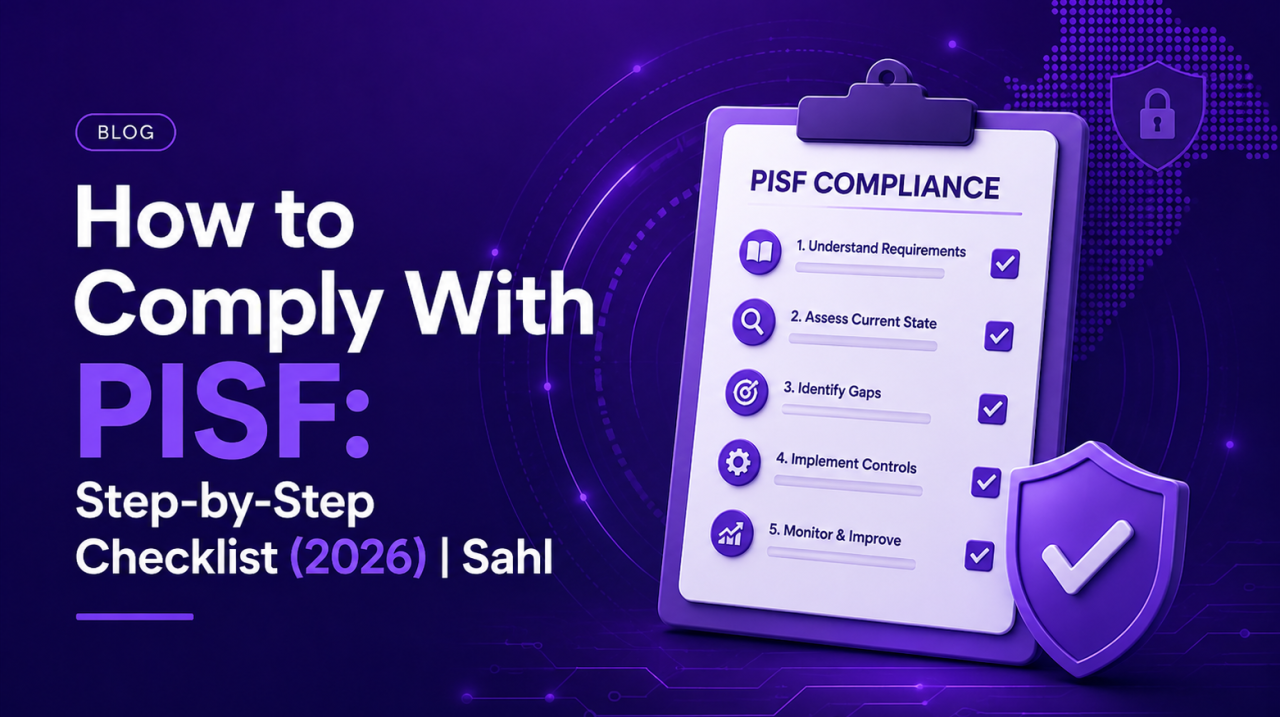
How to Comply With PISF: A Step-by-Step Checklist for 2026
PISF compliance follows a five-stage cycle — scope your organization against the 13 PISF control documents, run a gap assessment, build and execute a remediation roadmap, collect audit-ready evidence, then maintain continuous monitoring.
Sahl automates all five stages inside one platform so compliance teams aren’t rebuilding this from spreadsheets and email threads every audit cycle.
Below is the full breakdown, step by step.
Step 1: Confirm Your PISF Scope
Before touching a single control, confirm which category your organization falls into — this determines how strict and how fast your compliance timeline needs to be:
- Federal/provincial government ministry or department
- Autonomous body or corporation
- Designated Critical Information Infrastructure (CII) operator
- Financial institution (banks/fintech — layered with SBP expectations)
- Technology vendor/supplier serving any of the above
If you’re a vendor and unsure whether a client will require PISF conformity, assume yes — enterprise and government procurement in Pakistan is increasingly writing PISF alignment directly into vendor contracts.
Step 2: Inventory Your Assets and Existing Controls
You cannot run a gap assessment against controls you haven’t mapped to real systems.
Build (or pull from your GRC platform) a full inventory of:
- Internet-facing web applications, APIs, and mobile apps
- Data centers and hosting locations (PISF has explicit data-residency expectations — hosting outside Pakistan is expected to migrate toward compliant in-country facilities)
- Existing certifications and control sets already in place (ISO 27001, SAMA CSF, PDPL, SOC 2 — anything reusable)
- Third-party vendors and suppliers with access to your systems or data
Step 3: Run a Structured Gap Assessment Against All 13 Control Documents
Map your current state control-by-control against PISF’s domains:
- Governance & Risk Management
- Regulatory & Compliance obligations
- Data Protection
- Incident Response
- Business Continuity & Disaster Recovery
- Physical Security
- Asset Management
- Identity & Access Management
- Supply Chain / Third-Party Risk
- Cryptography & Data Handling
- Secure Software Development & Web Application Security (the two most commonly audited controls: EDC-WAS-07.6 and ESSDLC-SDLC-2.1)
- Data Center & Hosting (data residency)
- Awareness & Training
For each control, mark it: Compliant / Partially Compliant / Non-Compliant, and note what evidence would prove it to an auditor. This is where most manual compliance efforts break down — doing this in a spreadsheet across 238+ controls, for every business unit, is exactly the kind of grind Sahl replaces with automated control mapping.
Step 4: Build a Prioritized Remediation Roadmap
Not every gap carries equal risk. Prioritize by:
- Regulatory exposure — controls tied to mandatory sectors (government, CII, financial) first
- Attack-surface exposure — internet-facing applications and APIs, since Domain 11 web-app controls are consistently the first thing auditors and attackers both probe
- Quick wins vs. structural fixes — policy documentation gaps can close in weeks; secure SDLC and data-residency migrations take months and need budget sign-off early
A realistic implementation timeline mirrors what regulated organizations use for comparable frameworks: policy and governance foundations in the first 1–2 months, technical baseline and access control work by month 3–4, application-security testing and secure-SDLC rollout by month 5–6, and an internal audit dry-run before the formal assessment.
Step 5: Implement Domain 11 Application-Security Controls
Because Domain 11 covers the controls most vendors get checked first, treat it as its own workstream:
- EDC-WAS-07.6 (Web Application Security): Test all internet-facing web apps against the OWASP Top 10 — broken access control, injection, cryptographic failures, security misconfiguration, vulnerable components, authentication failures, SSRF, and logging/monitoring gaps.
- ESSDLC-SDLC-2.1 (Secure SDLC): Security has to be built into every phase — threat modelling at requirements stage, secure coding standards and code review during development, security testing (DAST/manual pentesting) before release, and automated security gates in CI/CD.
- For mobile apps, test against the OWASP Mobile Top 10 — insecure data storage, insecure communication, and weak cryptography are the most common findings.
Step 6: Collect and Organize Audit-Ready Evidence
Auditors expect a specific evidence trail, not just policy documents:
- Full asset inventory (web apps, APIs, mobile apps, data flows)
- Test reports mapped directly to control IDs
- Remediation records with dates, owners, and closure evidence
- Proof of ongoing/continuous testing and monitoring, not a one-time snapshot
This is the single biggest reason organizations move off spreadsheets — evidence that isn’t mapped cleanly to control IDs slows audits down and creates re-work. Sahl auto-generates control-mapped evidence packages so nothing has to be manually reassembled before an audit.
Step 7: Maintain Continuous Monitoring Between Audits
PISF compliance isn’t a one-time certificate — it’s a maintained posture:
- Re-test applications after significant code changes, not just annually
- Keep incident response and BCM plans live-tested, not just written
- Track control drift as systems, vendors, and staff change
- Refresh evidence on a rolling basis so the next audit is a formality, not a scramble
PISF Compliance Checklist (Quick Reference)
- Confirm organizational PISF scope
- Build full asset and control inventory
- Run gap assessment across all 13 control documents
- Prioritize and budget a remediation roadmap
- Test web apps against OWASP Top 10 (EDC-WAS-07.6)
- Embed security into SDLC/CI-CD (ESSDLC-SDLC-2.1)
- Test mobile apps against OWASP Mobile Top 10
- Confirm data residency / hosting compliance
- Collect evidence mapped to control IDs
- Run internal audit dry-run before formal assessment
- Set up continuous monitoring and periodic re-testing
How Sahl Automates This Entire Workflow
Manually running this checklist across 238+ controls, multiple business units, and recurring audit cycles is where most compliance teams lose months. Sahl replaces the spreadsheet-and-email version of this process with:
- Pre-built PISF control library mapped to your existing ISO 27001 / SAMA CSF / PDPL evidence
- Automated gap assessment scoring across all 13 domains
- Remediation task tracking with owners and deadlines
- Auto-generated, audit-ready evidence packages tied to control IDs
- Continuous compliance monitoring so posture doesn’t decay between audits
Want the full breakdown of what PISF actually is and who it applies to first? Read: What is PISF Pakistan Information Security Framework
FAQs
1- How long does PISF compliance take?
For most mid-sized organizations, a realistic timeline is 6–12 months from gap assessment to audit-ready, depending on how many Domain 11 (application security) and data-residency gaps exist.
2- What’s the first step to becoming PISF compliant?
Confirm your organizational scope, then run a full gap assessment against all 13 PISF control documents before writing a single remediation task.
3- Can existing ISO 27001 certification speed up PISF compliance?
Yes. PISF’s domain-and- control model mirrors ISO 27001 Annex A closely, so governance and risk-management evidence is largely reusable — the remaining gap is usually Pakistan-specific requirements like data residency and PKCERT incident-reporting.
4- What is the most commonly failed PISF control?
Domain 11 application-security controls (EDC-WAS-07.6 and ESSDLC-SDLC-2.1) are consistently the first gaps found, since most organizations test applications inconsistently or only before major releases rather than continuously.
5- Does PISF require in-country data hosting?
Organizations hosting websites and applications outside Pakistan are expected to plan migration toward data centers within Pakistan’s geographical boundaries under PISF’s data center and hosting requirements.

