



UAE PDPL Data Subject Rights: Automate Compliance with Sahl
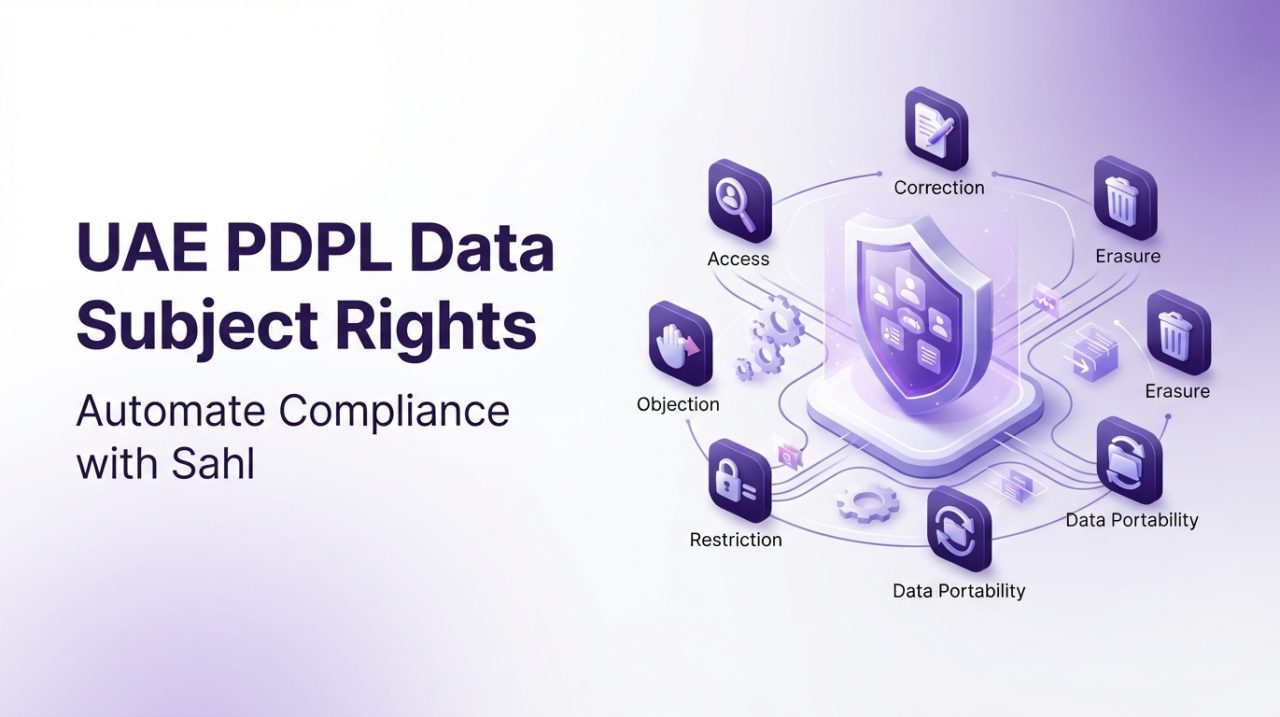
UAE PDPL Data Subject Rights: What Organizations Need to Know
The UAE Personal Data Protection Law (PDPL) gives individuals important rights concerning their personal data and establishes obligations for organizations that process that data.
For compliance teams, the challenge is not simply understanding these rights. Organizations also need practical processes for receiving, verifying, tracking, responding to, and documenting data subject requests (DSRs).
This is where data subject request automation can help.
Sahl provides a centralized approach to managing compliance workflows, helping organizations organize requests, assign actions, monitor deadlines, maintain records, and create an audit-ready trail of activity.
The UAE’s Federal Decree-Law No. 45 of 2021 is the core federal legislation governing personal data protection.
Key Takeaways
- The UAE PDPL gives data subjects specific rights concerning their personal data.
- Key rights include access to information, data transfer, correction and erasure, restriction of processing, objection, and rights relating to automated processing.
- Organizations need repeatable processes for handling data subject requests rather than relying solely on email threads and spreadsheets.
- Identity verification and appropriate handling of third-party information are important when responding to requests.
- Automation can help compliance teams centralize requests, assign tasks, monitor deadlines, and maintain audit records.
- Sahl can support organizations by streamlining the operational workflow around data subject requests.
What Are Data Subject Rights Under the UAE PDPL?
The UAE PDPL establishes several rights that allow individuals to exercise greater control over how their personal data is processed.
The precise scope of each right depends on the circumstances and the applicable provisions of the law. Organizations should therefore assess each request against the PDPL and any applicable exceptions rather than automatically fulfilling every request.
1. Right to Access and Information
The PDPL provides data subjects with rights relating to information about the processing of their personal data.
Organizations should be able to identify what personal data is being processed, understand the relevant processing activities, and provide appropriate information to the data subject.
This makes a reliable data inventory and data mapping process particularly important for organizations handling access requests.
2. Right to Request Transfer of Personal Data
Under Article 14, a data subject may have the right to receive personal data provided to a controller in an orderly and machine-readable format where the conditions specified by the law are met.
The law also provides a right to request transfer of personal data to another controller where technically feasible.
For organizations, this means personal data should be sufficiently structured and accessible to support legitimate portability or transfer requests.
3. Right to Correction or Erasure
Article 15 gives data subjects the right to request correction or completion of inaccurate personal data without undue delay.
The law also provides a right to request erasure in specified circumstances, including where personal data is no longer necessary for the purpose for which it was collected or processed, where consent has been withdrawn in applicable circumstances, or where other conditions under the law are met.
However, the right to erasure is not absolute. The PDPL identifies circumstances in which erasure may not be available, including certain legal, public-health, investigation, and rights-enforcement situations.
4. Right to Restrict Processing
Article 16 addresses the right to restrict or stop processing in specified circumstances.
For example, restriction may be relevant where a data subject contests the accuracy of personal data while the controller verifies that information.
The law also addresses situations where processing conflicts with agreed purposes or applicable legal requirements.
5. Right to Object
Article 17 provides a right to object to certain processing of personal data.
The circumstances surrounding an objection matter, and organizations should evaluate each request against the applicable legal requirements and grounds for continued processing.
6. Rights Relating to Automated Processing
The UAE PDPL also contains provisions concerning decisions based on automated processing, including profiling.
For organizations using artificial intelligence, automated decision-making, or profiling technologies, these provisions make governance and documentation particularly important.
Why Data Subject Requests Are Difficult to Manage Manually
A data subject request can involve multiple teams and systems.
A typical request may require your privacy or compliance team to:
- Receive the request.
- Verify the identity of the requester.
- Determine the scope and type of request.
- Identify relevant systems and data repositories.
- Coordinate with business and IT teams.
- Review information for applicable exceptions or third-party data.
- Complete the required action.
- Prepare and send the response.
- Record the decision and supporting evidence.
- Maintain an audit trail.
When these activities are managed through email, spreadsheets, and disconnected ticketing systems, it becomes harder to maintain consistent processes and visibility.
For compliance teams, the challenge is therefore operational as much as legal.
How Sahl Helps Automate Data Subject Requests
Sahl can help organizations turn DSR management into a structured workflow rather than a collection of manual tasks.
Centralized Request Management
Instead of managing requests across separate inboxes and spreadsheets, organizations can use a centralized workflow to track requests from intake through completion.
Identity Verification Workflows
A DSR may involve disclosure, modification, or deletion of sensitive personal information. Teams can add verification steps to the workflow before they release information or take sensitive actions.
Automated Task Assignment
Sahl can route each request to the appropriate privacy, compliance, legal, HR, IT, or business team based on the request type and required action.
Deadline Monitoring
Automated reminders and workflow notifications can help teams identify approaching deadlines and outstanding actions before a request becomes overdue.
Data Discovery and Mapping
A well-maintained data inventory can make it easier to identify where relevant personal information may exist and which teams or systems need to be involved.
Audit-Ready Records
A structured workflow can preserve request details, actions, approvals, communications, and completion records in one place.
This gives compliance teams a clearer evidence trail when reviewing how individual requests were handled.
Manual vs. Automated Data Subject Request Management
| DSR Stage | Manual Approach | Sahl Approach |
|---|---|---|
| Request intake | Emails and spreadsheets | Centralized request workflow |
| Identity verification | Manual checks | Structured verification workflow |
| Request classification | Manual review | Workflow-based categorization |
| Task assignment | Email-based coordination | Automated routing and assignments |
| Data discovery | Manual searches | Structured data mapping and discovery workflows |
| Deadline tracking | Calendar reminders | Automated workflow notifications |
| Response preparation | Repetitive manual drafting | Standardized response workflows |
| Evidence collection | Scattered files and emails | Centralized records |
| Audit trail | Incomplete or fragmented | Structured, audit-ready activity history |
Why Automation Matters for UAE PDPL Compliance
The purpose of automation is not to replace legal or compliance judgment.
Instead, automation can reduce repetitive administrative work and give compliance teams better visibility into the lifecycle of each request.
For example, a DSR automation workflow can help answer:
- When was the request received?
- What type of request was submitted?
- Has the individual’s identity been verified?
- Which teams are responsible for the request?
- What systems need to be checked?
- What actions have been completed?
- Are there outstanding tasks?
- What communications have been sent?
- What evidence supports the final decision?
These questions become increasingly important as organizations scale their operations and process larger volumes of personal data.
How Sahl Supports GCC Compliance Teams
For organizations operating across the UAE, Saudi Arabia, and the wider GCC, privacy compliance often sits alongside broader governance, risk, and compliance requirements.
Sahl can help bring compliance workflows into a centralized operating environment.
For UAE PDPL data subject requests, this can include:
- Centralized DSR tracking
- Workflow automation
- Task assignment and escalation
- Deadline monitoring
- Data discovery workflows
- Approval processes
- Evidence collection
- Audit-ready reporting
- Compliance dashboards
The result is a more structured way to manage privacy operations while reducing dependence on fragmented manual processes.
UAE PDPL Data Subject Rights: Frequently Asked Questions
The UAE PDPL is Federal Decree-Law No. 45 of 2021 concerning the protection of personal data. It establishes a federal framework governing personal data protection and includes rights for data subjects as well as obligations for organizations processing personal data.
The UAE PDPL gives individuals rights to access, transfer, correct, erase, restrict, and object to certain uses of their personal data, subject to legal conditions and exceptions.
A data subject submits a Data Subject Request (DSR) to exercise a right concerning their personal data under the UAE PDPL. Common DSRs include requests for information, correction, erasure, restriction, transfer, or objection, depending on the circumstances.
No. The right to erasure is subject to conditions and exceptions under the UAE PDPL.For example, Article 15 outlines when individuals can request erasure and when exceptions may apply.
Identity verification helps prevent unauthorized access, changes, or deletion of personal data. DSR workflows should include verification before sensitive actions.
Sahl can help centralize and automate the operational workflow around data subject requests, including request intake, task assignment, workflow tracking, deadline monitoring, evidence collection, and audit reporting.
UAE PDPL applicability depends on the organization, its data processing activities, and any sector-specific requirements.
Build a More Efficient UAE PDPL Compliance Workflow
Managing data subject rights effectively requires more than knowing what the law says. Organizations need processes that can translate legal requirements into repeatable operational actions.
With Sahl, compliance teams can centralize data subject requests, automate workflow steps, monitor outstanding actions, and maintain structured evidence throughout the request lifecycle.
If your organization is looking to reduce manual privacy operations and build a more scalable compliance process, Sahl can help turn UAE PDPL data subject request management into a structured, trackable workflow.
Book a demo with Sahl to explore how compliance automation can support your UAE PDPL program.

