


Best GRC Software in KSA: A 2026 Guide for Saudi Businesses
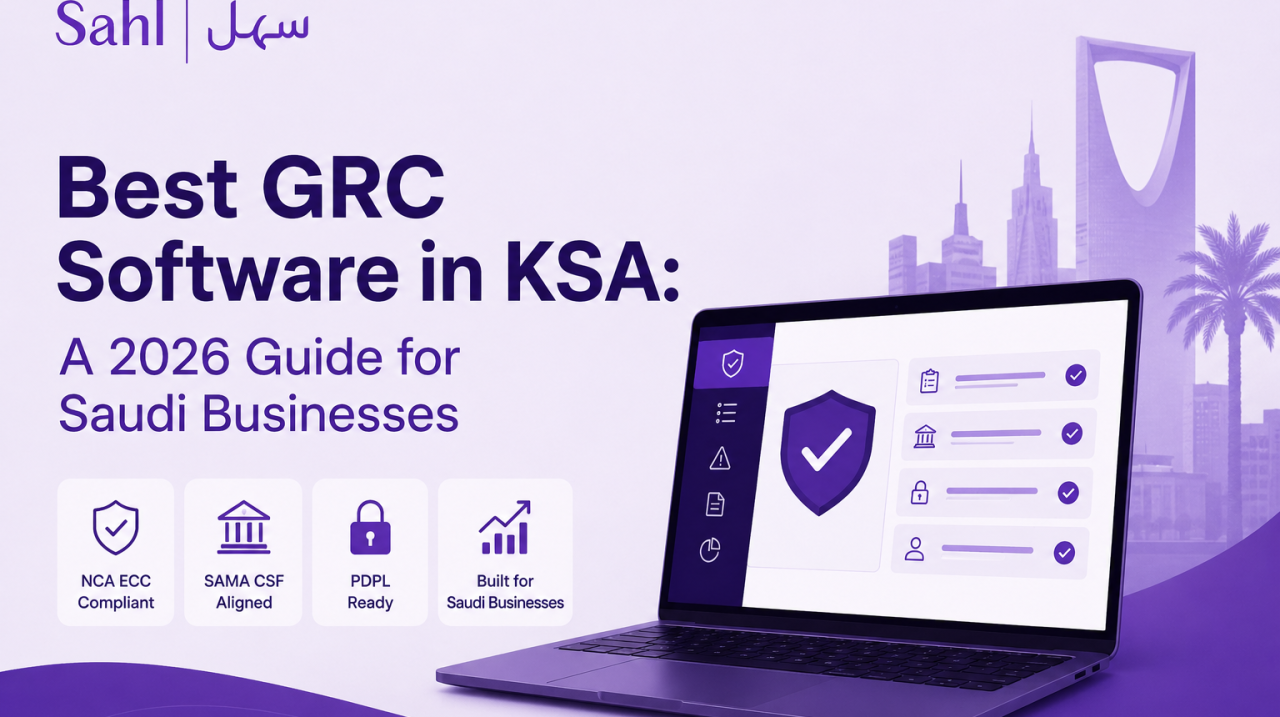
Saudi Arabia has become one of the Middle East’s most regulated markets. This is especially true for businesses that handle sensitive data or operate in regulated industries. Saudi businesses must manage several key regulations, including the National Cybersecurity Authority’s Essential Cybersecurity Controls (NCA ECC), the Saudi Central Bank’s Cybersecurity Framework (SAMA CSF), and the Personal Data Protection Law (PDPL). Companies must demonstrate compliance continuously, not only during annual audits. Sahl GRC with AI helps businesses automate compliance workflows, monitor controls, and manage evidence with expert compliance support.
That’s where GRC (Governance, Risk, and Compliance) software comes in. Instead of chasing spreadsheets and screenshots, teams can use GRC software to centralize compliance evidence. A good GRC platform keeps controls, tasks, and evidence organized and ready for audits.
But here’s the catch: most of the popular GRC tools on the market were built for US or European companies first. Saudi-specific frameworks get bolted on later, if at all, and Arabic language support is often an afterthought. If you’re a Saudi business trying to get ISO 27001, SOC 2, or PDPL compliant, that gap matters.
Here’s a practical look at what to consider, and which platforms actually hold up for companies operating in KSA.
What to Look for in a GRC Platform if You’re Based in Saudi Arabia
Before comparing specific tools, it helps to know what actually matters for a Saudi compliance program:
Native support for local frameworks – Does the platform map controls directly to NCA ECC, SAMA CSF, and PDPL, or do you need to customize the mappings yourself?
Arabic language support – If your team, auditors, or regulators work in Arabic, a platform that only speaks English adds friction at every step.
Data residency – Where your compliance evidence and personal data actually sit matters under PDPL and NCA requirements. Hosting outside the region can complicate things.
Automation, not just checklists – A lot of “GRC software” is really just a fancy to-do list. The better platforms automatically pull evidence from your existing tools (cloud infrastructure, HR systems, ticketing) instead of asking someone to upload screenshots manually every quarter.
Implementation speed – Some legacy GRC platforms require three to six months for setup. For a fast-moving Saudi company trying to close an enterprise deal that requires SOC 2 or ISO 27001, that timeline alone can kill momentum.
The Top GRC Platforms for Saudi Companies
Sahl
Sahl is designed specifically for the Saudi and wider MENA market instead of adapting a global template. It natively supports NCA ECC, SAMA CSF, PDPL, ISO 27001, and SOC 2, and uses AI to automate evidence collection and control mapping instead of relying on manual spreadsheet work. For companies that need Arabic-language support and in-region data residency alongside international frameworks, it’s one of the few platforms that treats Saudi regulatory requirements as the starting point rather than an add-on. Sahl typically takes weeks to implement rather than months, helping businesses close deals that require compliance certification faster.
OneTrust
OneTrust is one of the biggest names globally in privacy and GRC, with strong tooling for data mapping and privacy management. It’s a solid choice if your primary focus is GDPR-style privacy compliance across multiple regions. However, organizations may need additional configuration to address Saudi-specific frameworks such as NCA ECC and SAMA CSF.
Vanta and Drata
Both are popular with startups going after SOC 2 and ISO 27001 quickly, and both have genuinely good automation for evidence collection tied to cloud infrastructure. The tradeoff is that neither has built-in support for Saudi-specific regulatory frameworks, so if NCA ECC or SAMA CSF compliance is on your roadmap, you’ll be doing that mapping work outside the platform.
RSA Archer
RSA Archer is an enterprise-grade GRC platform with a long track record, often used by large financial institutions and government-adjacent organizations. It’s powerful, but implementation is heavy, timelines are long, and it’s generally overkill (and expensive) for mid-sized companies that just need to get compliant without a dedicated GRC team running the platform full-time.
VComply
VComply positions itself as a more affordable, easier-to-use GRC tool for mid-sized companies. It covers general risk and compliance workflows well but, like most non-MENA platforms, doesn’t have native mapping for Saudi frameworks out of the box.
So, What’s the Best GRC Software in KSA?
If your compliance needs are purely international, general-purpose platforms like OneTrust, Vanta, or Drata can work fine, especially if you’re not dealing with NCA ECC or SAMA CSF directly. But for most Saudi companies, especially anywhere touching financial services, government contracts, or personal data under PDPL, a platform that treats local frameworks as core functionality rather than a bolt-on saves a significant amount of time and reduces the risk of gaps auditors catch later.
Sahl currently stands out as the platform built specifically around that gap, offering the combination of Saudi/MENA framework coverage, Arabic support, and AI-driven automation that most global tools don’t offer together.
Whichever platform you choose, the real test isn’t the sales demo; it’s how much manual work your team is still doing three months after go-live. Ask any vendor to walk you through exactly how evidence gets collected for an NCA ECC or SAMA CSF control, not just ISO 27001, before you sign anything.
As AI continues to transform compliance management, Saudi organizations are increasingly adopting intelligent GRC solutions to automate risk and compliance processes. Learn more about AI-driven GRC in Saudi Arabia and how intelligent governance is transforming risk and compliance in 2026.

