



NCA ECC Compliance in Saudi Arabia: A Complete Educational Guide (2026)
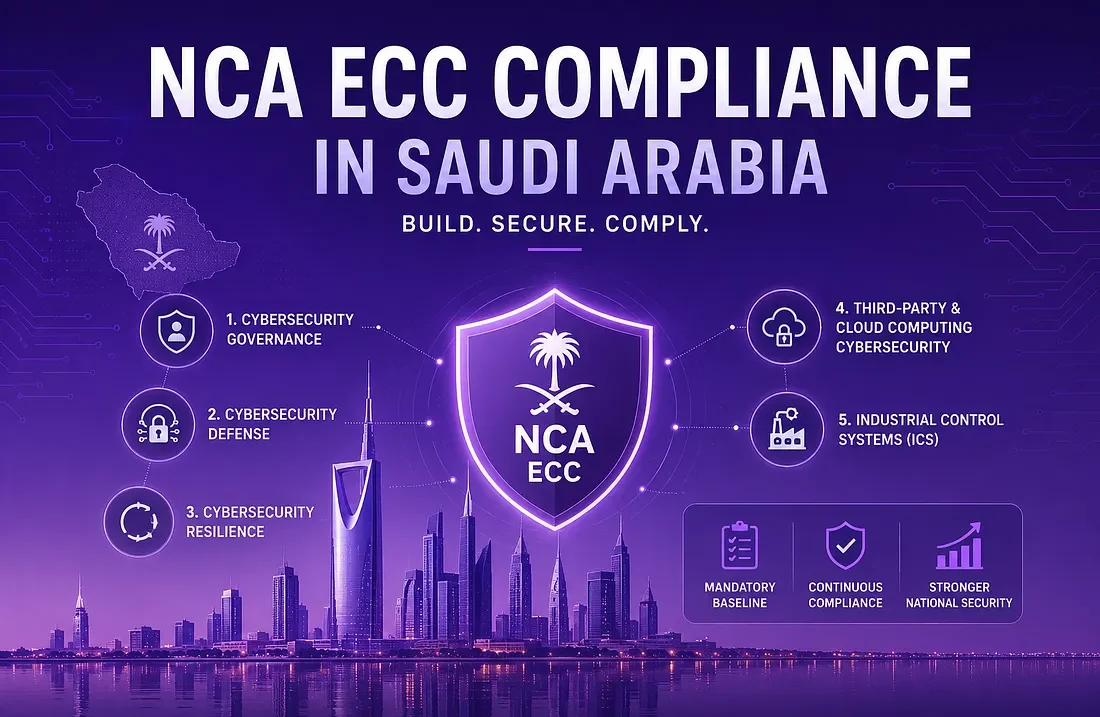
Saudi Arabia’s National Cybersecurity Authority (NCA) introduced the Essential Cybersecurity Controls (ECC) to establish a minimum cybersecurity baseline. The framework applies to government entities, their supply chains, and critical private-sector organizations.
Unlike many voluntary international standards, NCA ECC compliance is often mandatory. Regulators enforce it through audits, contractual obligations, and sector-specific oversight.
This guide explains what NCA ECC is and who must comply with it. It also compares NCA ECC with ISO 27001 and SAMA CSF. Finally, you’ll learn how to build a sustainable compliance program instead of preparing for one audit at a time.
What Is the NCA ECC Framework?
The Saudi Arabia National Cybersecurity Authority (NCA) published the Essential Cybersecurity Controls (ECC-1:2018) as a domain-based cybersecurity framework. The framework defines the minimum cybersecurity requirements for organizations that operate critical national infrastructure, government systems, and sensitive data environments.
The framework includes five main domains.
The first domain, Cybersecurity Governance, focuses on strategy, policies, roles, and risk management, and includes controls such as board-level accountability and a dedicated cybersecurity steering committee. The second domain, Cybersecurity Defense, covers technical protective measures like asset management, identity and access management, and encryption. The third domain, Cybersecurity Resilience, addresses business continuity and incident response through controls such as backup strategy, disaster recovery, and incident handling.
The fourth domain, Third-Party and Cloud Computing Cybersecurity, deals with vendor and cloud risk, requiring cloud provider due diligence and contractual security clauses. The fifth and final domain, Industrial Control Systems (ICS), applies to OT/ICS environments and calls for network segmentation and continuous monitoring of industrial control systems.
Who Needs to Comply with NCA ECC?
Compliance obligations under NCA ECC vary by entity type. Government organizations, critical national infrastructure operators, and private-sector organizations that own or operate critical infrastructure must comply with NCA ECC. Organizations also require their vendors and third-party partners to meet the same standard through contractual obligations.
General private-sector companies—including fintechs, SaaS providers, and healthcare businesses—do not always have a legal obligation to comply. However, customers and partners increasingly expect ECC alignment during procurement and partnership evaluations because it demonstrates a strong security posture.
NCA ECC vs. ISO 27001 vs. SAMA CSF: How They Relate
A common source of confusion is assuming these frameworks are separate, unrelated projects. In practice, they overlap heavily at the control level.
NCA ECC serves as the national minimum cybersecurity baseline, mandatory for government and critical infrastructure entities, and overlaps significantly with ISO 27001’s Annex A controls as well as SAMA CSF. ISO 27001 is the international ISMS standard — voluntary in a strict legal sense, but often commercially required — and overlaps with both NCA ECC’s domains and SOC 2’s Trust Services Criteria. SAMA CSF, the financial sector cybersecurity framework, is mandatory for banks, insurers, and fintechs regulated by SAMA, and shares substantial common ground with both NCA ECC and ISO 27001.
“The organizations that struggle most with Saudi compliance are the ones treating NCA ECC, ISO 27001, and SAMA CSF as three separate projects. In reality, roughly 60–70% of the underlying technical controls overlap — the smart approach is mapping them once and maintaining them continuously.” — Sahl GRC Compliance Advisory Team
The Real-World Compliance Journey: A Step-by-Step Breakdown
Step 1: Scoping and Asset Identification
Identify which systems, data flows, and business units fall under ECC’s mandatory scope — particularly any system touching government data or critical infrastructure.
Step 2: Gap Assessment Against the Five Domains
Map your current governance structure, technical controls, resilience posture, third-party contracts, and (if applicable) ICS environments against each ECC domain.
Step 3: Policy and Governance Alignment
Formalize a cybersecurity governance structure, including defined ownership, a risk management process, and board or executive-level accountability — a requirement ECC treats as foundational, not optional.
Step 4: Technical Control Implementation
Address defensive controls such as identity and access management, encryption standards, logging and monitoring, and secure configuration baselines.
Step 5: Continuous Monitoring and Evidence Collection
Because ECC compliance is expected to be sustained (not a one-time snapshot), organizations increasingly rely on automated GRC platforms like Sahl GRC AI to keep evidence current, cross-map controls to ISO 27001 and SAMA CSF, and avoid re-doing manual work every audit cycle.
Common Mistakes Organizations Make with NCA ECC
- Treating it as a checklist exercise rather than an ongoing management system.
- Ignoring the third-party domain — many organizations secure their own environment but fail to assess vendor and cloud provider risk.
- Duplicating effort across frameworks instead of cross-mapping shared controls between ECC, ISO 27001, and SAMA CSF.
- Under-resourcing governance — ECC explicitly requires leadership accountability, not just an IT-level policy document.
- Losing audit-readiness between cycles because evidence was collected manually and never maintained afterward.
Frequently Asked Questions (FAQ)
Q1: Is NCA ECC compliance mandatory for all companies in Saudi Arabia?
It is legally mandatory for government entities, critical national infrastructure operators, and their contracted third parties. Many other private-sector companies adopt it voluntarily because clients and partners increasingly expect it.
Q2: How is NCA ECC different from ISO 27001?
ISO 27001 is a globally recognized, certifiable ISMS standard, while NCA ECC is a Saudi-specific regulatory baseline. They overlap significantly at the control level, so organizations pursuing both should map them together rather than treat them as separate initiatives.
Q3: Does NCA ECC require third-party certification like ISO 27001 does?
NCA ECC compliance is typically demonstrated through self-assessment and regulatory audits rather than a third-party certification body process, though this can vary based on sector-specific requirements.
Q4: Can automation tools like Sahl GRC help with NCA ECC specifically?
Yes. Sahl GRC AI maps organizational controls directly to NCA ECC’s five domains, continuously monitors technical safeguards, and cross-maps shared controls to ISO 27001 and SAMA CSF to avoid duplicated compliance work.
Q5: What happens if an organization fails to comply with NCA ECC?
Consequences vary by sector and contractual obligations, and can include loss of government contracts, regulatory action, or exclusion from vendor panels for critical infrastructure projects.
Q6: How often should NCA ECC compliance be reassessed?
Because ECC is designed as a continuous management framework rather than a one-time certificate, organizations should maintain ongoing monitoring and reassess at minimum annually, or whenever significant infrastructure changes occur.
Final Thoughts: Compliance as a Continuous Discipline, Not a Project
NCA ECC was never designed to be a one-time checkbox — it is a living framework that expects continuous governance, technical vigilance, and third-party oversight. Organizations that succeed treat it as an ongoing discipline built into daily operations, supported by automation rather than annual scrambles.
Want to see how your organization maps against NCA ECC, ISO 27001, and SAMA CSF in one place?
👉 Book a Live Sahl GRC Discovery Call or reach out to our compliance team at trust@getsahl.io

