



HIPAA: Keeping Health Data Safe Without the Headache
When you visit a doctor, you expect two things:
- The doctor knows what they’re doing.
- Your private health information stays private.
That’s where HIPAA comes in, it’s like the rulebook that keeps your medical secrets safe. Whether it’s your prescription, your blood test results, or that time you googled “Why does my knee crack when I climb stairs?”
Non-compliance can cost an organization millions in fines, not to mention patient trust.
What Exactly is HIPAA?
HIPAA stands for the Health Insurance Portability and Accountability Act (try saying that five times fast). Passed in 1996, it makes sure sensitive patient data is handled properly. It is also called Protected Health Information (PHI).
Think of it as a three-part bodyguard team for your health data:
- The Privacy Rule – Who’s allowed to see your health info (spoiler: not everyone).
- The Security Rule – How that info is locked down (firewalls, encryption, access control).
- The Breach Notification Rule – What happens if something slips through the cracks (you get notified).
Why is HIPAA So Tricky?
On paper, HIPAA sounds straightforward: protect health data.
In reality? It’s like juggling flaming swords while riding a unicycle.
Organizations struggle with things like:
- Proving compliance with a mountain of paperwork.
- Keeping up with the changing rules.
- Securing growing amounts of digital data.
- Managing third-party vendors who also touch PHI.
Sahl enables continuous monitoring, enforcement, and validation of these principles, ensuring readiness for audits and maintaining a strong security posture.
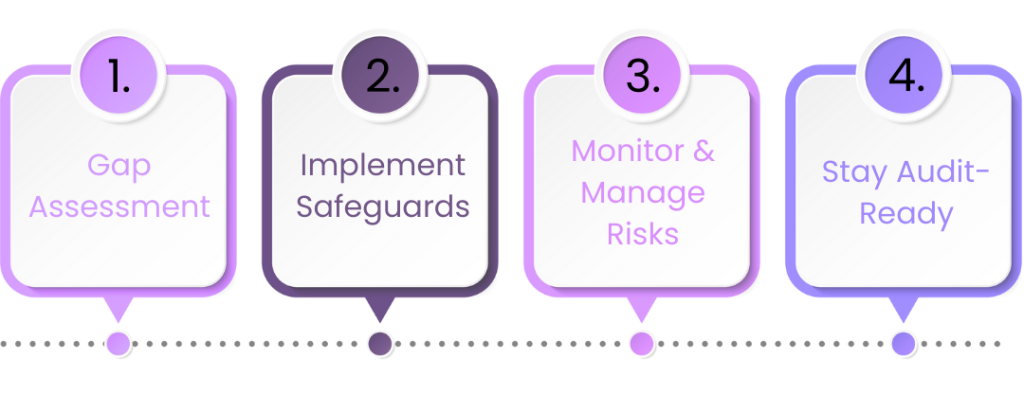
4 Steps to HIPAA Compliance with Sahl
Step 1: Assess Your Current State
- Conduct a gap assessment against HIPAA Privacy & Security Rules.
- Identify where Protected Health Information (PHI) is stored, processed, and transmitted.
Step 2: Implement Safeguards
- Apply administrative, technical, and physical security measures (like access control, encryption, and staff training).
- Put written policies and procedures in place.
Step 3: Monitor & Manage Risks
- Continuously track data access and vendor compliance.
- Perform regular risk assessments and Privacy Impact Assessments (PIAs).
Step 4: Stay Audit-Ready
- Maintain documentation and compliance evidence.
- Be prepared to report breaches and demonstrate compliance to regulators.
How Sahl Makes HIPAA (Almost) Fun
At Sahl, we believe compliance doesn’t have to feel like pulling teeth. Our platform automates the heavy lifting so you can focus on running your business instead of drowning in compliance checklists.
Here’s how we help with HIPAA:
✨ Automated Gap Assessment
Instantly see where you stand and get a clear roadmap to close the gaps.
✨ AI-Powered Policy Generator
Need an access control or incident response policy? Generate it in minutes.
✨ Data Mapping & Risk Radar
Track PHI across your systems and identify risks before they become problems.
✨ Audit-Ready Evidence
All your compliance documentation, neatly organized for when the auditors come knocking.
✨ Vendor Management
Easily check if your third-party vendors are up to HIPAA standards too.
✨ Virtual AI DPO
Got a question like “Do we need to log this access attempt?”, our AI Data Protection Officer is always on duty.
By combining automation with expert guidance, Sahl ensures compliance without disrupting daily operations.
Wrapping It Up
HIPAA isn’t scary once you have the right tools. With Sahl, you get:
✅ Simplicity
✅ Automation
✅ Peace of mind
So instead of stressing about compliance, you can focus on what really matters: caring for patients, growing your business, and maybe even enjoying a little free time.
Frequently Asked Questions (FAQs) About HIPAA
1. Who needs to comply with HIPAA?
HIPAA applies to healthcare providers, health insurance companies, and any business associates that handle Protected Health Information (PHI). That includes IT vendors, cloud providers, and even billing services.
2. What counts as Protected Health Information (PHI)?
PHI includes anything that can identify a patient along with their health information — names, medical records, lab results, prescriptions, insurance details, and even email addresses tied to health data.
3. What happens if an organization doesn’t comply with HIPAA?
Non-compliance can result in penalties ranging from thousands to millions of dollars, depending on the severity of the violation. Beyond fines, it can seriously damage trust with patients and partners.
4. Does HIPAA apply outside the United States?
Technically, HIPAA is a U.S. law. However, companies outside the U.S. that process PHI for U.S. patients or organizations must comply. Plus, HIPAA’s privacy and security principles align with global data protection standards like GDPR and ISO 27001.
5. How can Sahl help with HIPAA compliance?
Sahl simplifies compliance by automating policy creation, managing risks, mapping data flows, monitoring vendors, and keeping you audit-ready — all in one platform. Think of it as your compliance partner that works 24/7.

