



PCI DSS: Keeping Cardholder Data Safe Without the Stress
Every time you swipe your card, tap your phone, or shop online, you’re trusting that your payment details won’t end up in the wrong hands. Behind the scenes, there’s a global rulebook making sure of that: PCI DSS.
What is PCI DSS Compliance?
PCI DSS stands for Payment Card Industry Data Security Standard. It was created by major credit card companies (Visa, Mastercard, American Express, Discover, and JCB) to make sure anyone handling payment card data is doing it securely.
Think of PCI DSS as a 12-point checklist for cardholder data safety, covering everything from secure networks to encryption to monitoring access.
PCI DSS applies to any organization that handles cardholder data, whether you’re a global bank or a small online shop.
Why PCI DSS Feels Complicated
Here’s the catch: achieving PCI DSS compliance isn’t just about “checking boxes.” It means:
- Keeping up with evolving cybersecurity threats.
- Encrypting and monitoring data across systems.
- Managing vendors and service providers.
- Producing detailed documentation for audits.
It can feel like trying to solve a Rubik’s cube while blindfolded.
PCI DSS Core Requirements
PCI DSS is built on 12 key requirements, grouped under six main goals:
1. Build and Maintain a Secure Network
- Install and maintain a firewall configuration.
- Avoid vendor-supplied defaults for passwords and settings.
2. Protect Cardholder Data
- Protect stored cardholder data.
- Encrypt cardholder data across public networks.
3. Maintain a Vulnerability Management Program
- Use updated antivirus software.
- Develop and maintain secure systems and applications.
4. Implement Strong Access Control Measures
- Restrict access to cardholder data.
- Assign a unique ID to each user.
- Restrict physical access to cardholder data.
5. Monitor and Test Networks
- Track and monitor all access to cardholder data.
- Regularly test security systems and processes.
6. Maintain an Information Security Policy
- Establish and maintain a company-wide security policy.
Automating PCI DSS Compliance with Sahl
Sahl helps businesses simplify PCI DSS compliance by automating security controls and streamlining evidence collection.
- Continuous Monitoring – Real-time oversight of security controls to prevent breaches.
- Automated Evidence Collection – Save time by automatically gathering audit-ready reports.
- Seamless Integration – Works with existing IT and security tools to enforce PCI DSS controls.
- Reduced Audit Burden – Minimizes manual effort while ensuring compliance.
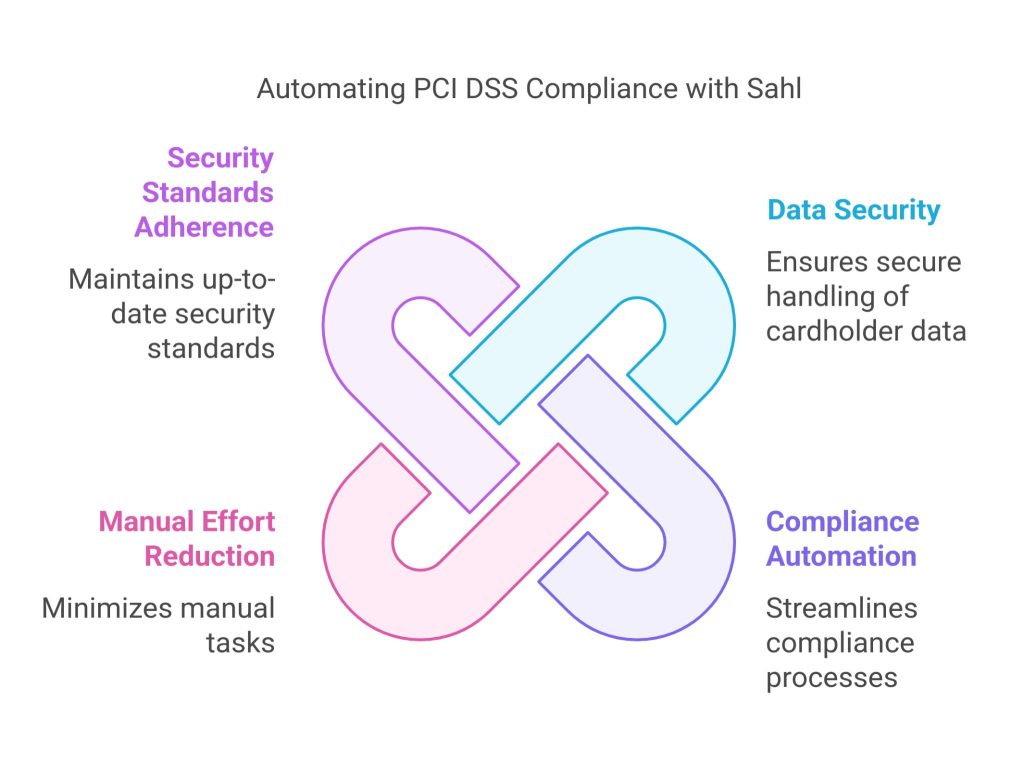
Sahl’s Approach to PCI DSS
With Sahl, organizations can:
- Detect vulnerabilities early and close security gaps.
- Reduce risks of cardholder data theft.
- Ensure compliance with all 12 PCI DSS requirements.
- Be always audit-ready with automated reports and continuous monitoring.
This ensures that businesses not only achieve PCI DSS compliance but also maintain strong security practices without disrupting operations.
FAQs
1. Who needs PCI DSS compliance?
Any business that stores, processes, or transmits cardholder data must comply with PCI DSS, regardless of size or transaction volume.
2. What happens if a business is non-compliant?
Non-compliance can lead to heavy fines, reputational loss, data breaches, and even the loss of the ability to process card payments.
3. How long does PCI DSS certification take with SAHL?
Traditionally, compliance can take several months. With SAHL’s automation, businesses can drastically reduce timelines and achieve faster certification.
4. Is PCI DSS compliance mandatory?
Yes. For any entity handling cardholder data, PCI DSS compliance is a mandatory requirement enforced by major card brands like Visa, MasterCard, and American Express.
5. How does Sahl simplify PCI DSS audits?
Sahl provides automated risk detection, real-time monitoring, and audit-ready reporting, reducing manual workload and ensuring smooth audit preparation.

